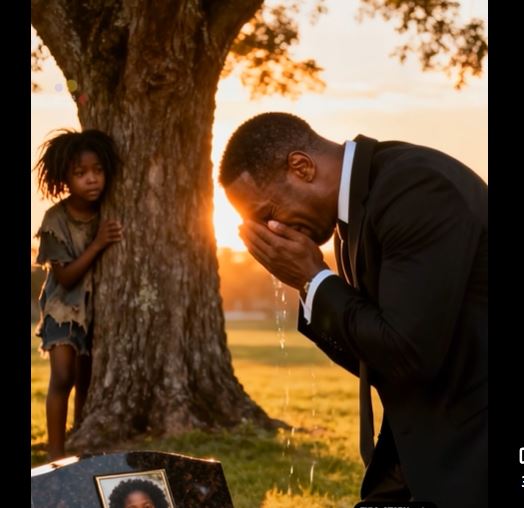
Gray clouds hung low over the rolling hills, and a cold breeze moved gently through rows of white headstones. Fallen leaves rustled across the damp ground, whispering against the polished marble like echoes of forgotten voices.
Marcus Whitmore stood alone at the center of it all.
One of the wealthiest men in the country — a self-made billionaire whose name appeared in magazines, whose companies shaped industries, whose decisions moved markets — now knelt helplessly beside a small grave.
All his power meant nothing here.
The expensive black suit he wore was wrinkled, his hands trembling as they pressed into the wet grass. His shoulders shook violently, and tears streamed down his face, soaking into the earth beneath him.
Marcus reached out with unsteady fingers, tracing the carved letters of her name as though touching them might bring her back.
“I’m sorry,” he whispered, his voice broken beyond recognition. “I’m so sorry, baby.”
The man who commanded boardrooms and governments now sounded like a lost child.
Three months earlier, Marcus Whitmore had buried his only daughter.
Amara had been just eight years old — bright, curious, endlessly kind. She loved painting, hated vegetables, and believed her father could fix anything in the world.
But there was one thing even he could not fix.
A sudden accident. A terrible fire. A hospital report delivered in cold, clinical words.
Fatal.
Marcus had built his empire from nothing. Raised in poverty, he had fought relentlessly to become a symbol of success, resilience, and power. He controlled wealth beyond imagination, owned hospitals, funded research centers, and could summon the best doctors on earth with a single phone call.
Yet none of it saved her.
The grief consumed him.
He withdrew from business, shut himself away from the world, and spent hours at her grave each day, speaking to the silence as though she could still hear him.
Today was no different.
But this time, something inside him finally broke.
“I should have been there,” Marcus sobbed, collapsing fully onto the ground. “I promised I would always protect you.”
His tears soaked the grass as memories flooded his mind — her laughter echoing through their home, her tiny hand in his, her voice calling him Daddy.
The pain was unbearable.
His breathing grew shallow, his chest tightening as grief overwhelmed his body. The world around him spun, and darkness crept into the edges of his vision.
Then he collapsed.
Face pressed against the earth above his daughter’s grave, Marcus Whitmore lost consciousness.
When he awoke, he was no longer alone.
Blurry figures moved around him — a cemetery caretaker, a paramedic, concerned voices speaking urgently. Someone helped him sit up while another handed him water.
“You fainted,” the paramedic explained gently. “You need rest.”
But Marcus barely listened.
His eyes remained fixed on the headstone, his expression hollow.
That was when a voice behind him spoke.
“Sir… are you Mr. Whitmore?”
Marcus turned slowly.
A woman in a gray coat stood a few steps away, her face pale with nervous tension. She clutched a folder tightly against her chest, as if gathering courage.
“Yes,” Marcus replied hoarsely.
Her voice trembled. “There’s something you need to know about your daughter.”
Time seemed to freeze.
Marcus stared at her, fear and confusion twisting together in his chest.
“What do you mean?” he demanded.
The woman swallowed hard. “There may have been… a mistake.”
Three months earlier, on the night of the fire, chaos had filled the hospital.
Multiple victims had arrived at once. Records were confused. Identification had relied on incomplete information — a bracelet, clothing, assumptions made under pressure.
The body Marcus had buried had never been confirmed through advanced testing.
And now, new evidence had emerged.
A young girl had been discovered alive in a private care facility under temporary identity protection — a child suffering memory loss, unable to communicate her name, but matching Amara’s description exactly.
Marcus’s world tilted.
“That’s impossible,” he whispered.
But the woman opened the folder and handed him a photograph.
A small girl sat in a hospital bed, her face pale, her hair shorter, her expression distant — but unmistakable.
Amara.
Marcus’s hands shook violently as he stared at the image. His heart pounded so fiercely he thought it might burst.
“She was found unconscious near the scene,” the woman explained. “Severe trauma. Temporary amnesia. The facility kept her identity confidential while authorities searched for relatives.”
Tears streamed down Marcus’s face again — but this time, they carried disbelief, shock, and a fragile, terrifying hope.