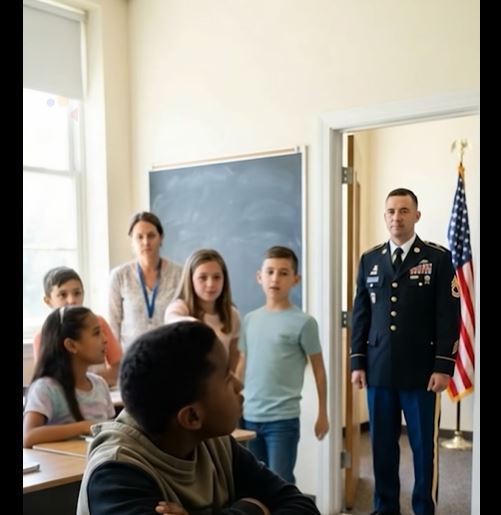
The words slipped from Noah Bennett’s lips almost casually, as if they were ordinary—yet in a room full of twelve-year-olds, ordinary quickly became remarkable.
Laughter rippled across the Lincoln Middle School classroom. Some kids snorted behind their hands. Others shook their heads in disbelief, unable to contain giggles.
“He probably means the Pentagon gym,” muttered one boy, whispering to his neighbor.
“No way! That’s impossible!” said another.
Noah, seated at his usual desk near the back, didn’t flinch. He adjusted his glasses, his small hands folded neatly on the tabletop. His eyes, sharp and serious beyond his years, scanned the room as if daring anyone to challenge him.
Ms. Caldwell, mid-sentence in her lesson on early American history, froze. Her chalk hovered above the blackboard. Slowly, she turned toward Noah, eyebrows raised.
“Noah,” she said cautiously, “are you… serious?”
“Yes, ma’am,” Noah replied, his tone calm, unwavering. “My dad works at the Pentagon. He deals with intelligence operations and national security.”
The laughter quieted slightly, replaced by the hum of whispers. Some kids exchanged incredulous glances. The Pentagon? National security? At twelve, most of them barely knew where Washington, D.C., was on a map.
One student, a boy named Tyler, smirked. “So… you mean your dad’s a spy?”
Noah didn’t smile. “Something like that,” he said. “I can’t tell you the details. But it’s serious work.”
The bell hadn’t rung yet, but the classroom felt different now. The usual chatter had dimmed. Curiosity replaced mockery. Even the students who had laughed the hardest now sat upright, leaning in as if expecting something extraordinary.
Ten minutes later, everything changed.
A loud metallic thud echoed from the hallway outside the classroom door, followed by the sound of boots on linoleum. The students turned toward the doorway, their initial amusement now replaced with unease.
Before anyone could speak, the door swung open. Two men in suits entered the classroom. Their expressions were stern. Their movements were precise. They carried no folders, no briefcases—only a sense of authority that immediately silenced every student in the room.
Ms. Caldwell stood frozen. “Can I help you?” she asked, trying to maintain composure, though her voice betrayed her worry.
One of the men stepped forward, his eyes scanning the students until they rested on Noah. “Is Noah Bennett present?” he asked.
Noah straightened in his seat, his heartbeat quickening, though his voice remained steady. “Yes, sir.”
The man nodded to his colleague, who produced a small badge from inside his suit jacket. “We need to speak with him outside, Ms. Caldwell. It’s… urgent.”
Whispers erupted, but the men’s serious demeanor immediately cut through them. The students’ curiosity had transformed into tension, their laughter completely gone.
Noah followed the men into the hallway, leaving a classroom filled with stunned silence. Ms. Caldwell slowly closed the door behind him, her mind racing. She had taught for nearly twenty years, and she had never seen an entire class so completely captivated and silent.
Outside, the men guided Noah toward a waiting car. The vehicle, black and unmarked, idled silently near the curb. The city street felt oddly subdued, the usual sounds of traffic muffled by the weight of the moment.
Inside the car, Noah remained composed, though his mind raced. He had been trained by his father for moments like this, at least in theory. The Bennett household had always emphasized discretion, secrecy, and preparedness.
One of the men turned to him. “Noah, your father requested you immediately. There’s an important situation at the Pentagon that requires your assistance—or at least your presence.”
Noah swallowed. “Yes, sir,” he replied. He knew enough to understand that whatever was happening was serious. Far beyond schoolyard jokes or casual intelligence.
Back in the classroom, the students sat frozen. Their earlier laughter seemed like a distant memory, replaced by awe and speculation.
“Do you think he’s really…?” whispered one girl.
“Yeah,” another replied softly. “I mean… the Pentagon isn’t a joke. This is real.”
Ms. Caldwell walked slowly among the desks, unable to break the silence. She had always known Noah was bright, disciplined, and unusually mature for his age—but she had no idea his father’s work could pull her students into such an extraordinary moment.
By the time the final bell rang, the story had spread through the school. Hushed conversations filled the hallways, students swapping theories about spies, secret missions, and government conspiracies.
Noah returned late that afternoon. He didn’t smile, didn’t boast, and didn’t confirm any of the wild stories circulating among his peers. But everyone who saw him—the subtle confidence in his step, the calm in his eyes—knew that his initial claim had been far from a joke.