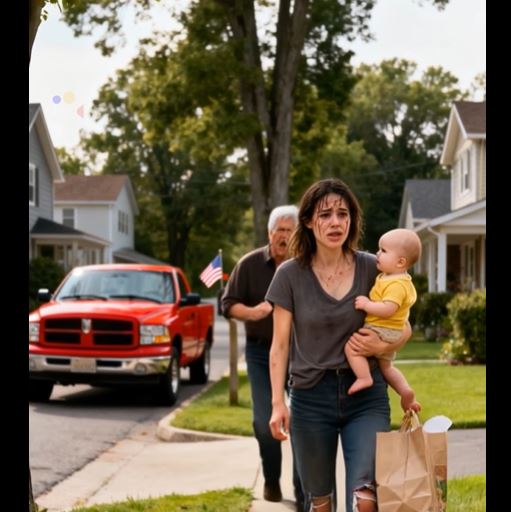
The late afternoon sun hung low over our quiet Midwestern street, casting long shadows across the pavement as I limped slowly along the sidewalk. My baby rested heavily on my hip, his small fingers gripping the collar of my worn sweater while his soft breathing brushed against my neck.
Each step sent a sharp pain through my ankle, but I kept moving, focusing on the steady rhythm of my footsteps and the distant sound of wind rustling through rows of identical maple trees. The neighborhood was peaceful, almost painfully so, with its neatly trimmed lawns and white picket fences hiding stories no one ever spoke about.
I had hoped no one would see me.
My arms ached from carrying the baby, and my body still hadn’t fully healed from the difficult birth three months earlier. Dark circles shadowed my eyes, and exhaustion weighed on me like a second skin.
But walking felt safer than staying in that house another moment. Walking meant breathing. Walking meant thinking. Walking meant, even if only briefly, that I was free.
That was when I heard the familiar rumble of an engine slowing beside me.
A pickup truck rolled to a stop at the curb, its tires crunching softly against gravel. The window slid down, and there he was — my father. His weathered face, framed by streaks of gray in his dark hair, tightened instantly when he saw me.
His eyes traveled from my swollen ankle to the baby in my arms, then back to my face. Confusion gave way to concern in a matter of seconds.
“Why are you walking?” he asked, his voice firm but laced with worry. “I bought you an SUV for situations exactly like this.”
His words struck something deep inside me. The concern in his voice, the simple assumption that I should be safe, cared for, protected — it all felt so foreign after months of living under constant tension. My throat tightened, and I struggled to answer.
I hadn’t planned to tell him. I had rehearsed excuses in my head countless times. The car was in the shop. I wanted fresh air. I needed exercise. Anything but the truth.
But the exhaustion broke through my defenses.
I shifted the baby slightly and lowered my eyes, my voice barely more than a whisper. “Judith took it,” I said. “She says I’m lucky they let me stay.”
Silence followed.
The kind of silence that presses heavily on your chest and makes the world seem to pause. My father’s hands tightened around the steering wheel, his knuckles turning pale. For a moment, I thought he might question me further, ask for clarification, try to make sense of what I had just confessed.
Instead, his jaw set firmly.
“Get in the truck,” he said.
There was no anger in his voice, only certainty — the steady, unshakable tone of a man who had already decided what came next.
I hesitated. Fear had trained me well over the past year. Fear of conflict, fear of consequences, fear of making things worse. Judith’s voice echoed in my mind, reminding me how much I depended on her, how the house was in her name, how the family business was hers now, how I had nowhere else to go.
But then my baby stirred in my arms, letting out a small whimper. His tiny face pressed against my shoulder, seeking comfort, seeking safety.
And suddenly, the choice became clear.
My father stepped out of the truck without another word and gently opened the passenger door. He took the diaper bag from my shoulder, as if it weighed nothing, and waited patiently. His presence alone felt like a shield against everything I had endured.
I climbed into the seat, my injured ankle throbbing, my hands trembling.
The interior of the truck smelled like engine oil and old leather — familiar, grounding, safe. The moment the door closed, something inside me broke. Tears spilled silently down my cheeks as months of bottled pain found their way to the surface.
My father started the engine but didn’t drive immediately. Instead, he glanced at me, his eyes softer now.
I shook my head. “I thought I could handle it,” I whispered. “She said I needed to learn responsibility. She said I was weak… that I should be grateful she gave me a place after the baby came.”
The memories surfaced like wounds reopening — Judith’s cold smiles, her constant criticism, the way she controlled every aspect of the household. She had slowly taken everything: my independence, my confidence, my sense of worth. What began as temporary help had turned into quiet imprisonment.