The gala was meant to be a night of elegance, champagne, and carefully curated art, but for us, it quickly became a test of patience, pride, and restraint. The grand chandelier cast sparkling light across the marble floors of the city gallery, illuminating every brushstroke and sculpture with almost theatrical precision.
Guests in tailored suits and flowing gowns murmured appreciatively as servers carried trays of champagne and delicate hors d’oeuvres. I had always loved these events—the quiet hum of cultured conversation, the soft clink of glasses, the subtle sense that we were part of something larger, something timeless.
My son, Lucas, had been excited for weeks. At nine years old, he loved art almost as much as he loved adventure, and tonight he would finally see a gallery gala firsthand. He wore his tiny blazer proudly, polished shoes, and a tie that he had fussed over for nearly an hour.
I watched him with pride as he walked beside me, his eyes wide at the sight of the towering canvases, the intricate sculptures, and the glittering crowd.
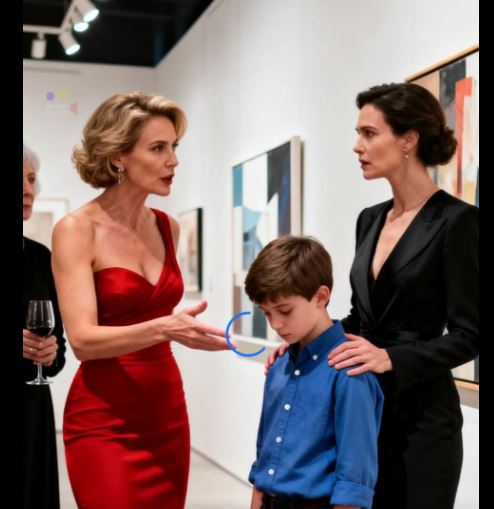
But that excitement evaporated the moment my aunt appeared. Cassandra had always carried herself with a sense of superiority, her high cheekbones and perfect posture amplifying every word she spoke as if the room were her stage.
She was quick with judgment and slow with kindness, a combination I had learned to navigate carefully over the years. Tonight, however, she seemed determined to assert dominance in front of everyone.
“Lucas,” she said sharply, her voice cutting through the soft classical music that filled the gallery, “wait in the lobby. Children aren’t meant to be here. You’re disturbing the ambiance.”
Lucas froze. His small hands clenched the edges of his blazer, and a flash of hurt crossed his face. He opened his mouth to protest, but my aunt’s stern glare silenced him. He stepped backward, downcast, heading toward the lobby with small, hesitant steps. My heart clenched.
I opened my mouth, intending to intervene, but then I noticed the amused expressions of nearby guests. Some were pretending not to watch, but others were subtly pointing, their curiosity barely masked.
My face heated with a mix of fury and disbelief. My own family member had humiliated my son in public, treating him as if he were invisible, unwanted, and unworthy of the very experience we had come to enjoy.
I let her continue, at least momentarily, as I considered my options. My aunt had no idea. No idea that I, quietly over the years, had acquired full ownership of the gallery—the very gallery she believed she could command.
No idea that every painting, every sculpture, every sparkling light fixture belonged to me. No idea that tonight, the power dynamic she assumed was firmly hers to control was, in fact, entirely in my hands.
I waited. Let the small crowd linger in whispered speculation. Let my aunt relish her sense of control.
Then I took a deep breath and stepped forward.
“Lucas,” I called, my voice calm but firm, carrying across the marble floors. He hesitated but looked back at me, his eyes flickering with hope. I motioned toward the main hall. “Come, let’s go see the Vanishing Horizons installation.”
My aunt’s brow furrowed. “Wait,” she said, trying to regain authority. “He can’t—”
I smiled, sweet but controlled, letting the full weight of the statement hang in the air. “Actually,” I said, turning to face her fully for the first time that evening, “he can. In fact, he can go anywhere in this gallery tonight. Every piece, every room, every private exhibit. This entire space belongs to me.”
Her mouth opened and closed, the words she wanted to say trapped somewhere between shock and disbelief. The other guests turned, murmuring in quiet amazement as I guided Lucas by the hand.
He walked beside me now with renewed confidence, shoulders straight, head held high, his previous hurt replaced by pride. We moved through the gallery, pausing to admire paintings and sculptures, and for the first time that evening, the air seemed light and full of possibility.
My aunt’s attempts at intimidation had crumbled entirely. Her carefully maintained poise faltered as she realized the true extent of her powerlessness. She had assumed authority based on social appearances alone, failing to understand that ownership, influence, and respect do not always align with entitlement or family connection.
By the end of the night, Lucas had visited every corner of the gallery, guided by my whispered explanations of the art, encouraged to touch certain interactive exhibits, and praised for his insightful observations.
The other guests watched, impressed by the ease with which he moved through the space and by the quiet pride that radiated from both of us.