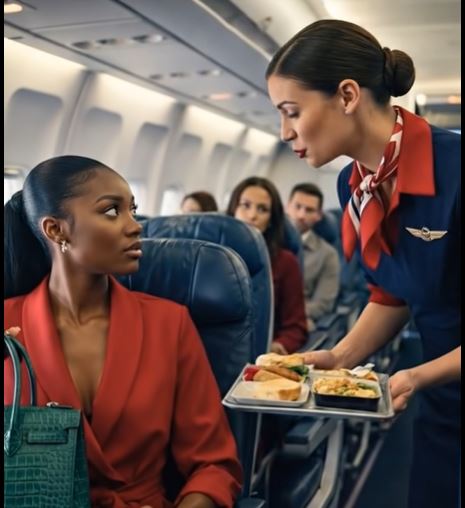
She stepped onto the plane with quiet confidence, dressed in a simple but elegant navy suit, her posture calm and composed. Most passengers barely noticed her as she walked down the aisle of the first-class cabin, carrying only a small leather handbag and a laptop case. To them, she looked like just another traveler.

But they had no idea who she really was.
Amara Williams was the CEO of a powerful global technology corporation worth billions. She had built her company from nothing, rising through years of struggle, rejection, and relentless determination. Her success had earned her respect in boardrooms across the world—but unfortunately, not everywhere.
That day, she was flying home after closing a major international deal. Exhausted but satisfied, she had booked a first-class ticket, hoping for a peaceful flight and a proper meal after a long week of work.
As she settled into her seat, a flight attendant approached with a polite but distant smile.
“May I see your boarding pass?” the attendant asked.
Amara handed it over calmly. The attendant scanned it, her expression shifting slightly.
“This is first class,” she said, her voice carrying a hint of doubt.
“Yes,” Amara replied gently. “That’s correct.”
The attendant studied her for a moment longer before returning the ticket without apology. Though subtle, the exchange did not go unnoticed by nearby passengers, some of whom glanced at Amara with curious expressions.
The flight took off smoothly, and soon meal service began. Elegant trays of carefully prepared dishes were delivered to passengers one by one. The scent of freshly prepared food filled the cabin, and quiet conversation flowed easily.
When the service cart reached Amara, she was ready to order. But instead of offering her the menu, the flight attendant hesitated.
“I’m sorry,” the attendant said stiffly, “but the first-class meals are reserved for confirmed passengers only.”
Amara blinked, confused. “I am a confirmed passenger.”
The attendant’s smile was thin. “There may have been a mistake. We can offer you something from economy class instead.”
A few nearby crew members overheard the exchange. One of them chuckled softly, whispering something to another attendant. Their quiet laughter carried clearly enough to be humiliating.
Amara felt the weight of their assumptions pressing down on her—the familiar judgment based not on her ticket, but on her appearance.
She spoke calmly. “Please check again.”
The attendant sighed dramatically, scanning the passenger list on her device before shaking her head. “No, I’m afraid there’s no record here,” she said dismissively. “You must be mistaken.”
The quiet laughter returned. Some passengers looked uncomfortable, while others simply watched.
Amara sat silently for a moment, her expression composed but her eyes sharp with disappointment. She had faced challenges far greater than this, yet the sting of disrespect never became easier.
Without raising her voice, she reached into her handbag and removed her phone.
“Very well,” she said quietly. “Let’s clarify the situation.”
She sent a brief message.
Within minutes, subtle changes began unfolding.
The lead flight supervisor received an urgent notification from headquarters. His expression shifted from routine professionalism to visible alarm. He immediately hurried toward the first-class cabin, followed by two other senior crew members.
The supervisor approached Amara with unmistakable respect.
“Ms. Williams,” he said, his voice tense, “we sincerely apologize for the misunderstanding.”
The entire cabin fell silent.
The flight attendants who had questioned her looked confused, their earlier confidence fading. One of them quickly checked the system again—this time noticing a prominent alert attached to Amara’s reservation.
She wasn’t just a passenger.
She was one of the airline’s largest corporate partners, whose company managed major technology contracts for the airline’s global operations.
But that was not all.
Amara’s corporation also held significant influence over several key aviation partnerships, including service evaluations and executive travel agreements that affected the airline’s reputation and revenue.
The laughter stopped instantly.
The supervisor personally ensured that Amara received the finest meal available, along with repeated apologies. The crew members who had mocked her stood silently nearby, their faces pale with realization.
But Amara did not raise her voice, nor did she show anger. She simply accepted the meal and continued working on her laptop, her calm dignity speaking louder than any confrontation.
However, the incident did not end there.
After the flight landed, a formal investigation was launched by the airline’s executive office. Witness statements, service records, and onboard footage confirmed the crew’s conduct—unprofessional behavior, discrimination, and public humiliation of a passenger.
Within days, disciplinary actions were taken. The crew members involved were removed from their positions, and the airline issued a public statement reaffirming its commitment to respect and equal treatment for all passengers.