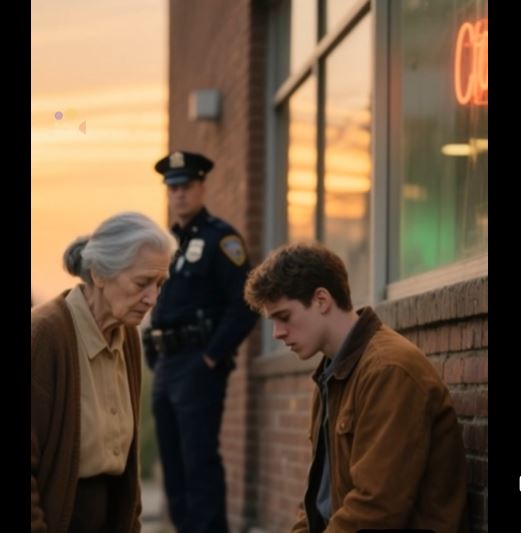
The sharp voice cut through the quiet afternoon like a blade. The small bookstore fell silent as every head turned toward the entrance. A thin boy, no older than fourteen, stood frozen near the door, his trembling hands raised in the air. Beneath his worn jacket, a loaf of bread slipped from his grasp and hit the floor with a soft thud.
His face was pale with fear.
The security guard, a large man with a stern expression, stepped closer. “You thought you could steal and just walk out?” he demanded, his voice echoing through the shop.
The boy said nothing. His lips quivered, and his hollow eyes darted nervously between the guard and the customers staring at him. His clothes were torn, his shoes barely holding together with loose threads, and his thin frame told a story no words could fully explain.
Hunger.
The bookstore, known as “Bread and Books,” was a quiet neighborhood place where people came to read, drink tea, and buy freshly baked bread. It was owned by a middle-aged woman named Helena, whose gentle nature had made the shop a refuge for many. The scent of warm pastries and old pages usually filled the air with comfort.
But that day, tension replaced warmth.
“I—I’m sorry,” the boy whispered finally, his voice barely audible. “I didn’t mean to steal.”
“Didn’t mean to?” the guard replied sharply. “You hid the bread under your jacket. That’s theft.”
The boy’s stomach growled loudly in the heavy silence, a painful sound that made several customers shift uncomfortably. His cheeks burned with shame.
“I haven’t eaten in two days,” he admitted, tears forming in his eyes. “My little sister… she’s waiting for me.”
The guard hesitated for only a moment before reaching for his radio. “The police can sort this out.”
“No, please,” the boy begged, stepping forward instinctively before stopping himself. “If I don’t bring food, she’ll be alone again tonight.”
Just as the guard began to speak into the radio, a calm voice interrupted.
“That won’t be necessary.”
Helena stepped out from behind the counter. Her silver-streaked hair was tied neatly behind her head, and her eyes carried a quiet wisdom shaped by years of understanding human pain. She walked slowly toward the boy, her expression neither angry nor judgmental.
“Put the radio down,” she told the guard gently.
“But he stole—” the guard began.
“He was hungry,” she replied simply.
The shop remained silent as Helena bent down and picked up the fallen loaf of bread. She examined it briefly, then wrapped it carefully in fresh paper. From a nearby shelf, she selected another loaf, some cheese, and a small bag of fruit.
She handed them to the stunned boy.
“For your sister,” she said softly.
The boy stared at the food, unable to move. “I… I don’t have money.”
“I know,” Helena answered.
Tears streamed down his face as he accepted the package with shaking hands. Years of pride and desperation collided in his chest.
“Why?” he asked quietly. “Why would you help me?”
Helena studied him for a long moment before answering.
“Because hunger is not a crime,” she said. “And dignity should never be taken from someone who is already suffering.”
Her words settled over the room like a warm light. The tension that had filled the shop slowly dissolved into something gentler—something thoughtful.
But Helena was not finished.
“Come with me,” she told the boy.
Fear flickered across his face again, but there was kindness in her eyes, and he followed her toward a small table near the window. She placed a plate of fresh bread and soup before him.
“Eat,” she said.
The boy hesitated, then began to eat with careful urgency, as though afraid the food might disappear. Each bite seemed to bring life back into his exhausted body. Customers watched quietly, many lowering their eyes in reflection.
He explained how their mother had died the previous year, leaving them alone in a small apartment. He worked odd jobs when he could, collecting bottles, cleaning streets, carrying bags at the market. But work was scarce, and hunger had become a constant companion.
He had entered the shop hoping to find something cheap, something he could afford. When he realized he had no money, desperation had guided his actions.
“I didn’t want to steal,” he repeated. “I just didn’t know what else to do.”
Helena listened without interruption.
When he finished, she stood and walked toward a shelf filled not with bread, but with books. She selected a worn volume and returned.