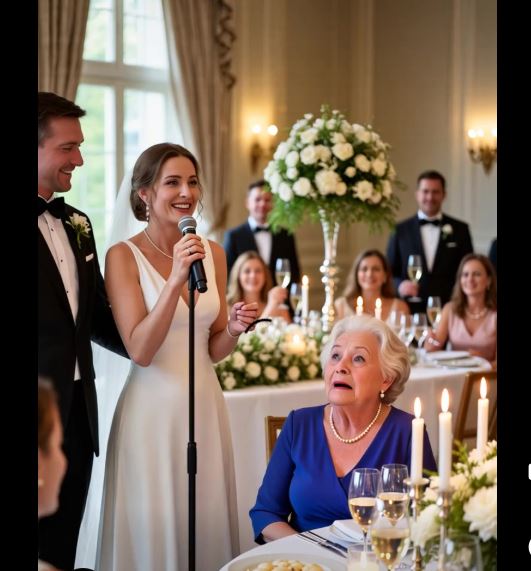
The ballroom shimmered with golden light, crystal chandeliers glowing above round tables draped in silk. Laughter echoed across the hall, glasses clinked in celebration, and a string quartet played softly in the corner.

It was my daughter’s wedding day — the day I had dreamed of since she was born. I had paid for everything: the venue, the flowers, the designer dress, the five-tier cake, and even the honeymoon she had always wanted. Every detail had been chosen with love, every expense carried quietly, without hesitation.
And yet, as I stood there among two hundred guests, my daughter stood on the stage and mocked me.
I remember the moment clearly. She raised her champagne glass, smiling brightly, her voice sweet but sharp underneath.
“Of course,” she said, glancing at me with a smirk, “none of this would have been possible without my mother — who believes throwing money at everything solves all problems.”
The crowd chuckled awkwardly. Some people laughed, unsure if it was a joke. Others turned toward me, waiting to see how I would react.
I simply smiled.
Inside, something cracked. But my face showed nothing except quiet composure. I had learned long ago that dignity speaks louder than anger.
The words continued. She spoke about my “old-fashioned values,” my “constant interference,” and how she had succeeded “despite growing up under strict control.” Each sentence felt like a small blade, carefully disguised as humor. People shifted uncomfortably in their seats. A few guests avoided my eyes.
Still, I smiled.
I thought of the nights I had worked double shifts after her father passed away. I remembered skipping meals so she could have dance lessons, selling my jewelry to pay her university tuition, and spending months planning this wedding so she could have the day she had always imagined. I remembered holding her when she cried over heartbreaks, celebrating her achievements, forgiving her harsh words during her rebellious years.
Love, I had learned, often means giving without expecting gratitude.
When her speech ended, polite applause filled the room. She stepped down from the stage, satisfied, laughing with her friends. I remained seated, hands folded calmly in my lap.
Then something unexpected happened.
A tall man in an elegant suit — the groom’s boss, a well-known figure in the business world — slowly stood from his table near the front. His expression was serious, thoughtful. He walked toward the stage with deliberate steps and gently took the microphone from the wedding coordinator.
The room fell silent.
He cleared his throat and looked directly at me before speaking.
“I wasn’t planning to say anything tonight,” he began, his voice steady and strong. “But after hearing that speech, I feel compelled to share something.”
Curious murmurs spread through the hall. My daughter’s smile faded slightly, confusion flickering across her face.
The man continued.
“When I heard this woman’s name,” he said, gesturing toward me, “I realized I know exactly who she is.”
Whispers rippled among the guests.
“Many years ago,” he said, “when my company was on the verge of collapse, when banks refused to help and investors turned their backs, there was one person who believed in me. One person who risked everything to give me a second chance.”
The room grew utterly still.
“That person,” he said, his voice softening, “was her.”
A wave of shock moved through the crowd. My daughter stared at me, her eyes widening.
He explained how, decades earlier, I had quietly lent him money — my life savings at the time — so he could rebuild his struggling business. I had asked for nothing in return, no recognition, no public acknowledgment. I had simply believed in helping someone who was desperate and determined.
“Because of her,” he continued, “my company survived. Hundreds of people kept their jobs. Families were supported. Lives were changed.”
He paused, emotion visible in his eyes.
“And today, I stand here as a successful man because of her generosity.”
The silence in the room was overwhelming.
Then he turned toward my daughter.
“You spoke of wealth solving problems,” he said gently. “But what your mother gave was not money — it was compassion, sacrifice, and faith in others. Those qualities cannot be purchased.”
My daughter’s face turned pale. Highlighted by the lights, tears began forming in her eyes.
The man continued speaking, his voice now filled with deep respect.
“I have met many powerful people in my life,” he said. “But true greatness comes from kindness without expectation. Your mother is one of the most remarkable individuals I have ever known.”
He stepped down from the stage and walked toward me. Before I could react, he bowed his head slightly and thanked me again — in front of everyone.
The room erupted into applause.