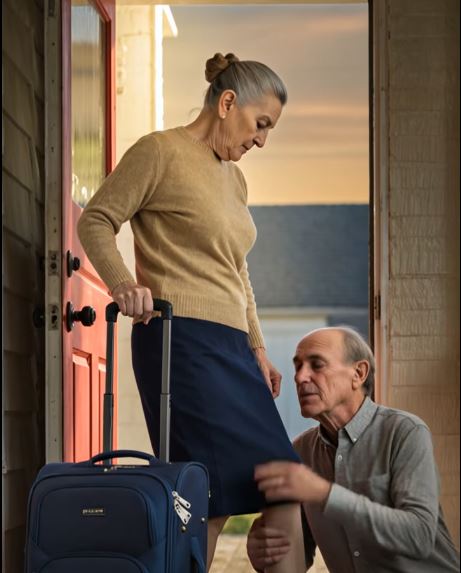
The words landed softly, almost gently, yet they shattered something deep inside me. There was no anger in his voice, no dramatic tone, no bitterness—just a quiet certainty that made them feel even heavier.
For a moment, I simply stared at him across the kitchen table, the same table where we had shared thousands of meals, arguments, laughter, and long silences.
I had imagined many endings to our story over the years. I had prepared myself for illness, for the slow drifting apart that often comes with age, even for loneliness. But I had never imagined this simple, brutal confession.
Outside the window, the evening sun painted everything in warm gold, as if the world itself refused to acknowledge the storm that had just erupted inside my chest.
I swallowed carefully. “Why?” I asked, surprised by how steady my voice sounded.
He sighed, rubbing his hands together the way he always did when he was nervous. “Because I never lived the life I wanted,” he said. “I stayed because it was expected. I stayed because it was comfortable. But I was never truly happy.”
The words cut deeper than any insult could have. Not because he blamed me directly, but because he spoke as though our life together had been nothing more than a long mistake.
Forty years.
Forty years of shared mornings, raising children, building a home, supporting each other through financial struggles, illnesses, and losses. Forty years of believing that love, even when imperfect, had been real.
And now he was telling me it had all been a compromise.
I stood from the table slowly, afraid my legs might give out. The kitchen suddenly felt unfamiliar, like a stranger’s home. Every object seemed to question the meaning of the life I thought I had lived.
“I see,” I said quietly.
He looked almost relieved by my calmness. Perhaps he had expected shouting, tears, accusations. But what I felt was not rage. It was something colder—a quiet unraveling.
That night, I didn’t cry. Instead, I walked through the house we had built together. I traced my fingers along the hallway walls where our children’s heights had been marked year after year. I opened old photo albums, looking at smiling faces frozen in time—holidays, anniversaries, birthdays. In every picture, we looked happy.
Had it all been an illusion?
Or had happiness existed, only to fade somewhere along the way?
Sleep did not come easily. Memories surfaced one after another: the day we first met, young and uncertain; our tiny first apartment with the leaking ceiling; the nights we stayed awake worrying about bills; the pride we felt watching our children grow. I remembered holding his hand during difficult times, believing that whatever happened, we were partners.
By morning, something inside me had shifted.
If he truly regretted our life together, then I would no longer spend my remaining years trying to preserve something he had already abandoned.
At breakfast, I spoke calmly. “If you regret marrying me,” I said, “then you should be free to live the life you think you missed.”
He looked startled. “What are you saying?”
“I’m saying,” I replied, “that I deserve happiness too.”
The following weeks were filled with quiet changes. We spoke little. We moved around each other like strangers sharing a space out of habit rather than affection. Eventually, we agreed to separate.
Friends were shocked. Our children struggled to understand. How could a marriage that had lasted four decades end so suddenly? But the truth was, the ending had not been sudden. It had been forming silently, hidden beneath routines and responsibilities.
Living alone for the first time in forty years was terrifying. The house felt unbearably quiet. The absence of familiar sounds—his footsteps, his voice, even his complaints—left an aching emptiness.
Yet, slowly, that emptiness transformed into space.
Space to breathe.
Space to think.
Space to rediscover who I was beyond being a wife.
I began doing things I had postponed for years. I enrolled in a painting class, something I had always wanted to try but never found time for. I traveled with friends. I read books late into the night without worrying about anyone else’s schedule. I learned to enjoy my own company.
And something unexpected happened.
I began to feel alive again.
One afternoon, nearly a year after our separation, I ran into him at a grocery store. He looked older, more fragile, as though time had caught up with him suddenly. We exchanged polite conversation, speaking about the children, about everyday matters.
Before leaving, he hesitated.
“I thought freedom would make me happy,” he admitted quietly. “But sometimes I wonder if I misunderstood what happiness really was.”