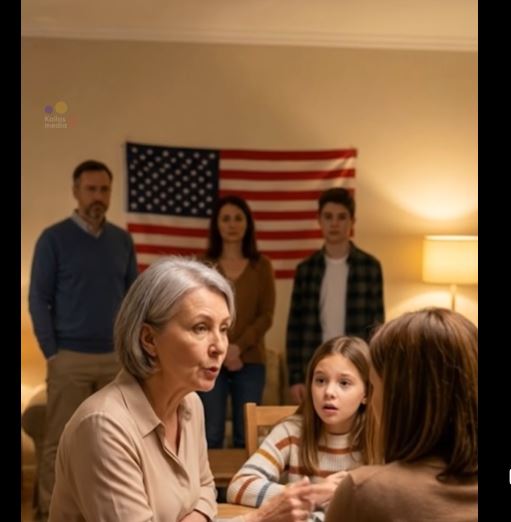
She said it calmly, almost casually, while placing her fork down beside her plate as if she had merely commented on the weather. Around the table, glasses clinked softly, someone cleared their throat, and my sister continued cutting her chicken like nothing unusual had happened. But my twelve-year-old daughter, Lily, froze.
Her eyes widened in confusion. She looked first at her grandmother, then at me, searching for an explanation that didn’t come.
“Why?” she asked quietly, her voice trembling just enough to break my heart.
My mother sighed dramatically, as if burdened by the question. “It’s an adult celebration,” she replied. “Children would only make noise and disrupt things.”
But we all knew that wasn’t true. Family birthdays had always included everyone — children, cousins, neighbors, even distant relatives. This was different. This was deliberate.
Lily lowered her gaze to her lap, her shoulders shrinking inward as if she wished she could disappear. No one defended her. No one questioned the cruelty hidden behind my mother’s polite tone.
I felt something shift inside me at that moment — something final.
“Well,” I said quietly, placing my napkin beside my plate, “if Lily isn’t invited, then neither am I.”
My mother looked at me with surprise, then irritation flickered across her face. “Don’t be dramatic,” she said. “You’re overreacting.”
But I simply stood, took my daughter’s hand, and left the table.
That night, Lily sat on the edge of her bed, silent. Usually she would talk endlessly about school, her friends, the books she was reading. But now she stared at the floor, twisting her fingers together.
“Did I do something wrong?” she finally asked.
The question broke something in me.
“No,” I said, sitting beside her. “You did absolutely nothing wrong.”
She hesitated. “Grandma doesn’t like me, does she?”
I could not lie to her. My mother had never fully accepted Lily. From the moment I adopted her three years earlier, my mother had kept her distance, always polite but cold, treating her as something temporary, something lesser.
“Some people,” I told her gently, “don’t understand what family truly means.”
Lily nodded slowly, though I could see the hurt remained.
That night, after she fell asleep, I sat alone in the living room, replaying every moment of that dinner in my mind. The silence of my relatives. My father’s refusal to speak. My mother’s indifference.
And then an idea came to me.
If my mother wanted to exclude my child from the family, then perhaps she needed to understand what exclusion truly felt like.
The invitation to my mother’s birthday arrived a week later — elegant cream paper, gold lettering, and a note reminding guests of the formal dress code. There was no mention of Lily, of course.
I declined politely.
But I also prepared a gift.
Not an ordinary gift wrapped in decorative paper, but something far more meaningful.
I spent days gathering documents, photographs, and letters. Old memories my mother had tried to bury, truths she preferred to keep hidden. I assembled everything carefully into a simple wooden box.
Inside was a message she could not ignore.
The evening of her birthday party arrived. I stayed home with Lily, ordering her favorite pizza and watching movies together. She laughed again that night, her earlier sadness softened by our quiet celebration.
Meanwhile, my gift was delivered to my mother’s house.
Later, my sister called me, her voice shaking with disbelief.
“You sent her something,” she said. “What did you do?”
I only replied, “She opened it?”
“Yes. And she turned completely pale.”
Inside the box were adoption papers.
But not Lily’s.
They were mine.
I had discovered the truth years earlier while searching through old family records after my grandmother’s death. I was not my mother’s biological child. I had been adopted as an infant after my parents died in an accident. My mother had raised me, yes — but she had always hidden the truth, fearing judgment, fearing questions, fearing anything that might disrupt the image of a perfect family.
I had kept her secret out of respect.
Until she rejected my daughter for being adopted.
Alongside the documents, I included a letter.
It read:
“You taught me that family is not defined by blood, but by love. Or at least, I believed you did. When you rejected my daughter for the very reason you once hid about me, you showed me that your love has conditions. I refuse to raise my child in a family where she must earn her place. From now on, we choose honesty, dignity, and unconditional love — even if that means distance.”