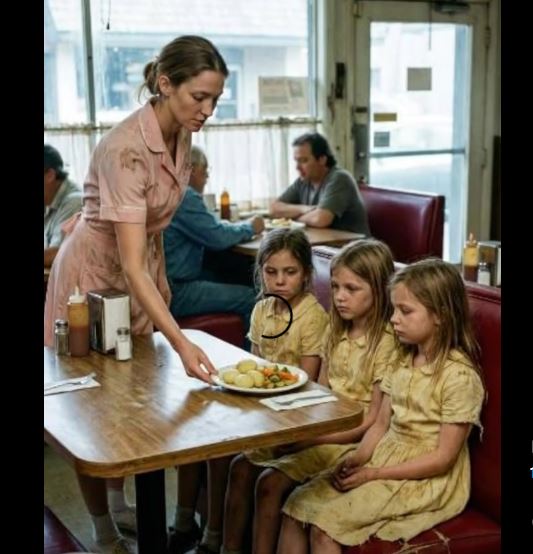
No announcements. No recognition. No photographs shared online. Just three small plates of food, prepared every evening with quiet care, and left where three hungry girls would find them.
To the world, Maria Kovac lived an ordinary life.
She was a widow in her late sixties who occupied a modest house at the end of a quiet street. Her days followed a simple rhythm — tending her small garden, walking to the local market, and returning home before sunset. Neighbors described her as polite but reserved, a woman who spoke gently and kept mostly to herself.
No one knew about the promise she had made.
And no one knew about the three girls.
It began one winter night.
The wind had been merciless, rattling windows and sweeping icy rain through the narrow streets. Maria had just finished preparing her dinner when she noticed movement outside her gate — three thin figures huddled beneath the weak glow of a flickering streetlamp.
They were children.
Two of them looked no older than ten, while the eldest — perhaps fourteen — stood protectively in front of the others. Their clothes were soaked, their faces pale from cold, their eyes filled with a mixture of fear and determination.
Maria watched from behind her curtain.
She had seen poverty before. She had lived through years of hardship herself. But there was something in the way the eldest girl tried to shield the younger ones from the rain that stirred something deep within her heart.
Without thinking, Maria wrapped her dinner in cloth, stepped outside, and approached them.
“You must be hungry,” she said softly.
The girls hesitated, uncertain whether to trust her. But hunger eventually overcame fear. They accepted the food with trembling hands, whispering quiet words of gratitude before disappearing into the night.
Maria expected never to see them again.
But the next evening, they returned.
And the evening after that.
She never asked many questions, and they never offered many answers. Over time, she learned only fragments of their story — that they had no parents, that they slept wherever they could find shelter, that survival had become their daily struggle.
The eldest was named Elena. The younger two were sisters, Mira and Ana.
They never begged.
They never demanded.
They simply waited quietly near the gate each evening, hoping.
And Maria never turned them away.
What began as a single act of kindness became a routine.
Every day, she prepared three extra meals. Sometimes it was warm soup and bread. Other times rice, vegetables, or small pieces of fruit she could afford. She left the plates near the back entrance, where the girls could collect them without attracting attention.
She never invited them inside.
Not because she lacked compassion, but because she sensed their pride. They accepted food, but they guarded their dignity fiercely.
Over the years, an unspoken bond formed between them.
On cold nights, Maria left blankets. During summer, she placed bottles of clean water beside the meals. Occasionally she tucked handwritten notes into the baskets:
Stay safe.
You are not alone.
Tomorrow will come.
Sometimes she found small tokens in return — wildflowers, carefully arranged stones, simple drawings left at her doorstep.
Their gratitude needed no words
They embraced her tightly, tears flowing freely.
The story they shared seemed almost unbelievable.
After years on the streets, a charitable organization had discovered the girls and provided them shelter, education, and opportunities. The eldest, Elena, had excelled in her studies, later building a successful career in international business. Mira had become a lawyer advocating for vulnerable children. Ana had dedicated her life to medicine, working to care for those who had no access to treatment.
Through every hardship, they had survived.
And they had never forgotten the woman who fed them when no one else would.
“For years,” Elena explained gently, “your food was the only reason we kept going. It gave us strength… and hope.”
Maria could hardly speak.
All the meals, all the quiet gestures she had believed small and insignificant, had shaped the course of three lives.
In the months that followed, Maria visited the center often. She watched children laugh, eat, learn, and dream within its walls. She saw hope where once there had been despair.
Her small acts of kindness had grown into something far greater than she ever imagined.
And each evening, out of habit and love, she still prepared three extra plates.
But now she knew.
Even the smallest acts of compassion can echo across years, transforming lives in ways we may never see.
Because sometimes, the world is changed not by grand gestures or great power — but by a quiet heart, a warm meal, and a kindness offered when no one else is watching.