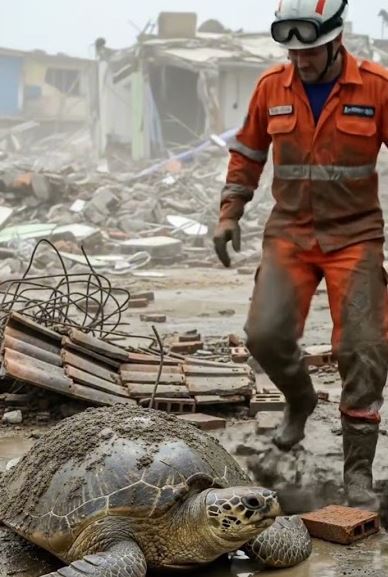
The forest was unusually quiet that afternoon, as if every leaf and branch understood that something extraordinary was about to unfold. Sunlight filtered gently through the tall pines, casting golden streaks across the moss-covered ground.

It was the kind of peaceful wilderness scene that most people pass by without a second thought. But hidden between the roots of an old oak tree, a small drama was taking place — one that would challenge everything you thought you knew about the animal kingdom.
It began with a turtle.
The turtle had been slowly making its way across the forest floor, navigating the uneven terrain with patient determination. Each step was careful, deliberate. But the forest can be unforgiving, especially for a creature built for steady ground and shallow water. A recent storm had loosened the soil near a fallen log, creating a shallow but treacherous depression in the earth. The turtle didn’t see it coming. One moment it was moving forward; the next, its front leg slipped. Its heavy shell shifted, tipping its balance. Within seconds, it found itself wedged awkwardly between exposed roots and packed mud.
It tried to push forward.
Nothing.
It tried to reverse.
Still nothing.
The more it struggled, the deeper its shell pressed into the damp earth. For a turtle, patience is natural. But this was different. This wasn’t a pause. This was a trap.
That’s when the raccoons appeared.
At first, it was just a flicker of movement in the underbrush. Then another. Two raccoons cautiously approached, their masked faces alert, their paws light against the leaves. Soon, a third emerged from behind a tree trunk. They weren’t rushing. They weren’t snarling. They were observing.
Raccoons have a reputation — clever, curious, sometimes mischievous. They are opportunistic feeders, known for rummaging through trash cans and outsmarting obstacles. But what happened next didn’t look like opportunism. It looked like assessment.
One raccoon moved closer to the turtle, tilting its head slightly as if studying the situation. The turtle, sensing movement, pulled its head partially into its shell but couldn’t retreat fully due to the tight space. The raccoon extended a paw and gently touched the edge of the shell. No claws. No aggression. Just contact.
The other two circled behind.
They sniffed the soil, pawed lightly at the mud, and examined the exposed roots pinning the turtle in place. There was no chaotic movement, no competition. Instead, there was something that resembled communication — subtle chirps, soft clicks, brief eye contact between them.
And then, as if a silent plan had been agreed upon, they began to act.
One raccoon positioned itself near the turtle’s rear, placing both front paws against the shell. Another began digging at the mud packed tightly against the turtle’s side. The third tugged at a thin root that had become wedged beneath the shell’s rim.
It was not violent. It was not frantic.
It was coordinated.
The raccoon at the side worked steadily, scooping mud away with rapid, precise movements. Dirt flew backward in small bursts. The raccoon behind applied gentle but consistent pressure, rocking the shell ever so slightly. The third kept working at the root, gnawing just enough to loosen it without snapping it abruptly.
The turtle remained still for a moment, perhaps sensing the shift in pressure. As the mud gave way, its front leg found a fraction of movement. A small push. Not enough.
The raccoons adjusted.
The one digging moved slightly forward, clearing space near the turtle’s front leg. The one pushing shifted its stance for better leverage. There was no leader visible, yet their movements seemed synchronized — each reacting to the other in real time.
Minutes passed.
The forest, still silent, bore witness.
Then it happened.
With one final coordinated effort — a push, a dig, and a tug — the turtle’s shell tilted just enough to break free from the grip of the roots. The mud collapsed inward, releasing its hold. The turtle slid forward onto firmer ground, legs scrambling until it stabilized itself a few inches away from the depression.
Free.
The raccoons froze.
For a brief moment, predator and potential prey stood within arm’s reach of each other. The turtle slowly extended its neck, turning its head slightly as if acknowledging the strange alliance that had just saved it. The raccoons did not lunge. They did not chase.
Instead, one of them lightly tapped the shell again — almost as if confirming the turtle was steady — before stepping back.
And just like that, the “meeting” ended.
The turtle resumed its slow journey toward the nearby stream, leaving behind faint tracks in the soft earth. The raccoons watched for a few seconds, then turned and disappeared into the underbrush as quietly as they had arrived.