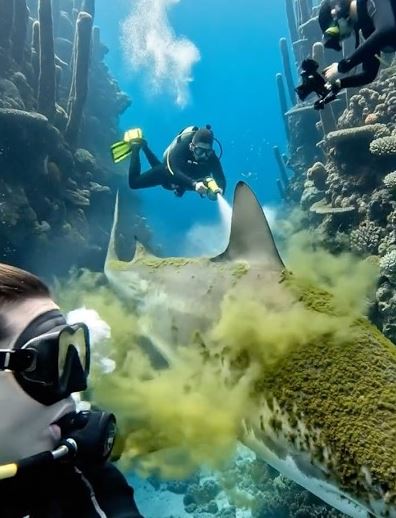
The ocean floor stretched beneath us like a sunless cathedral, vast and silent except for the occasional hiss of our regulators and the muted shuffle of our fins through silt. Light from the surface filtered down in fractured beams, shimmering like pale gold in the deep blue, cutting through the water with a slow, deliberate grace. I exhaled, watching bubbles trail upward, disappearing into the faint glow above.
Our mission today was unusual — a clean-up operation of a different kind. A large shark, recently spotted near the coral reefs, had become entangled in fishing lines and debris, a combination of human negligence and misfortune that left it trapped and struggling.
Its movements were labored, calculated, and every twitch of its powerful tail sent a ripple through the water around us.
I stayed close to the lead diver, observing their technique. Every motion was measured, precise. A sudden jerk could frighten the shark, provoke a defensive response, or worsen the entanglement. Even at a distance, you could feel the animal’s intelligence — its awareness of the danger around it, the way it tracked our movements with dark, circular eyes.
“Remember,” the team leader said in a soft, muffled voice through the comms, “we’re not just removing debris. We’re restoring freedom. One wrong move, and this could turn dangerous.”
I nodded, gripping my cutting tool tighter, muscles tense. The first step was always observation: tracking how the lines wrapped around the shark’s fins, body, and gills.
The animal twitched nervously as we approached, scanning us as though questioning our intentions. Sharks are apex predators, yet here, constrained by human carelessness, it was vulnerable. And that vulnerability demanded respect.
Slowly, we began. One diver gently approached the tail, cutting the thicker lines that had dug into the flesh. The shark responded with subtle flicks, testing our reaction, but we were patient, letting it acclimate to our presence.
Every cut, every pull, was deliberate — too fast and we risked injury; too slow and the animal could panic and make a sudden, unpredictable move.
I moved closer to the entanglement around the dorsal fin, careful not to get caught in the taut lines that could snap back like a whip. The shark’s eyes followed me, unblinking, aware.
I spoke to it softly, though it couldn’t hear, as if my calm voice could translate through the water and reassure it. I imagined the fear in its mind, the frustration of being trapped, and let that guide the gentleness of my movements.
Another diver handled a complex knot of fishing net wrapped around the gills. It was delicate work — the shark could barely breathe, and any sudden tension risked suffocation.
We communicated with subtle hand signals and nods, a silent choreography refined through years of training. Every moment was a balance between speed and care, efficiency and empathy.
Finally, after what felt like hours, the last of the entanglements were freed. The shark paused, floating in the open water, its tail flicking experimentally. It circled slowly, testing the new freedom in its movements. Its eyes, once tense and wary, seemed to soften slightly, acknowledging — in its own way — that the threat was gone.
The team hung back, giving space, watching the creature regain strength. There was no celebration, no cheering, only quiet relief. The ocean returned to its natural rhythm, and for a moment, the only sound was the rush of water against the reef and the soft hum of our bubbles.
As we slowly ascended, sunlight breaking through the water in fractured beams, I realized the magnitude of what we had done. It wasn’t just about removing debris. It was about giving life a chance to continue on its terms, restoring balance, and correcting a small piece of human impact on the natural world.
The shark lingered near the reef for a few moments, tail swishing, before slipping gracefully into the deeper waters. We watched it disappear into the blue, an apex predator restored to its rightful domain, free once more.
The sight was humbling — a reminder of the resilience of life, the responsibility humans carry, and the fragile intersection of our world with theirs.
Back on the boat, we removed our masks, still tasting the salt of the ocean. Conversation was minimal, each of us lost in reflection. The ocean had given us a glimpse of something primal — fear, struggle, and triumph — and we had witnessed it, and in our small way, facilitated its continuation.
I took one last glance at the water as we packed up. Somewhere below, the shark swam again, unencumbered, powerful and elegant. Our presence had been brief, but necessary. The ocean floor, once a trap, had been transformed into a sanctuary once more.
And in the quiet, I knew this was the reason I trained for this work: to intervene without harm, to respect without dominance, and to restore where human carelessness had caused harm.