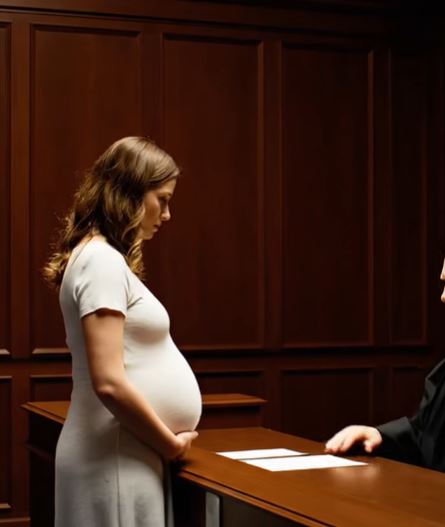
The courtroom was charged with tension, the kind that makes every breath feel heavier than usual. The pregnant defendant sat in the center of the room, her hands trembling in her lap as she avoided eye contact with anyone around her.
Her attorney, a middle-aged woman with a calm but firm demeanor, whispered reassurances, though it was clear even she was struggling to maintain composure. The judge, an imposing figure with a reputation for strict rulings, leaned forward slightly from his bench.
His voice, steady yet commanding, cut through the silence. “I will ask you again,” he said, his eyes fixed on the young woman. “Who is the father?”
The question hung in the air, and for a moment, it seemed as though the courtroom itself was holding its breath. Jurors shifted uncomfortably in their seats, reporters scribbled frantically, and spectators murmured quietly among themselves, unsure whether to expect a confession or continued silence.
The defendant’s lips quivered, and she blinked rapidly, as though the very act of speaking might shatter her. She opened her mouth to answer, then closed it again, swallowing against a lump in her throat.
The air was thick with anticipation, the kind of suspense that made hearts race even among those who had seen courtroom dramas countless times.
Then, something unexpected happened. From the back row, a man stood slowly, deliberately, drawing the attention of everyone present. He was wearing the sharp uniform of a decorated police officer, his posture rigid but calm, and his eyes locked directly on the defendant.
The room collectively gasped at the sight. Whispers erupted as spectators tried to process what they were seeing. It was one thing to have a defendant on trial, but it was another to have a law enforcement officer rise in a courtroom, seemingly preparing to intervene in a case where everyone assumed he would play the role of enforcer.
The officer’s presence changed the entire dynamic of the room. The judge’s gaze shifted slightly, acknowledging the man but maintaining authority. “Officer Daniels,” the judge said, his tone wary yet curious, “what is the meaning of this?” Daniels, the officer in question, took a slow, measured step forward, his eyes never leaving the young woman.
“Your Honor,” he said clearly, his voice carrying both strength and restraint, “I believe I have information relevant to this case that the court deserves to hear before any further proceedings continue.”
Gasps and murmurs rippled through the spectators. Reporters exchanged stunned looks, scribbling rapidly as they tried to adjust their narratives in real-time. The jurors leaned forward in their seats, suddenly aware that the case was far from straightforward.
Even the attorneys shifted in surprise, some frowning as they considered how this new development might impact their strategies.
The defendant, meanwhile, looked as though a weight had been lifted off her shoulders, though fear and uncertainty still lingered in her expression.
Daniels cleared his throat and continued, addressing the courtroom with unwavering composure. “I have known the defendant for several years in a professional capacity,” he said, “and I can personally attest to her character, her actions, and circumstances that the prosecution may not fully understand.
I am also prepared to answer the question regarding the father’s identity, as it is my duty to ensure the truth is presented accurately and fairly.”
His words carried a calm authority that seemed to momentarily still the murmurs, as every person in the room realized that the narrative they had been following was about to change dramatically.
The judge, after a brief pause to process the implications, nodded slightly. “Very well, Officer Daniels,” he said, his voice measured but firm. “The court will hear your testimony. Proceed.”
The room was still tense, but an undercurrent of relief began to form around the defendant. She was no longer alone, and someone who wielded authority and respect in the community had just chosen to stand with her rather than against her.
As Daniels began to speak, recounting facts, observations, and evidence that had previously been overlooked, it became increasingly clear to everyone in the courtroom that the situation was far more complex than the prosecution had presented.
His testimony painted a nuanced picture of the defendant’s circumstances, her relationship with the alleged father, and the reasons for her actions, revealing a side of the story no one had expected.
By the time he finished, the atmosphere in the courtroom had completely shifted. Shock and disbelief were replaced with careful contemplation, and whispers of support for the defendant began circulating among the spectators.
The jurors exchanged uncertain glances, understanding that their initial assumptions were no longer sufficient to guide their judgment.