It was a quiet afternoon in the small town of Maplewood, the kind of day where the sun hung lazily in the sky, and the birds’ chirping filled the empty streets.
Henry Thompson, a retired carpenter in his seventies, was sitting on his porch, sipping tea and enjoying the calm. At his feet, his loyal dog, Max—a clever golden retriever with an uncanny sense of intuition—watched him attentively, ears perked, eyes sharp.
Most people thought Max was just a pet. But Henry had always known there was something different about him. Max seemed to understand more than any ordinary dog should. He reacted to subtle changes in mood, anticipated Henry’s steps, and even seemed to warn him of trouble before it arrived.
That afternoon, Max started pacing back and forth, letting out soft, urgent barks. Henry frowned. “What is it, boy? Sun too bright for you?” he chuckled, though he noticed Max’s behavior was far from playful. The dog ran a few steps toward the gate, stopped, then turned to Henry, whining and pawing at him insistently.
Henry furrowed his brow. “Alright, alright… what is it? You want me to go somewhere?”
Max barked again, louder this time, then bolted down the street, glancing back to make sure Henry followed. Curious and trusting his companion’s instincts, Henry grabbed his coat and shuffled after him.
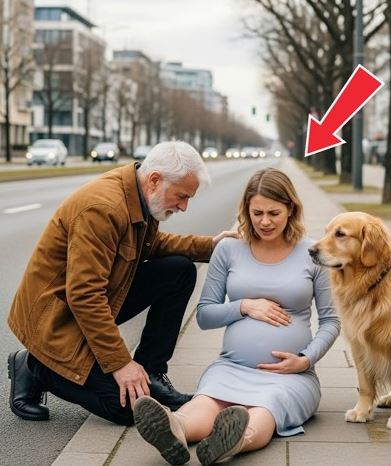
Max led him to the edge of town, near the old wooden bridge where a narrow dirt path crossed a small creek. And there, sitting on the ground with a hand pressed to her stomach, was a young pregnant woman. Her face was pale, her breathing shallow, and it was clear she was in distress.
“Oh my goodness!” Henry exclaimed, hurrying to her side. “Are you alright? Can you stand?”
The woman shook her head weakly. “I… I don’t know… the baby… I think it’s coming early. I didn’t know who to call…”
Max nuzzled her gently, then turned to Henry, giving a soft bark that seemed almost like a command. Henry understood immediately: the dog was urging him to act, to help her, and to stay calm.
Henry helped the woman to a safer spot under a nearby tree while keeping Max close by. Pulling out his phone, he called the local emergency services, giving them clear instructions and descriptions. Max remained alert, circling the area, keeping the woman calm with gentle nudges and warm eyes.
Minutes later—which felt like hours—the ambulance arrived. Paramedics rushed forward, but Max wouldn’t let them near her without Henry. It was as if he understood the need for reassurance and safety. The young woman clutched Henry’s hand, comforted by the presence of both the kind grandfather and his wise, intelligent dog.
By the time she was safely loaded into the ambulance, her eyes filled with tears of gratitude. “Thank you… both of you,” she said. “I don’t know what I would’ve done without you.”
Henry smiled, though he was still catching his breath. “We didn’t do much, just followed Max here.”
Max wagged his tail proudly, as if he knew the impact of his actions. He had saved a life, guided his grandfather, and reminded everyone that intelligence and intuition come in all forms—not just human ones.
The story spread through Maplewood quickly. Neighbors spoke in awe of the clever dog who had sensed danger, alerted his owner, and helped save both mother and child.
Henry, usually modest about his companion, finally nodded with a proud smile. “Max isn’t just a dog,” he told anyone who would listen. “He’s family. And sometimes, family knows exactly what to do when you need it most.”
From that day forward, Max was no longer just the Thompson family dog—he was a hero in the town, a reminder that courage and intelligence aren’t limited to humans. And for Henry, he had learned something simple but profound: sometimes, listening to a dog could change lives forever.