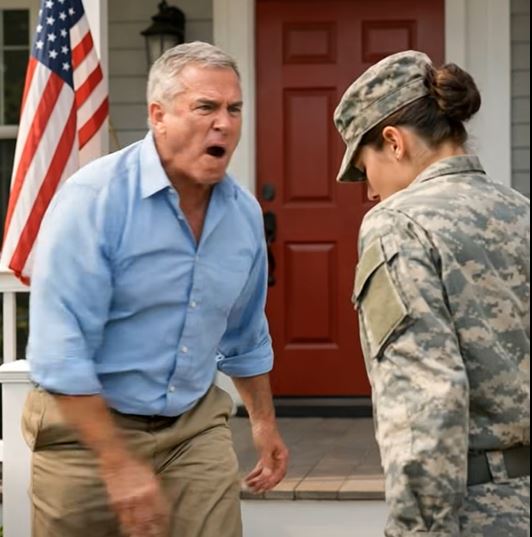
After eight years of service in the military, I finally stepped off the plane and back onto home soil. The smell of familiar streets, the cool winter air, and the soft hum of city life felt like a dream.

I had imagined this moment countless times while stationed overseas: hugging my mother, catching up with friends, and finally celebrating Christmas at home with the family I had missed so painfully.
Eight Christmases. Eight birthdays. Eight moments I had sacrificed in service to my country, and now, finally, it was time to reconnect.
But the first sign that things might not be as I had imagined came just hours after I landed. My phone buzzed with a single text from my father.
“We don’t have time for you this year. Merry Christmas.”
At first, I thought it was a mistake. Perhaps he had sent it to the wrong person. But no, the message bore his unmistakable signature: “Dad.” I stared at the screen in disbelief, my heart tightening.
How could he send something so cold, so dismissive, after all the years I had given away, the sacrifices I had made, and the countless holidays I had spent far from home, facing danger and uncertainty?
I called him immediately, but there was no answer. My mother didn’t pick up either. I drove to their house anyway, hoping that seeing him in person would somehow repair the sudden sting of rejection.
When I arrived, the front door was unlocked, but the house was silent. I called out his name, my voice echoing through empty halls. Nothing. I checked the kitchen, the living room, even the small study where he used to sit reading the newspaper. Still, no one was there.
Then I noticed the pile of unopened letters on the counter, bills and notices stacked haphazardly. My stomach sank. Something felt off. I picked up the mail and found a small envelope with my name on it, handwritten in my father’s meticulous script. Hesitant, I tore it open.
“I can’t face you this year. I’m sorry for everything.”
The words barely explained anything. My mind raced, searching for answers, trying to piece together what could have happened during my absence. It felt like my father had become a stranger while I was away.
Determined to uncover the truth, I asked around the neighbors and even my father’s colleagues. Slowly, fragments began to emerge: my father had been struggling with illness and financial problems he had hidden from everyone, even my mother. The pride that had always made him stoic now weighed heavily on him, isolating him in his own home.
I finally found him sitting in the garage, hunched over a workbench, fiddling with tools as if the past eight years hadn’t existed. His head lifted as I approached, and for a moment, I saw a flicker of recognition—then shame.
“I… I didn’t want you to see me like this,” he whispered, voice cracking. “I didn’t know how to reach out. I was too proud to ask for help, and I didn’t want to ruin Christmas for you.”
I stood frozen, torn between anger and empathy. All the hurt I had felt in the past moments—the cold text, the silence, the sense of abandonment—fought against the truth I now realized. My father had been silently struggling, trapped by his own pride and fear, feeling unworthy of my return.
I knelt beside him, placing my hand on his shoulder. “Dad… you don’t have to do this alone,” I said softly. “I’m home now. We can face it together.”
Tears welled up in his eyes, and for the first time in years, I felt the barrier between us begin to crumble. That moment of truth, painful and raw, revealed a man who was flawed but human—a father who had suffered quietly while I was away, just as I had endured my own hardships in service.
We spent that Christmas together, sitting by the fireplace, exchanging stories, and finally reconnecting. It wasn’t the perfect holiday I had envisioned, but it was real, filled with honesty, vulnerability, and love that had been buried under years of silence.
The text that had initially shattered me became the key to discovering a deeper truth: that even those we think have abandoned us may be carrying invisible burdens, and that forgiveness and understanding can transform heartbreak into healing.
By the end of the night, I realized that home isn’t just about tradition or past memories—it’s about presence, compassion, and the courage to face the truth, no matter how painful. That Christmas, we weren’t perfect, but we were together, and that was enough.