The sun hung low over the vast savannah of Zimbabwe, casting long golden shadows across the dry grasslands. The air was still, heavy with heat, and the distant calls of wildlife echoed faintly across the horizon.
It was a landscape both beautiful and unforgiving—a place where survival often depended on strength, instinct, and sometimes, luck.
But on this particular afternoon, one of the largest and most powerful animals on earth had run out of both.
Deep near the edge of a protected wildlife area, a massive bull elephant—estimated to weigh nearly eight tons—had wandered too close to a boundary marked by an electric fence. These fences were designed to prevent human-wildlife conflict, keeping elephants away from farmland where they could cause destruction. But sometimes, these barriers became deadly traps.
No one knew exactly how it happened.
Perhaps the elephant had been searching for water. Perhaps it had been startled and backed into the fence. Or perhaps it simply misjudged the distance.
What was certain was this: the powerful animal had become entangled in the wires.
The electric current surged through the fence, delivering repeated shocks. In a desperate attempt to break free, the elephant had thrashed violently, wrapping the wires tighter around its legs and body. The more it struggled, the worse the situation became.
By the time rangers discovered it, the scene was heartbreaking.
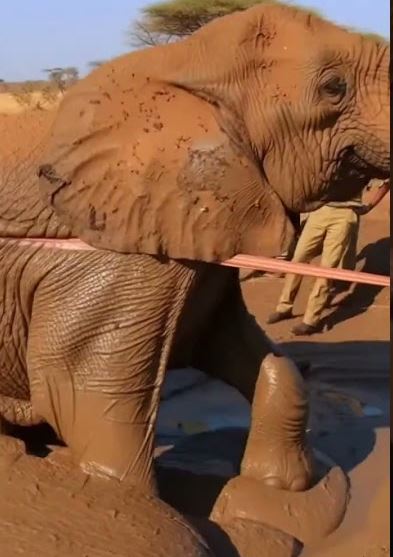
The giant lay partially on its side, its massive chest rising and falling heavily with exhaustion. Burn marks and deep cuts lined its thick gray skin where the electrified wires had dug in. Its trunk moved weakly, occasionally lifting and falling back to the ground as if even that effort had become too much.
Despite its size, the elephant was helpless.
And time was running out.
A nearby conservation team was alerted immediately, and within a short time, a group of wildlife rescuers and veterinarians arrived at the scene. They had handled difficult rescues before—but nothing on this scale.
“This is serious,” one of the veterinarians said quietly, assessing the situation. “If we don’t get those wires off soon, it won’t survive.”
The first challenge was safety.
Even in its weakened state, an elephant of that size could be extremely dangerous if it panicked. One wrong movement could injure both the rescuers and the animal itself.
They needed to act carefully.
A tranquilizer was prepared.
From a safe distance, the veterinarian aimed and fired a dart into the elephant’s thick shoulder. The team watched closely as the powerful animal’s movements slowed further, its body relaxing just enough to allow the rescuers to approach without triggering a violent reaction.
“Okay… let’s move,” the team leader instructed.
The rescuers advanced cautiously.
Up close, the true scale of the situation became even more overwhelming. The elephant’s body was enormous, its sheer weight pressing into the dry earth. The wires were wrapped tightly around its legs, some embedded so deeply they had nearly disappeared into the folds of skin.
Cutting them wouldn’t be easy.
And there was another risk—the electricity.
Before anyone could begin, the power to the fence had to be completely shut down. A ranger quickly contacted the control station, and after a tense wait, confirmation came through.
“The current is off.”
Only then did the real work begin.
Using heavy-duty insulated cutters, the team started to slice through the thick wires. Each cut required strength and precision. The metal was tough, and the tension from the elephant’s earlier struggles made the wires snap back unpredictably when severed.
“Careful!” one rescuer shouted as a cut wire recoiled sharply.
Sweat poured down their faces under the relentless sun as they worked.
Minutes turned into an hour.
Then another.
Slowly, piece by piece, the wires began to loosen.
One of the rescuers focused on the elephant’s front legs, where the entanglement was worst. The metal had dug deep, leaving visible wounds that would need immediate treatment.
“Almost there,” he said through clenched teeth as he made another cut.
Finally, with one last effort, the final wire snapped free.
For a moment, everything went still.
The elephant was no longer trapped.
But the rescue wasn’t over yet.
The team quickly moved to treat the injuries. Antiseptic solutions were applied to the wounds, and medication was administered to prevent infection. The veterinarian monitored the elephant’s breathing closely, ensuring that the tranquilizer hadn’t slowed its system too much.
With visible effort, the elephant began to move. Its legs trembled as it struggled to push itself upright. For a moment, it seemed like it might collapse again.
The elephant stood still for a few seconds, as if regaining its bearings. Its ears flapped slowly, and its trunk lifted into the air, sensing the environment.