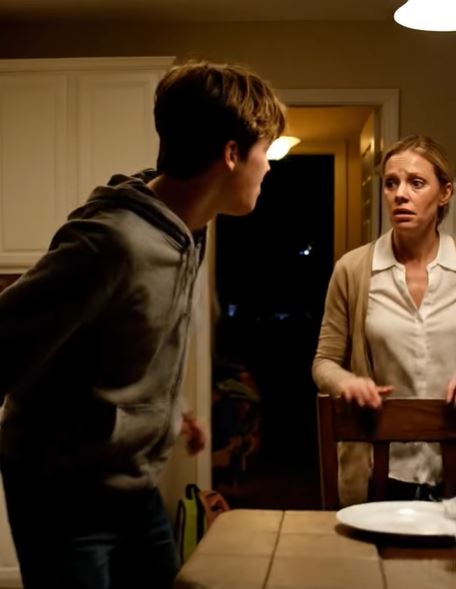
The ceramic plate shattered against the dining room wall, leaving a jagged red smear of pasta sauce against the white wallpaper. But the sound of breaking china was nothing compared to the words that followed.
“You’re not my real mother! I don’t have to listen to you!” my twelve-year-old son, Toby, screamed. His face was contorted with a rage that seemed too heavy for his young shoulders.
I stood frozen, the dish towel still in my hand. I had spent twelve years wiping his forehead during fevers, cheering at his soccer games, and reading him bedtime stories until my voice went hoarse. I had carried him in my heart since the day we “adopted” him as an infant.
“Toby, please…” I whispered, my voice trembling.
I looked at my husband, Mark, expecting him to step in. I expected him to defend me, to tell Toby that biology doesn’t define motherhood. But Mark didn’t move. He sat at the head of the table, his eyes fixed on his glass of water, his knuckles white as he gripped the tablecloth. His silence wasn’t just shock—it was a heavy, suffocating guilt.
“Mark?” I said, my heart starting to race. “Say something.”
He didn’t look up. He just stood up quietly and walked out of the room, leaving the echoes of Toby’s scream hanging in the air.
That night, the house felt like a crime scene. Toby had locked himself in his room, and Mark was “working late” in his home office. But I couldn’t sleep. The way Mark had looked—or rather, the way he couldn’t look at me—gnawed at my soul.
I waited until I heard Mark’s steady breathing from the guest room. I went to his office. It was a place I rarely entered, a sanctuary of mahogany and locked drawers. I didn’t have to look far. The safe in the closet, usually locked, was slightly ajar.
Inside was a blue accordion folder labeled Family Records. I pulled out Toby’s adoption papers. I had seen them a hundred times—the official seal, the signatures, the date we brought him home from the agency in Seattle.
But as I held the original document under the desk lamp, I noticed something strange. The ink on the “Mother’s Name” section was a fraction of a shade darker than the rest of the page. I took a magnifying glass from the desk drawer.
Under the light, the truth began to bleed through. The paper had been meticulously scraped and altered. Beneath the high-quality forgery of “Adoption Agency,” there was a different heading. It wasn’t an adoption from an agency. It was a private transfer.
And then I saw it. The original name of the biological mother had been poorly erased, but the indentation was still there.
Elena Vance.
The name hit me like a physical blow. Elena was Mark’s “assistant” from his first year of law school—the woman he claimed had moved back to Europe after a brief internship.
I went through the rest of the folder. Tucked at the very bottom was a DNA results kit from six months ago. Toby must have found it. He must have done a secret test, realized he was biologically related to Mark, but not to me.
Mark hadn’t adopted a stranger with me. He had brought his own secret child into our home and let me believe we were a “rescue” family. He had let me pour a decade of love into a child while he lived a lie every single day, keeping the truth about Toby’s mother hidden to protect his own reputation.
I didn’t scream. I didn’t cry. I walked into the guest room and turned on the lights. Mark sat up, blinking against the brightness, his eyes landing on the blue folder in my hand.
“You didn’t adopt him, Mark,” I said, my voice eerily calm. “You brought your mistake home and called it a miracle.”
“Claire, listen…” he started, his voice cracking. “Elena didn’t want him. She was going to leave him at a fire station. I couldn’t let my son grow up in the system. I thought if I made it an ‘adoption,’ we could be a real family. I didn’t want to lose you.”
“You lost me the moment you used white-out to erase another woman’s existence,” I replied. “You let Toby grow up thinking he was chosen by us, when really, he was a secret you were hiding in plain sight.