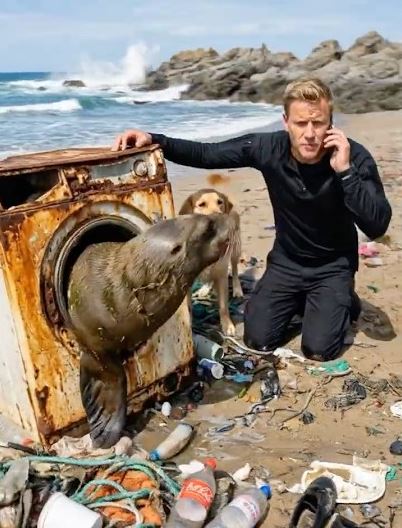
The northern coastline was rugged, a place where the Atlantic Ocean constantly tossed up secrets onto the rocky shore. I was out for an early morning hike with Barnaby, my golden retriever, whose nose was usually preoccupied with tracking squirrels or finding the perfect tennis ball hidden in the tall grass.
But as we reached a secluded cove filled with driftwood and old debris washed up by the last storm, Barnaby’s demeanor changed. He stopped, his ears pitching forward, and let out a low, vibrating growl that I had never heard before.
“Barnaby? What is it, buddy?” I called, but he didn’t wait.
He took off toward a pile of rusted metal—an old, discarded washing machine that had been half-buried in the sand and kelp for years. Barnaby began circling the machine, barking with an intensity that told me this wasn’t a game. He started digging frantically at the sand around the opening, then looked back at me with eyes full of urgent pleading.
I scrambled over the rocks, fearing he’d found a trapped raccoon or something dangerous. But as I reached the rusted hull of the machine, I heard it—a soft, labored wheeze followed by a desperate, high-pitched cry.
I knelt down and looked into the dark, cramped drum of the machine. My breath hitched. Inside, wedged tightly against the metal, was a juvenile sea lion. It had clearly crawled in looking for shelter or chasing a fish, but the rising tide had packed wet sand around the door, sealing it in a metal tomb.
The sea lion’s large, dark eyes were wide with exhaustion. Its fur was dry, and it looked like it had been struggling for hours. Every time it tried to move, the sharp, rusted edges of the machine’s inner drum scraped against its skin.
“It’s okay, little one,” I whispered, though I knew I couldn’t move the heavy machine alone.
Barnaby didn’t just stand by. He seemed to understand the gravity of the situation. While I called the local Marine Mammal Rescue, Barnaby laid down right at the opening of the machine. He began licking the sea lion’s dry flipper that was sticking out, his tail thumping softly against the sand. It was as if he was providing the only comfort he knew how to give—a silent promise that help was on the way.
When the rescue team arrived forty minutes later, they were stunned by the location. “We’ve seen them stuck in nets and plastic,” one rescuer said, “but never a 1990s washing machine.”
The team had to use specialized hydraulic tools to carefully peel back the rusted metal without injuring the pup. Throughout the entire process, Barnaby refused to move. He sat just a few feet away, his gaze locked on the sea lion, acting as a furry sentinel.
As the last piece of metal was cut away, the sea lion pup finally slid out onto the sand. It was weak and dehydrated, but alive. The rescuers wrapped it in damp towels to prepare it for transport to the rehab center.
Before they loaded the pup into the crate, something incredible happened. The sea lion let out a soft sound—a gentle chirp—and tilted its head toward Barnaby. Barnaby walked up, gave the pup’s nose one last gentle nudge, and let out a single, satisfied woof.
“Your dog saved this pup’s life,” the lead rescuer told me, patting Barnaby’s head. “If he hadn’t noticed the sound over the roar of the waves, this machine would have been completely submerged by the next high tide.”
We watched the rescue truck drive away, heading toward the sanctuary where the sea lion would be fed and rested before being released back into the wild.
Barnaby turned back toward the ocean, his golden fur glowing in the midday sun. He looked back at the rusted washing machine—now just a heap of scrap metal—and then at me. He picked up a piece of driftwood, shook it happily, and started heading back toward the trail.
I realized then that heroes don’t always wear uniforms or carry tools. Sometimes, they have four paws, a golden coat, and a heart that can hear a cry for help even when it’s buried deep inside a rusted machine.
Barnaby hadn’t just found a “secret” on the shore; he had found a soul to save, proving once again that the strongest bond in nature isn’t between species—it’s between those who care and those who need it most.