The morning air at Arlington National Cemetery was thick, not just with the humidity of a Virginia spring, but with the invisible weight of a million untold stories. It was Memorial Day, a date that most citizens associated with barbecue smoke and three-day weekends, but for my father, Elias Thorne, it was the only day of the year he truly felt alive—and the only day he felt the crushing presence of the dead.
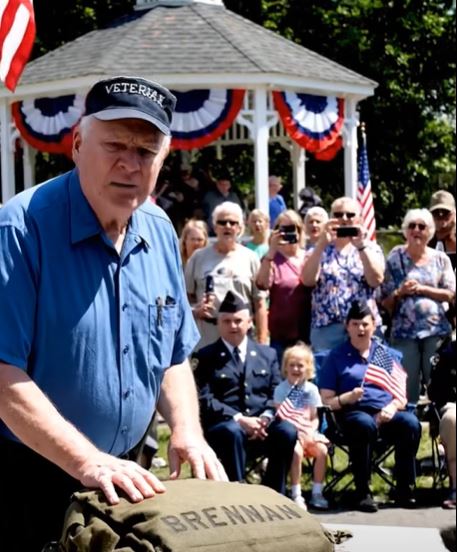
Elias was a man of few words, a retired Master Sergeant whose face was a map of every conflict the United States had touched since 1970. He stood at the edge of Section 60, his back as straight as a bayonet, clutching a worn, olive-drab canvas rucksack.
This wasn’t a modern tactical bag; it was an artifact, stained with the red clay of Southeast Asia and the motor oil of a dozen different motor pools. He held it with a white-knuckled grip, as if the fabric itself might dissolve if he let go.
To my left, the ceremonial proceedings were in full swing. Brass bands played somber hymns, and politicians in crisp suits spoke about “the ultimate sacrifice” with rehearsed gravity.
We were standing near the perimeter where the local police K9 units were conducting routine sweeps for security. It was standard protocol for a high-profile event, but what happened next was anything but standard.
A massive Belgian Malinois named Rex, led by Officer Miller, was working the line. Rex was a seasoned veteran of the force, trained to detect the sharp scent of gunpowder or the chemical signature of C4. He moved with a mechanical precision, ignoring the crowds and the noise. But as he drew level with my father, Rex didn’t just pause. He stopped mid-stride, his body tensing like a coiled spring.
The dog didn’t sit—the standard signal for a “hit.” Instead, he let out a low, guttural growl that sounded less like a police alert and more like a primal scream. His hackles rose, a jagged line of fur standing straight up along his spine. Then, Rex lunged. He didn’t bite, but he buried his snout into the side of my father’s rucksack, scratching at the canvas with a frantic, desperate energy.
“Sir! Step back from the bag! Put your hands in the air now!” Officer Miller shouted, his voice cutting through the nearby music like a gunshot.
The crowd scattered. Secret Service agents nearby went into a defensive crouch. My father didn’t flinch. He didn’t drop the bag. He looked down at the dog with a strange, haunting expression—not of fear, but of profound relief.
“He’s not smelling a bomb, Officer,” my father said, his voice a gravelly rasp. “He’s smelling the ghosts. He’s smelling the metal they told us didn’t exist.”
Miller didn’t care about riddles. He forced my father to his knees, zip-tying his hands behind his back while another officer grabbed the rucksack. The perimeter was cordoned off. The “Memorial Day Tribute” had officially become a crime scene.
“Check the bag,” Miller commanded his partner. “Be careful. If it’s a hair-trigger, we need the squad.”
The junior officer slowly pulled the rusted zipper back. The sound was like a scream in the sudden silence of the cemetery. He reached inside and pulled out a heavy, lead-lined box, roughly the size of a cigar humidor. It was wrapped in a tattered American flag, but the stars weren’t white—they were yellowed with age and what looked like chemical scorching.
When the lid was pried open, the sun hit the contents, and the light that bounced back was blinding. Inside were twelve Medals of Honor. But these weren’t the standard decorations you see in museums. They were cast in a darker, denser metal, and instead of names, the reverse sides were stamped with eight-digit serial numbers starting with the prefix “X-SHADOW.”
But the medals were just the beginning. Tucked into the velvet lining was a series of microfiche slides and a handwritten flight log from June 1974. The title on the log was stamped in fading red ink: OPERATION SHADOW-STEP: EXPENDABLE ASSET RECOVERY.
Officer Miller stared at the medals, then at the dog, who was now sitting silently at my father’s feet, his head resting on the lead box. Rex had stopped growling. He looked at the box with a sorrowful, heavy-lidded gaze.
“What is this?” Miller asked, looking at my father. “These medals… they aren’t in the system. I’ve been a cop for fifteen years, and I’ve never seen this marking.”