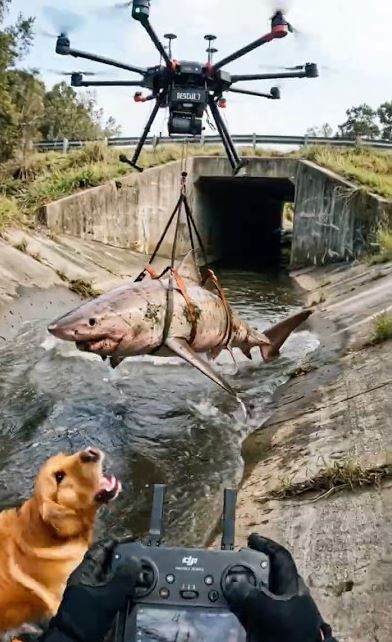
The coastal town of Silver Bay was still recovering from the “King Tide,” a massive swell that had pushed the Atlantic Ocean hundreds of yards inland, flooding the low-lying streets and turning the storm drains into temporary saltwater rivers. As the water receded, it left behind debris, seaweed, and a quiet, lingering sense of displacement.
Max, a five-year-old Golden Retriever known throughout the neighborhood for his eerie, almost human-like intelligence, was on his morning walk with his owner, Leo. Max wasn’t a dog who chased squirrels or barked at mailmen. He was a “thinker.” He observed the world with a calm, analytical gaze that often made Leo feel like Max was the one walking him.
As they passed a heavy iron storm grate near the old pier, Max stopped dead in his tracks. He didn’t just sniff the air; he leaned his head down, pressing his ear against the metal bars.
“Come on, Max. It’s just wet leaves in there,” Leo said, checking his watch.
Max didn’t move. He let out a low, vibrating whine—not a sound of fear, but one of deep concern. He began to pace in a tight circle around the grate, his paws clicking rhythmically on the asphalt. Then, he did something unexpected: he grabbed Leo’s sleeve in his teeth and pulled him toward the dark opening of the sewer pipe that led out to the bay.
“Max, stop! You’re going to ruin my jacket,” Leo complained, but the dog’s persistence was undeniable.
Max ran to the edge of the concrete embankment where the large drainage pipe emptied into the receding tide. The water level inside was low, leaving a dark, muddy tunnel exposed. Max splashed into the shallow, murky water, his golden fur immediately turning a dull brown. He barked once—a sharp, authoritative command—and disappeared into the pipe.
“Max! Get back here! That’s dangerous!” Leo shouted, grabbing his flashlight and scrambling down the rocks.
Leo shone the beam into the pipe. About fifteen feet inside, he saw the golden glimmer of Max’s coat. The dog was standing over something that was thrashing weakly in a shallow pool of trapped saltwater. At first, Leo thought it was a large salmon or perhaps a piece of plastic caught in the current.
But as the flashlight beam sharpened, Leo’s heart skipped a beat.
It was a juvenile Blacktip Reef Shark, about three feet long. It had likely been washed into the drainage system during the peak of the tide and had become trapped in a dip in the pipe as the water level dropped. Now, it was suffocating. Its gills were barely moving, and its sleek, grey skin was starting to dry out in the stagnant air of the sewer.
“Max, get away from that! It’s a shark!” Leo yelled, terrified his dog would be bitten.
But Max wasn’t attacking. In a display of tactical brilliance, Max was using his nose to gently nudge the shark’s tail toward the deeper channel of the pipe. He seemed to understand that the shark needed to be in moving water to survive. When the shark snapped weakly in the air, Max didn’t retreat; he simply waited for the creature to calm down, then used his broad chest to slide it forward.
“You’re trying to save it?” Leo whispered, realization dawning on him.
Max looked back at Leo, his eyes reflecting the flashlight beam. He gave a short, urgent huff and then grabbed a piece of discarded rope that was tangled in the debris nearby. He looped the rope around a heavy piece of driftwood that was wedged behind the shark and began to pull, clearing a path toward the exit.
Leo knew he had to help. He couldn’t let his dog do this alone. He waded into the pipe, the smell of salt and old iron thick in his nostrils. Using a plastic crate he found nearby, Leo managed to create a makeshift “stretcher.”
“Okay, Max. Together,” Leo said.
Max seemed to understand the plan perfectly. He used his snout to guide the shark’s head into the crate while Leo lifted the back. It was a delicate, dangerous operation.
The shark’s skin was like sandpaper, and its instincts were to fight, but Max stayed inches away, his calm presence seemingly acting as a sedative for the wild animal.
Slowly, they navigated the crate out of the pipe and onto the rocky shore. The bay was still fifty yards away across the receding tide pools. Max took the lead, finding the deepest path through the rocks so the crate wouldn’t snag. He was like a maritime navigator, picking a route that minimized the bumps and jolts for the fragile passenger.