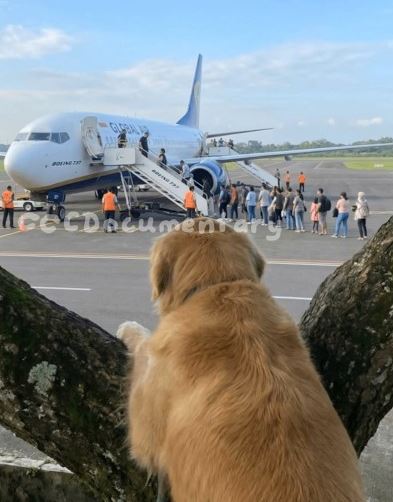
The transatlantic flight from Paris to New York was five hours into its journey. The cabin was dim, the “fasten seatbelt” sign was off, and most of the three hundred passengers were either asleep or lost in the blue glow of their personal screens.
The soft hum of the jet engines created a hypnotic lullaby that made the world outside the pressurized tube feel like a distant memory.
In seat 14B sat Marcus, a retired engineer, and at his feet lay Cooper, a highly trained three-year-old Golden Retriever. Cooper wasn’t just a pet; he was a medical alert dog, trained to detect subtle chemical changes in the human body. He had spent his life keeping Marcus safe, but today, Cooper’s nose was picking up something that had nothing to do with Marcus’s blood sugar.
It began as a faint, sharp scent—something metallic and slightly sweet. To a human nose, it might have been mistaken for a cleaning fluid or the aroma of the galley’s ovens. But to Cooper, it was a biological alarm bell.
Cooper sat up. He didn’t bark, as his training taught him that silence was a tool. He nudged Marcus’s hand with a cold, wet nose.
“Not now, Coop. I’m watching a movie,” Marcus whispered, stroking the dog’s velvet ears distractedly.
But Cooper was persistent. He didn’t lie back down. He stood up in the narrow space of the legroom and began to pace as much as his harness would allow. He let out a low, vibrating whine—a sound he only made when a situation was critical.
Marcus looked down, finally noticing the intensity in Cooper’s eyes. “What is it, boy? Are you okay?”
Cooper didn’t look at Marcus. He turned his head toward the air vents above the seats. He began to sniff the air with a frantic, rhythmic intensity. Then, breaking his years of silent training, Cooper let out a single, sharp bark that echoed through the quiet cabin.
A flight attendant named Sarah hurried down the aisle. “Sir, you need to keep your service animal quiet. We have passengers sleeping.”
“I know, I’m sorry,” Marcus said, his voice trembling. “But Cooper never barks. Never. He’s sensing something. He’s looking at the vents.”
Sarah looked up at the vents. Everything looked normal. “It’s probably just the air conditioning adjusting, sir. Please, try to calm him down.”
But Cooper wasn’t finished. He realized the humans weren’t understanding the urgency. He pulled on his leash, leading Marcus into the aisle. He walked toward the back of the plane, toward the galley where the air felt thicker, heavier. He stopped in front of a service panel near the rear lavatories and began to bark relentlessly—a loud, piercing alarm that brought the entire cabin to life.
“Something is wrong!” a passenger shouted, panic beginning to ripple through the seats.
The lead purser arrived, his face set in a professional mask that was quickly cracking. “Sir, get your dog back to your seat immediately!”
“No!” Marcus shouted back, standing his ground. “My dog is an alert animal! He’s pointing at this panel! There’s something behind it!”
At that moment, a faint wisp of white vapor began to curl out from the edges of the service panel. It wasn’t smoke, but it was cold—deadly cold. Sarah reached out to touch the panel and jumped back; the metal was covered in a thin layer of frost.
“Code Blue in the aft galley!” the purser shouted into his radio. “We have a primary coolant leak! Repeat, a coolant leak!”
The cabin air began to change. The oxygen levels were being displaced by the escaping gas. In the cockpit, the pilots received a secondary alarm, but the sensors had delayed because the leak was in a localized “blind spot” of the ventilation system. Cooper had sensed it minutes before the machines.
The crew moved with practiced efficiency. They moved the passengers from the last ten rows toward the front of the plane. They deployed portable oxygen concentrators and began the emergency protocols to seal the leaking line.
“Ladies and gentlemen, please remain calm,” the Captain’s voice crackled over the speakers. “We are experiencing a minor technical issue and will be diverting to Gander, Newfoundland for an unscheduled landing. Please follow the instructions of your flight attendants.”
The descent was steep and fast. Throughout the turbulence and the growing tension, Cooper stayed in the middle of the aisle, his body acting as a calm anchor for the frightened passengers.
He didn’t bark anymore. He sat stoically, his presence reassuring the children who were crying and the adults who were clutching their armrests. He had done his job; the humans were now aware of the invisible enemy.