The abandoned warehouse on the edge of the industrial district was a skeleton of rusted steel and rotting wood. It was a dangerous place, filled with jagged metal and the constant threat of collapse.
Deep within a pile of water-damaged shipping crates, a stray mother dog—a thin, weary Greyhound mix named Luna—had given birth to six tiny, shivering puppies.
Luna was a protective mother. She had spent weeks scavenging for scraps, her body weakened by hunger, but her spirit focused entirely on the survival of her litter. The crates were her fortress, the only world her puppies had ever known.
On a Tuesday morning, a large yellow excavator rumbled into the lot. Behind the controls was Elias, a man with calloused hands and a face that rarely showed emotion. To the people living in the nearby apartments, Elias was the “villain.” He was the contractor hired to clear the lot for a new parking complex.
As the mechanical claw of the excavator began to tear into the side of the warehouse, a crowd gathered. They saw Luna bolt out of the crates, barking frantically at the giant machine. She was terrified, circling the excavator and snapping at the air, her maternal instincts clashing with the overwhelming power of the steel.
“Stop! There are puppies in there!” a woman screamed from the sidewalk.
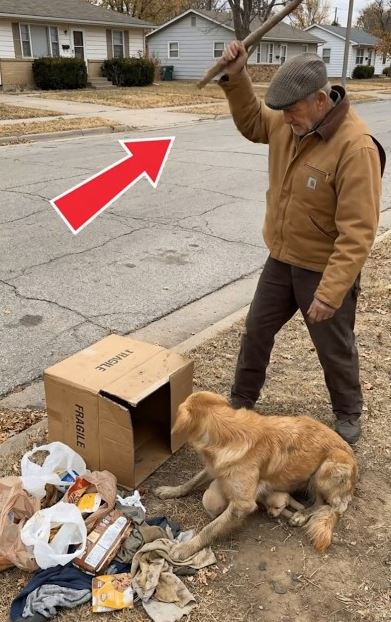
Elias didn’t stop. He ignored the shouts. He maneuvered the claw with a cold, surgical precision, slamming it into the very crates where Luna had made her nest. Wood splintered, dust filled the air, and the crowd let out a collective gasp of horror. They watched as Elias systematically “destroyed” the only home the stray family had ever known.
But then, Elias turned off the engine. The heavy silence that followed was broken only by the sound of Luna’s desperate whimpering.
Elias climbed down from the cab, carrying a heavy-duty transport crate and a thick, wool blanket. He didn’t look at the angry crowd; he walked straight toward the pile of splintered wood.
The truth was, Elias hadn’t been destroying their home out of cruelty. He had spent the previous night studying the structure of the warehouse. He knew that the roof directly above Luna’s nest was minutes away from a natural collapse due to a recent storm. If he hadn’t “destroyed” the crates in a controlled way, the entire building would have crushed the puppies within the hour.
Elias knelt in the dust. He used his hands to move the light, broken boards he had carefully loosened with the machine. Beneath the debris, protected by a secondary “shield” of steel he had positioned with the excavator claw, were all six puppies. They were dusty, but they were perfectly safe.
“Come here, Luna,” Elias whispered, his voice surprisingly gentle.
He didn’t just grab the puppies. He waited until Luna approached, sniffing his hand. He placed the puppies one by one into the warm, lined transport crate. Luna, sensing the change in energy, climbed in beside them, licking the dust off her children’s faces.
But the “destruction” was only the first half of the truth.
Elias carried the crate to his truck. He didn’t drive them to a crowded city shelter. He drove them to his own home—a farmhouse with ten acres of fenced-in land and a custom-built, heated kennel he had spent the entire weekend building.
The crowd, who had been ready to protest, watched in stunned silence as Elias loaded the dog and her puppies into his vehicle. The man they thought was a monster was actually the only person who had bothered to notice the stray family before the wrecking ball arrived.
Over the next few months, Elias transformed. He wasn’t just a construction worker anymore; he was a caretaker. Luna regained her weight, her coat becoming a sleek, shiny silver. The puppies grew into strong, healthy dogs, their paws thumping happily on the wooden floors of Elias’s porch.
Elias didn’t stop at just saving them. He used his construction skills to build a small “sanctuary” on his property, partnering with a local vet to provide a safe haven for other strays found on his job sites. He became known as the “Builder of Second Chances.”
The parking lot was eventually built on the old warehouse site, but in the corner of the lot, Elias insisted on a small, fenced-in green space with a water fountain for dogs and a plaque that read: To Luna, who taught us that sometimes you have to tear something down to build something better.