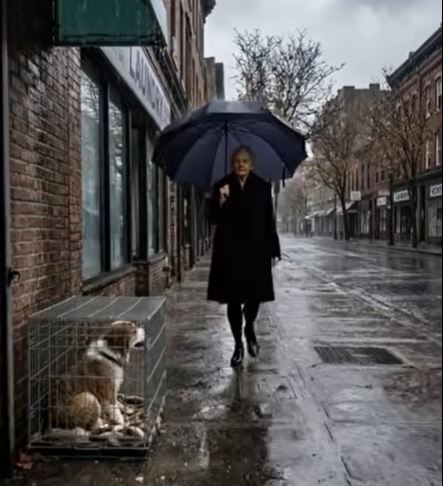
The city was a blur of slate gray and cold, relentless rain. It was one of those autumn afternoons where the wind bites through layers of wool, and the only goal for most people is to get from point A to point B as quickly as possible.
On a busy sidewalk, lined with red-brick buildings and glowing cafe signs, hundreds of feet marched in a rhythmic, hurried pace. Umbrellas collided, puddles splashed, and heads remained bowed against the drizzle.
But there, tucked against the cold brick wall of a shop, was a small, wire cage. Inside sat a dog—a mix of brown and white fur, shivering as the water dripped from the green awning above directly onto his metal enclosure.
He wasn’t barking. He wasn’t begging. He simply sat there, his eyes tracking the hundreds of strangers passing him by, his fur matted and soaked. He was the invisible occupant of a very visible street.
Young men in hoodies rushed past, eyes glued to their phones. Groups of students hurried to find dry shelter, laughing and talking, oblivious to the small heartbeat inside the cage. To the world, he was just part of the urban landscape, like a fire hydrant or a discarded newspaper.
Then, the rhythm of the street changed.
Emerging from the gray mist was an elderly woman. She dressed in a long, dark coat, her silver hair perfectly kept, carrying a large black umbrella. She wasn’t rushing. As she approached the cage, her pace slowed. Unlike the hundreds before her, she didn’t look past the cage—she looked at it.
She stopped. The flow of pedestrians swirled around her like water around a stone, some huffing in annoyance at the sudden obstruction. She didn’t care. She stepped closer to the cold metal bars.
The dog looked up, his tail giving a hesitant, weak wag. He was used to being ignored; he wasn’t used to eye contact.
The woman leaned over, her face softening into a look of pure, maternal compassion. She didn’t have a key to the cage. She didn’t have a blanket to give. But she had something else.
She adjusted her grip on her umbrella and stepped right up against the wall, positioning herself so that her large canopy completely shielded the dog from the falling rain.
She stood there, oblivious to the rain now hitting her own shoulders as she tilted the umbrella to protect the animal. She reached out a hand—thin, weathered, but steady—and gently stroked the dog’s head through the wire mesh.
It was a small act, but in that moment, the entire street seemed to fall silent. The dog stopped shivering. He leaned his head into her touch, closing his eyes. For the first time that day, he was dry. For the first time that day, he was seen.
The woman stayed there for a long time. She spoke to him in low, melodic tones that were lost to the wind but clearly understood by the dog. She became his guardian in a world that had forgotten him.
As night began to fall and the streetlights flickered to life, casting orange reflections on the wet pavement, people finally started to notice. They didn’t just see a dog in a cage anymore; they saw the woman holding the umbrella. They saw the sacrifice of her own comfort for a creature that could offer her nothing in return.
Her gesture was a silent protest against the indifference of the modern world. It was a reminder that while we cannot solve all the suffering in the world, we can always hold an umbrella for someone—or something—caught in the storm.
When she finally had to leave, she didn’t just walk away. She waited until a shopkeeper came out, alerted by the small crowd that had gathered, and made sure the cage was moved under a permanent shelter. She folded her umbrella, gave the dog one last lingering look of love, and disappeared back into the city fog.
She left behind a dog that was finally warm, and a street full of people who had just been reminded what it truly means to be human. The rain continued to fall, but the cold didn’t feel quite as sharp as it did before.