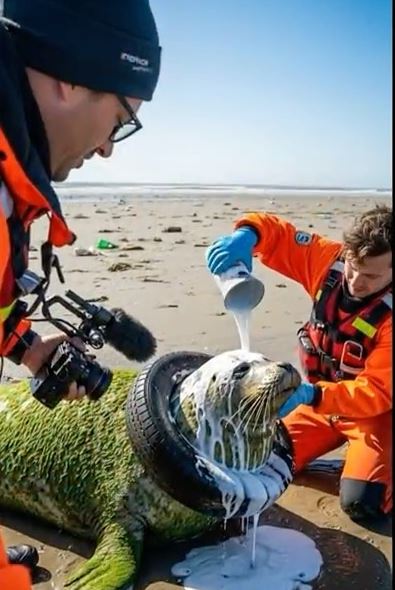
The Atlantic was restless today, tossing grey-capped waves against the jagged rocks of the North Shore. I was out for my morning run, the salt spray stinging my cheeks, when I spotted something unnatural near the high-tide line. It wasn’t driftwood or kelp. It was a massive, weathered tractor tire, half-buried in the wet sand.
As I drew closer, I saw a movement—a desperate, rhythmic heaving.
My heart sank. Wedged firmly inside the center of the heavy tire was a juvenile harbor seal. The rubber was cinched around its midsection like a cruel, black corset. The animal’s skin was raw where the tire had chafed against its blubber, and its breathing was shallow, labored. It had likely swam through the tire when it was smaller, or during a storm, and as it grew, the “toy” had turned into a tomb.
The seal looked at me, its dark, liquid eyes wide with a terrifying mix of exhaustion and mistrust. It tried to flop away, but the weight of the water-logged tire anchored it to the sand.
“Easy, girl. Easy,” I whispered, though the wind swallowed my words.
I knew I couldn’t just pull her out. The suction of the wet rubber against her fur was too strong, and I risked crushing her ribs. I reached into my running pack and pulled out my multi-tool and a small bottle of biodegradable dish soap I always carry for cleaning gear.
The tide was coming in. The first cold waves were already beginning to lap at the base of the tire. If I didn’t free her soon, the weight of the tire would trap her underwater as the tide rose.
I began by pouring the soap around the edges of her trapped body, creating a slippery barrier between the skin and the rubber. The seal let out a soft, guttural moan, a sound of pure misery that vibrated in my chest.
“I know, I know,” I muttered, my hands shaking with adrenaline.
I took the serrated blade of my tool and began to saw at the inner rim of the tire. It was grueling work. The rubber was reinforced with steel wires that bit back at the blade. Minutes felt like hours. Every time a wave hit us, the tire shifted, dragging the seal deeper into the sand.
Finally, I felt a snap. A section of the inner wire gave way. I used a piece of sturdy driftwood as a pry bar, wedging it between the rubber and the seal’s flank.
“Now or never,” I breathed.
With one hand stabilizing the seal’s head—careful to avoid her sharp teeth—and the other heaving on the driftwood, I created just enough of a gap. The soap did its job. With a sickening slurp of suction releasing, the seal slid forward.
She didn’t bolt immediately. She lay there on the sand for a few seconds, her chest expanding in a deep, unobstructed breath—the first full breath she’d taken in months. She looked back at the black ring that had almost been her end, then up at me.
There was no medal, no applause—only the sound of the crashing surf.
The seal gave a clumsy flop, then another, gaining speed as she reached the foam. She hit the water and dived, her sleek body vanishing into the iron-grey waves. Ten yards out, she surfaced, her head bobbing like a cork. She stayed there for a long moment, watching me stand on the shore with the rusted pry bar still in my hand.
I hauled the tire up beyond the storm line so it would never hunt again.
As I walked back, the $150,000 “beach restoration” signs posted by the city felt empty. They were focused on the sand, but they had missed the soul of the place. I realized that the real work of restoration isn’t done with heavy machinery or big budgets; it’s done in the quiet moments when one creature decides to help another.
I didn’t need a thank you. The sight of that silver silhouette diving deep into the Atlantic was more than enough. I had gone out for a run and ended up participating in a miracle.
The tire was just trash, but the life inside it was priceless. And as the sun finally broke through the grey clouds, the ocean didn’t seem so restless anymore—it just felt like home.