The atmosphere at the Jersey Zoo was festive, filled with the sounds of laughing children and the distant calls of exotic birds. Five-year-old Levan Merritt was perched on the stone railing, his small hands gripping the edge as he tried to get a better look at the massive primates below. But in a split second, his grip slipped.
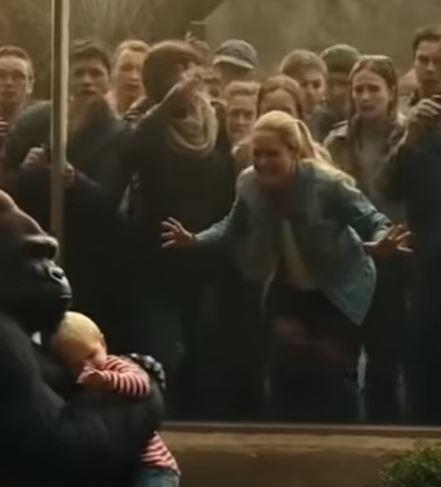
The crowd let out a collective, bone-chilling scream as Levan tumbled twenty feet down, landing with a sickening thud on the concrete floor of the gorilla enclosure. He lay there, motionless, a small blue figure against the grey stone.
Silence fell over the onlookers. The panic was paralyzed by a sudden, terrifying sight: Jambo, a 450-pound silverback gorilla, was walking toward the boy.
Jambo was the undisputed leader of the troop—a mountain of muscle and dark fur. To the people above, he looked like a predator closing in on its prey. Parents turned their children away, and Levan’s mother collapsed into the arms of a stranger, her heart breaking in real-time.
But Jambo didn’t charge. He didn’t roar. He approached with a slow, deliberate pace that felt hauntingly human.
When he reached the boy, Jambo did something that defied every “beast” stereotype. He sat down. He positioned his massive frame between Levan and the other younger, more impulsive gorillas who were beginning to circle with curiosity. Jambo was creating a perimeter. He was acting as a living shield.
The silverback reached out a hand that could easily crush a bowling ball. With a gentleness that brought tears to the eyes of the keepers above, he began to stroke Levan’s back. He wasn’t aggressive; he was comforting. It was a primal display of empathy—a fatherly instinct that crossed the boundary of species.
When Levan regained consciousness and began to cry, the sudden sound startled the troop. One of the younger gorillas lunged forward, but Jambo let out a sharp, authoritative bark, physically pushing the other gorilla back. He was communicating a clear message: This one is under my protection.
As the paramedics lowered a ladder into the pit, Jambo didn’t challenge them. He looked at the boy one last time, turned his massive back, and led his entire troop into the indoor pen, clearing the way for the humans to finish what he had started.
The “beast” had been the only one in the enclosure with enough composure to save a life.
The story of Jambo changed the world’s perception of gorillas forever. It proved that behind the strength and the silence, there is a complex emotional architecture. The $150,000 “security infrastructure” the zoo built after the incident was necessary, but it couldn’t replicate the grace Jambo had shown for free.
Levan survived, and years later, he returned to the zoo as an adult. He stood at that same railing, but he didn’t feel fear. He felt a deep, unspoken debt to the giant who had watched over him when he was at his most vulnerable.
Jambo passed away years ago, but a bronze statue of him now stands at the zoo—a permanent reminder that humanity isn’t a trait exclusive to humans. Sometimes, the greatest display of “humanity” comes from a 450-pound silverback who decided that a fallen child was worth defending.
In the archives of the Jersey Zoo, the records show a successful rescue. But in the hearts of those who stood there that day, it was a resurrection of hope. Jambo proved that even in the wild, there is a code of honor.
He wasn’t just a gorilla; he was the Silverback’s Shield, the guardian who reminded us that we are all connected by the same thin thread of life.
The world learned that day that you don’t need a voice to speak the truth, and you don’t need a uniform to be a hero. You just need the heart to stand still when everything else is falling apart. Jambo’s legacy lives on in every person who looks past the surface and sees the soul within—a soul that, for a few tense minutes in a sunlit pit, was the bravest thing on earth.