The Arctic wind didn’t just blow; it screamed. I was stationed at Research Outpost 4, a cluster of metal containers bolted to the permafrost. The temperature had plummeted to -40°C, and the visibility was zero. I was checking the perimeter sensors when a strange heat signature flickered on my handheld thermal scanner.
It wasn’t a caribou. It was a cluster of small, vibrating pulses buried deep under a collapsed snowdrift near the old supply hangar.
“Outpost 4 to Command,” I crackled into my radio. “I’ve got biological signatures trapped under the Sector 7 drift. It looks like a den collapse.”
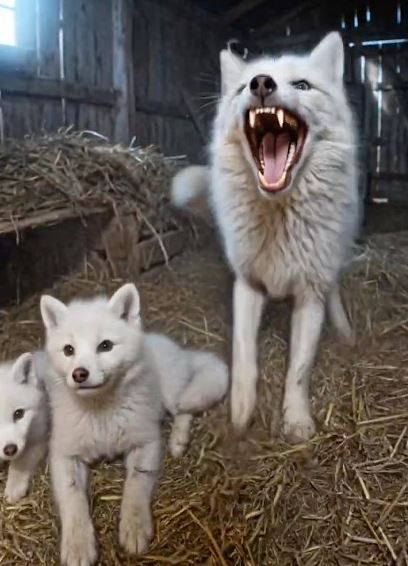
I grabbed my heavy-duty shovel and a heated transport crate. As I fought my way through the wall of white, I saw her—the mother snow fox. Her fur was a pristine, ghostly white, blending perfectly with the drifts, but her eyes were wide with a frantic, primal desperation. She was digging with her front paws until they bled, trying to reach her kits buried under three feet of packed, frozen slab.
The weight of the snow from the hangar roof had created a vacuum seal. If I didn’t get them out in the next ten minutes, they would suffocate or freeze as the internal temperature of the den dropped.
“Easy, mama,” I grunted, thrusting the shovel into the ice.
The mother fox didn’t run. She didn’t bite. She stepped back just enough to let me work, her tail tucked low, watching my every move with an intelligence that felt unsettlingly human.
The snow was like concrete. Every breath I took felt like needles in my lungs. After five minutes of back-breaking labor, my shovel struck something soft. I dropped to my knees and began digging with my gloved hands.
One by one, I pulled them out—six tiny, shivering balls of white fluff. They were barely breathing, their heartbeats faint rhythmic thumps against my palms. I tucked them into the heated crate, the warmth of the internal coils slowly bringing the color back to their small ears.
But the mother was still agitated. She began to yelp, a sharp, piercing sound that cut through the gale. She ran toward a second pile of debris ten yards away.
“There’s more?” I gasped, my muscles screaming in protest.
I followed her. Beneath a twisted piece of sheet metal from the hangar, the father fox was pinned. His leg was caught in the wreckage, and he was shielding a seventh kit—the smallest of the litter—with his own body. He was losing heat fast, his fur matted with ice.
Using a hydraulic jack from my kit, I pried the metal off his leg. He let out a low whimper but didn’t struggle. I gathered the last kit and helped the father limp toward the heated shelter of the outpost’s crawlspace.
For the next three hours, I sat in the sub-flooring of the research station, monitoring the family. I provided bowls of high-protein mash and fresh water. The mother fox approached me, not for food, but to nudge my hand with her cold nose—a silent “thank you” from the heart of the frost.
The $750 million infrastructure of the research project was designed to study climate change, but that night, its only purpose was to serve as a sanctuary for eight lives that the world would never have missed.
By dawn, the storm had passed. The tundra was a sea of calm, sparkling diamonds. I opened the hatch, and the snow fox family emerged. The father’s limp was gone, and the kits were tumbling over each other in the fresh powder. They stopped at the edge of the horizon, the mother looking back one last time before they vanished like spirits into the white expanse.
I realized that the Arctic isn’t just a place of ice and statistics; it’s a place of families, of battles fought in silence, and of miracles buried under the drift. I walked back to my station, the “overwhelmed” feeling of the storm replaced by a profound peace.
I hadn’t just saved a family; I had been part of one for a night. And as the sun hit the ice, I knew that the “Guardians of the Frost” were still out there, running free in a world that was a little less cold because of a shovel and a bit of heat.