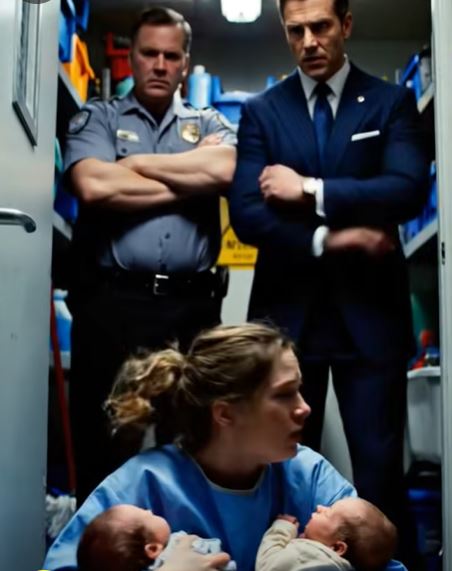
The fluorescent lights of the executive suite hummed with an artificial, cold energy. To the world outside, this office was a temple of progress, the headquarters of a firm managing a $750 million national grid project. But in the small, unventilated alcove behind the mainframe, it was a nursery of shadows.

Maria’s face was a map of exhaustion. Her eyes, usually lowered in polite greeting during the day, were now wide with a primal, maternal terror.
“They took my apartment, Mr. Elias,” she whispered, her voice cracking as she glanced at the three sleeping infants. “The landlord… he raised the rent by four hundred dollars in one month. I had no savings. No family left. I didn’t know where else was safe. The office has heat. It has light. I thought… I thought if I was quiet enough, no one would notice.”
I looked at the management official, a man named Julian, who was already reaching for his phone to call security. “They are trespassing, Elias! This is a liability. If one of those kids gets hurt near the high-voltage lines, the company is finished. Get them out now!”
I stepped between Julian and Maria. I felt a surge of something I hadn’t felt in years of corporate climbing—a raw, unfiltered sense of justice.
“Put the phone down, Julian,” I said, my voice low and dangerous.
“Are you crazy? She’s living in a server room!”
“She’s surviving in a server room,” I corrected him. “And you’re about to call the police on a woman who has cleaned your coffee spills for five years without a single complaint.”
I turned back to Maria. I realized that while I had been obsessing over a $150,000 bonus, this woman had been timing her shifts to ensure her children wouldn’t cry when the night guards walked by. She had turned our discarded corporate surplus—old blankets from the promotional events, cardboard boxes from the new monitors—into a makeshift home.
“Maria,” I said gently, kneeling beside the cardboard “cribs.” “Why didn’t you tell us?”
“People don’t see me, sir,” she said, a single tear tracing a path through the dust on her cheek. “I am the ghost who empties the trash. If I told you I was homeless, you wouldn’t give me a raise. You would give me a termination notice because I was ‘unstable.'”
The truth of her words hit me like a physical blow. Our corporate culture was built on efficiency, not empathy. We had built an infrastructure for electricity, but we had failed to build one for humanity.
“Julian,” I said, turning to the manager. “If you call the police, I will personally testify that I gave her permission to stay here. And then, I will call the press and tell them exactly how this ‘award-winning’ firm treats its most loyal staff.”
Julian froze. The threat of a PR disaster was the only language he understood. He lowered his phone, grumbled something about “company policy,” and walked away into the darkness of the hall.
That night, I didn’t leave. I sat on the floor with Maria. I learned that the babies were only four months old. Their father had been a construction worker who died in a structural collapse on a site across town—a site our firm had audited. The irony was a bitter pill to swallow.
The “desperate situation” revealed a deeper story of a system that rewards the high-rise but forgets the foundation.
I didn’t just “not call the police.” I acted.
Over the next week, I used my influence within the board to establish the “Foundation Fund.” We took a small fraction of the $750 million project budget—a rounding error in the eyes of the accountants—and redirected it toward a subsidized housing initiative for the support staff of our buildings.
Maria didn’t just get a place to stay. She became the supervisor of the new program. She moved into a safe, warm apartment just twelve miles from the office, but a world away from the server room.
As for the babies, they grew up knowing that their mother was a warrior who had fought a silent war in the heart of a steel jungle.
The moment Julian shouted “Get them out,” he expected me to see a nuisance. Instead, I saw a mirror. I saw the fragility of our own success. We are all just one storm, one tragedy, or one rent hike away from needing a sanctuary.
Maria isn’t a “cleaning lady” to me anymore. She is the woman who saved the soul of this company. Every time I walk past that server room now, I don’t see a ghost. I see a space that was once filled with the bravest kind of love—the kind that refuses to be silenced by the cold hum of a machine.