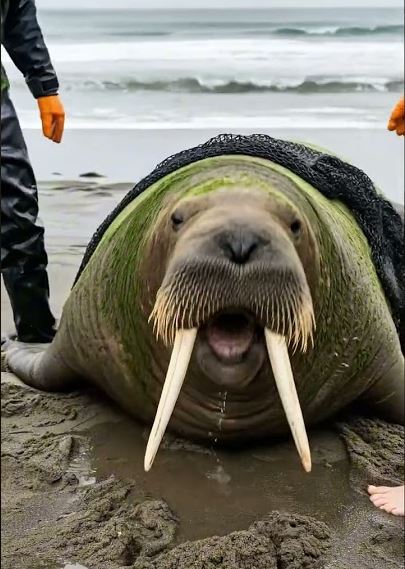
The wind howled across the frozen shoreline, carrying with it the sharp scent of salt and ice. The sky was a pale gray, stretching endlessly above the Arctic waters, and the sea itself churned slowly beneath drifting sheets of ice.
From a distance, everything seemed calm—quiet, even—but as you moved closer, the stillness broke. There, near the edge of a cracked ice shelf, something massive struggled against the cold reality of its situation.
At first, it was hard to understand what you were seeing. A large shape moved awkwardly, shifting its weight again and again, as if trying to escape an invisible trap. Then it became clear. It was a walrus—huge, powerful, and normally unstoppable in its environment. But today, it wasn’t gliding through water or resting peacefully among its herd. It was stuck. Around its thick neck and upper body was a worn-out rubber tire, likely discarded years ago and carried by ocean currents until it found its way here.
The walrus groaned softly, its deep, resonant calls echoing over the icy landscape. It tried to move forward, but the tire tightened with every attempt. Its skin was already chafed and raw in places where the rubber had dug in. Each movement seemed painful, yet it didn’t stop trying. Survival was instinct, and the animal refused to give up—even as exhaustion began to show in its slow, labored motions.
You weren’t supposed to be here. The mission had been simple: document wildlife activity along this remote stretch of coastline. But nothing about this moment felt routine. As you raised your camera, your hands hesitated. This wasn’t just something to observe. This was suffering—real, immediate, and preventable. The tire, an object so ordinary to humans, had become a life-threatening trap in a place where it never should have existed.
The walrus noticed you then. Its small, dark eyes locked onto your figure, and for a moment, everything froze. There was no aggression in its gaze, only confusion—and maybe a hint of desperation. It didn’t understand what you were or why you were there, but it seemed to sense that you were different from the silent, indifferent world around it.
You took a careful step forward, then another. The ice cracked faintly beneath your boots, reminding you how fragile your position was—not just physically, but ethically. Intervening in wildlife situations is never simple. There are rules, risks, and consequences. But looking at the walrus, those considerations felt distant, almost irrelevant. It was suffering because of something humans had left behind. Walking away didn’t feel like an option.
You called for help over the radio, your voice steady but urgent. Coordinates, situation, immediate need for assistance. The response came quickly, but help would take time. And time was something the walrus didn’t have much of.
As you waited, you kept your distance, watching carefully. The walrus tried again to move, dragging its enormous body across the ice. The tire shifted slightly, digging deeper into its flesh. A low, pained sound escaped it, and you felt a tightening in your chest. This wasn’t just about survival anymore. This was about endurance—about how long it could withstand the pain before it became too much.
Minutes felt like hours. The wind grew stronger, whipping snow across the ground in thin, swirling patterns. You could barely feel your fingers anymore, but you didn’t move. The walrus lay still now, its breathing heavy, sides rising and falling with visible effort. It wasn’t giving up—but it was running out of strength.
Finally, in the distance, you heard it—the faint hum of an approaching vehicle. Relief washed over you, sharp and immediate. A small rescue team arrived, moving quickly but cautiously. They assessed the situation with trained eyes, speaking in low, focused tones. There was no panic—only determination.
Approaching a walrus is dangerous under normal circumstances. A stressed, injured one is even more unpredictable. But this time, something was different. As the team slowly moved closer, the walrus didn’t lash out. It didn’t try to escape. It simply watched, too tired to resist, yet somehow aware that this might be its only chance.
Using long tools and careful coordination, the team worked to secure the animal just enough to attempt the removal. Every second mattered. The tire was thick and stubborn, resistant to quick cutting.
One member worked steadily with specialized equipment, slicing through the hardened rubber while others kept watch, ready to react if the walrus suddenly moved.
The tension was unbearable. One wrong move could injure the animal—or the rescuers. But slowly, bit by bit, the tire began to give. A small tear appeared, then widened. The walrus shifted slightly, letting out a deep, almost guttural sound—not of pain this time, but something closer to relief.