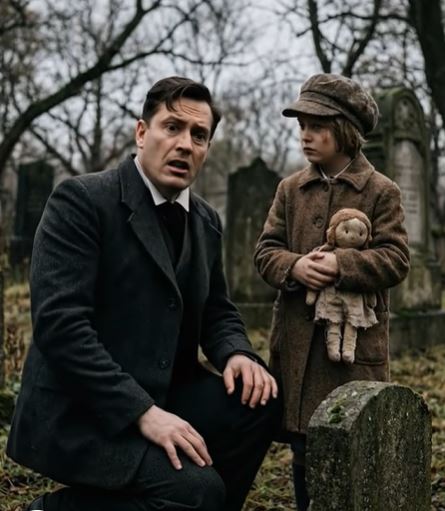
The cemetery was always quiet in the early hours of the morning. A thin layer of mist hovered just above the ground, and the sound of distant birds barely disturbed the stillness. For most people, it was a place visited only on special occasions—moments of grief, remembrance, or closure. But for Daniel Hayes, it had become a daily ritual.
Every morning at the same time, he walked slowly down the narrow stone path, dressed in a dark coat, carrying a small bouquet of fresh white flowers. His steps were steady, but heavy, as if each one carried the weight of years he hadn’t been able to let go of.
At the far end of the cemetery, side by side beneath an old oak tree, were two small graves.
Emily Hayes.
Sophia Hayes.
His daughters.
He knelt down in front of them, as he always did, placing the flowers carefully against the cold stone. His fingers lingered there for a moment, tracing the engraved names as if trying to feel something beyond the surface.
“I’m here,” he whispered, his voice barely audible.
Years had passed, but the pain hadn’t softened the way people said it would. It hadn’t faded or dulled. It had simply become part of him—quiet, constant, and impossible to ignore. He had built a successful life on the outside, but inside, something had remained broken.
“I should’ve protected you,” he murmured, his eyes fixed on the ground. “I should’ve done more…”
The wind shifted slightly, rustling the leaves above him. He closed his eyes, letting the silence settle around him like it always did.
But that morning… something was different.
At first, it was just a faint sound. Soft footsteps against the gravel path. Daniel didn’t turn. Visitors came and went all the time. It wasn’t unusual.
But then—
“Why do you cry here every day?”
The voice was small. Gentle.
Daniel froze.
Slowly, he turned his head.
A young boy stood a few feet away, no older than seven or eight. His clothes were worn, his shoes dusty, and his hair slightly unkempt. He looked like he had been walking for a long time. But his eyes… his eyes were calm, curious—not afraid.
Daniel frowned slightly.
“This isn’t a place for children,” he said quietly. “You should go.”
The boy didn’t move.
“Are they your daughters?” he asked, glancing at the graves.
Daniel’s expression tightened. “Yes.”
The boy stepped a little closer, looking at the names. He didn’t seem uncomfortable, the way most people were around grief. Instead, he studied the stones as if trying to understand something.
“They’re not here,” the boy said softly.
Daniel’s breath caught for a second, then he let out a short, tired sigh.
“People say things like that,” he replied. “It doesn’t change anything.”
The boy shook his head.
“No… I mean it. They’re not here.”
Daniel stood up slowly now, a hint of frustration creeping into his voice. “Listen, kid, you don’t understand—”
“I do,” the boy interrupted gently.
That made Daniel pause.
The boy reached into his pocket, his small hands moving carefully, as if whatever he held was important. Then he pulled out something worn—a folded piece of paper.
“I found this,” he said.
Daniel hesitated before taking it. The paper was old, creased from being opened and closed many times. Slowly, he unfolded it.
His hands began to tremble.
It was a drawing.
Two little girls, holding hands, standing under a large tree. Above them, a simple sun drawn in the corner. And beside them… a man.
Him.
Daniel stared at it, his heart pounding.
“This…” he whispered. “This is my daughters’ drawing…”
He looked up sharply. “Where did you get this?”
The boy pointed toward the far edge of the cemetery, beyond the old fence where fewer people ever went.
“They gave it to me,” he said.
Daniel’s chest tightened. “That’s not possible.”
“They were there,” the boy insisted. “A long time ago. They weren’t scared. They said you come here every day… and that you’re always sad.”
Daniel felt his throat go dry.
“What are you talking about?” he asked, his voice unsteady now.
The boy’s expression didn’t change.
“They said you think they’re here,” he continued, nodding toward the graves. “But they’re not.”
Silence fell between them.
Daniel looked back at the drawing, his mind racing. It was unmistakable. The way the girls were drawn—the small details, the tiny initials in the corner—they were things only his daughters would have done.
“How…?” he whispered.
The boy sat down on the grass, as if the conversation wasn’t strange to him at all.