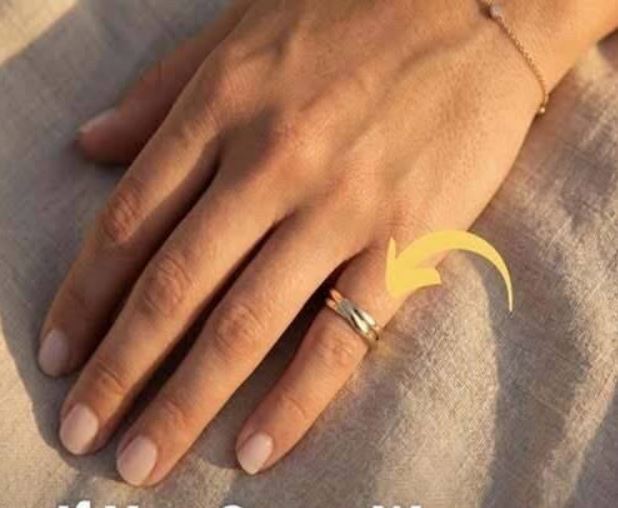
For centuries, rings have carried deep symbolic meaning. They have been used to represent commitment, status, identity, and belonging. Most often, they have been associated with romantic relationships — a visible sign of partnership and long-term promises. Over time, specific fingers became tied to specific meanings, shaping how society interprets even the smallest details of personal style.

Against this long tradition, a quiet shift has been taking place.
More women today are choosing to wear rings on their pinky finger — a place that historically carried little fixed meaning. This subtle change is not just about fashion. For many, it represents a move away from expectations and toward personal definition.
Unlike other fingers that are often linked to engagement or marriage, the pinky finger offers freedom. It allows space for meaning that is self-created rather than socially assigned. In this sense, the pinky ring becomes less about signaling something to others and more about expressing something inward.
For some women, wearing a pinky ring marks a personal milestone. It might represent growth after a difficult period, a career achievement, a fresh start, or a commitment to self-respect and emotional well-being. These are moments that don’t always receive public recognition, yet they hold deep personal value.
Psychologically, symbols can play an important role in how we see ourselves. A ring worn with intention can act as a quiet reminder — a commitment not to another person, but to one’s own values, boundaries, and direction in life. This kind of self-commitment reflects a broader understanding of confidence, one that comes from within rather than from external validation.
There is also a historical layer to consider. In the past, pinky rings were often associated with power, status, or rebellion, and were more commonly worn by men. Today, many women are reshaping that meaning. Instead of representing authority over others, the pinky ring can symbolize personal independence and ownership of one’s identity.
Style plays a role as well. Some choose minimalist designs that blend naturally into everyday wear, while others prefer bold or engraved pieces that carry a more defined personal message. The variety reflects the core idea behind the trend: there is no single meaning, only the one each individual chooses to give it.
Social media has helped bring visibility to this shift, but its meaning often remains private. Many women wear pinky rings without explanation, not as a statement for others, but as something meaningful for themselves. This quiet approach highlights an important idea — not everything valuable needs to be publicly defined.
In a broader sense, the growing popularity of pinky rings reflects a cultural shift. It suggests a move toward valuing personal growth, emotional independence, and self-awareness alongside — or even above — traditional markers of success and identity.
Ultimately, the pinky ring is small in size but significant in meaning. It shows how even the simplest form of self-expression can carry depth, intention, and individuality.
And perhaps most importantly, it reminds us that identity is not something fixed by tradition — it is something we continue to define for ourselves over time.