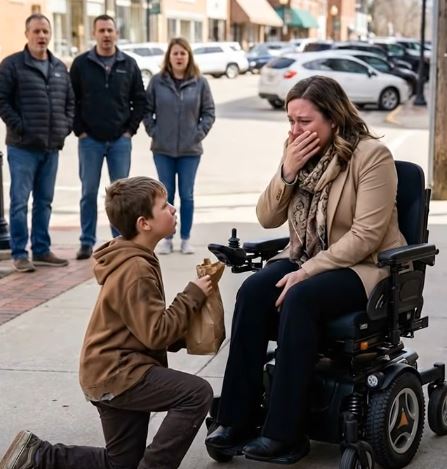
The penthouse on the 42nd floor of the Meridian Tower overlooked the glittering skyline of Singapore, but for Victoria Langford, the view had become nothing more than a cruel reminder of everything she could no longer reach.

At forty-seven, the self-made millionaire and founder of Langford Tech had once commanded boardrooms with a single raised eyebrow. Now she sat motionless in a custom motorized wheelchair, her body paralyzed from the waist down after a devastating spinal injury in a helicopter crash two years earlier. The best neurosurgeons in the world had given up. Experimental treatments in Switzerland and stem-cell trials in the United States had all failed. Victoria had accepted her fate with cold resignation. She worked from home, managed her empire through video calls, and rarely left the penthouse except for medical appointments.
Her days blurred into one another. Nurses came and went. Expensive meals were prepared and often left half-eaten because nothing tasted right anymore. The loneliness was heavier than the paralysis itself.
One humid Thursday evening, Victoria was sitting on the private terrace overlooking the city lights, picking at a plate of untouched grilled salmon and asparagus. Her longtime housekeeper, Mrs. Tan, had left for the night. The terrace doors were open to let in the breeze, and the security guard at the private elevator had stepped away for a moment.
That was when the boy appeared.
He couldn’t have been more than twelve years old. Thin, barefoot, dressed in a faded oversized T-shirt and shorts that had seen too many washes. His dark hair was messy, and his face carried the wary expression of someone who had learned early that the world was not kind. In his hands he clutched a small, crumpled plastic bag. He had somehow slipped past security — probably through the service entrance or by following a delivery person.
The boy stopped a respectful distance away and stared at the plate of food on the table beside Victoria’s wheelchair.
Victoria tensed. “How did you get in here? Security!”
The boy didn’t run. Instead, he looked directly at her with calm, intelligent eyes and spoke in soft but clear English. “I’m sorry for coming inside without permission, Ma’am. I saw the leftover food from the kitchen window downstairs. I haven’t eaten since yesterday. But I don’t want to steal it.”
He took a small step closer. “I can cure you… in exchange for that plate of food.”
Victoria stared at him for a long moment, then let out a bitter, exhausted laugh. “Cure me? Little boy, the finest doctors on three continents couldn’t cure me. What makes you think you can?”
The boy didn’t smile or flinch. “My grandmother taught me things before she died. Old ways. Things doctors don’t know. I helped my uncle walk again after his motorcycle accident when the hospital said he never would. I can try with you. If it doesn’t work, you can call security and I’ll go to jail. But if it does work… I just want the food. And maybe… a place to sleep tonight.”
Something in the boy’s steady gaze made Victoria pause. Most people looked at her with pity or awkward professionalism. This child looked at her with quiet confidence — the kind that came from having nothing left to lose.
She studied him carefully. His hands were calloused but clean. His eyes were clear, without the haze of drugs or desperation she had seen in other street children. Against her better judgment, and perhaps because the loneliness had grown unbearable, she nodded once.
“Sit down. Eat first. Then we’ll see about this miracle of yours.”
The boy’s name was Kai. He ate the salmon and asparagus slowly, savoring every bite as if it were the finest meal he had ever tasted. When he finished, he carefully wiped his hands on his shorts and asked Victoria to lie down on the wide outdoor daybed. She hesitated, but something — curiosity, exhaustion, or the faint spark of hope she thought had died — made her agree.
Kai knelt beside her. He didn’t use any machines or fancy equipment. Instead, he placed his small hands gently on her lower back and began to apply precise pressure along her spine, humming a soft, rhythmic melody his grandmother had taught him.
He spoke quietly as he worked, explaining what he was doing in simple words: releasing blocked energy, waking up nerves that had fallen asleep, encouraging blood flow where it had stopped.
Victoria felt nothing at first except the warmth of his small hands. She closed her eyes, half-expecting nothing to happen.
Then a strange tingling began in her toes.