The narrow mountain road between Pec and Istok wound through thick pine forests, its edges dropping sharply into rocky ravines. It was a cold November evening, the kind where dusk falls fast and headlights cut through swirling mist.
Fatmir Berisha, a forty-one-year-old truck driver returning home after a long haul from Pristina, gripped the steering wheel of his old blue pickup. The heater rattled weakly, and his thermos of strong Turkish coffee had gone cold hours ago. He was tired, thinking only of his wife and two young sons waiting with warm bread and soup.
Then his headlights caught movement.
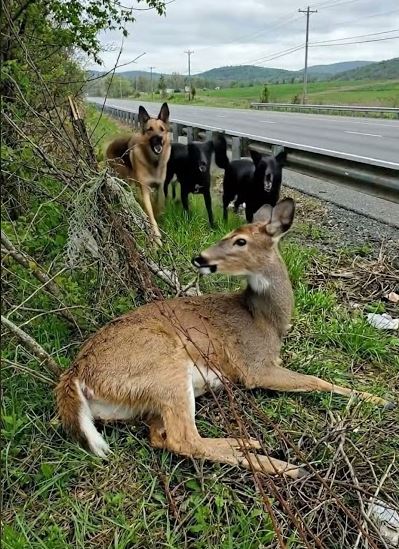
A young doe stood frozen on the shoulder of the road, her slender legs trembling. One front leg was awkwardly twisted, and she kept trying to step forward only to collapse onto her side.
Blood matted the fur on her shoulder—fresh, bright against her gray-brown coat. Nearby, half-hidden in the underbrush, a tiny fawn no older than a few weeks old cried out in high, panicked bleats.
The mother tried desperately to reach her baby, but every attempt sent her crashing down again. She had clearly been hit—perhaps by a speeding car that hadn’t stopped—and now both animals were exposed to the freezing night.
Fatmir’s first instinct was to slow down and drive past. Wild animals on these roads were common, and stopping could mean trouble. But as he drew closer, the fawn’s desperate cries pierced something deep inside him. The little one kept nudging its mother, trying to help her stand, its tiny white-spotted body shaking with cold and fear.
He couldn’t drive on.
Fatmir pulled his truck onto the narrow shoulder, hazard lights flashing orange into the gathering dark. He left the engine running and stepped out into the biting wind, his heavy work jacket zipped tight. The doe panicked at first, thrashing weakly and trying to drag herself away, eyes wide with terror. The fawn pressed closer to her side, bleating louder.
“Easy, easy,” Fatmir murmured in a low, soothing voice, the same tone he used with his own frightened children. He approached slowly, hands visible, moving in a wide arc so he wouldn’t corner them. From the bed of his truck he grabbed an old blanket, a length of soft rope, and the small first-aid kit he always carried for long drives.
The mother deer’s breathing was labored, her injured leg clearly broken or badly sprained. Fatmir could see deep lacerations from where she had probably tumbled down the embankment after the impact. He spread the blanket on the ground a safe distance away and sat down, making himself smaller. For several long minutes he simply talked to them—soft Albanian words mixed with gentle shushing sounds—letting the animals grow used to his presence.
The fawn was the first to respond. Hunger and cold overcame its fear. It took a few wobbly steps toward Fatmir, nose twitching at the scent of the man. When the little one reached him, it nudged his hand with its wet nose.
Fatmir’s heart clenched. He carefully lifted the fawn onto the blanket, wrapping it loosely to warm its shivering body. The mother watched every movement, her sides heaving.
“I’m not going to hurt you,” Fatmir whispered. “Your baby needs you. Let me help.”
Working slowly and carefully, he used the rope to fashion a makeshift sling. He managed to slide it under the doe’s body without causing more pain, then gently rolled her onto the blanket. She let out a sharp cry once, but then lay still, exhausted and perhaps sensing the man’s kindness.
Fatmir dragged the blanket—mother and fawn together—across the road and into the back of his pickup, creating a soft nest with more blankets and an old tarp to block the wind.
He called the local forestry service and a veterinarian he knew in Pec, describing the location as best he could. Signal was weak, but the vet promised to meet him at a nearby ranger station. Then Fatmir climbed into the driver’s seat and drove as carefully as he had ever driven in his life—never faster than twenty kilometers per hour, avoiding every bump and pothole on the mountain road.
At the ranger station, the veterinarian and two forest rangers were waiting with proper equipment. They examined the doe under bright lights. Her leg was fractured but not shattered.
The wounds were cleanable. With pain relief and a temporary splint, she had a strong chance. The fawn was dehydrated and cold but otherwise healthy—miraculously unharmed.
While the professionals worked, Fatmir stayed close, stroking the fawn’s head when it cried for its mother. “You’re both going to be okay,” he told them quietly.