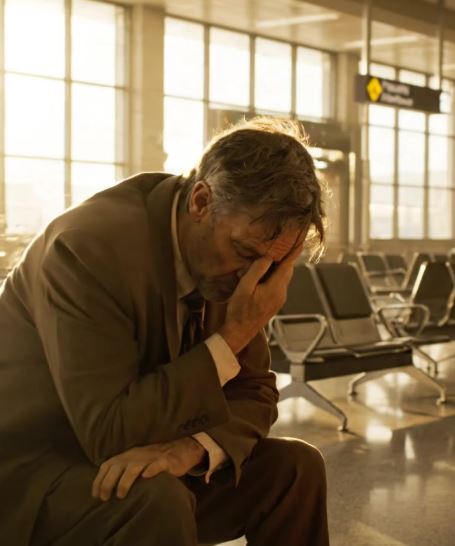
The Greyhound bus terminal in downtown Chicago smelled of stale coffee, diesel fumes, and the faint metallic tang of desperation.

Fluorescent lights buzzed overhead, casting harsh shadows across rows of hard plastic seats filled with weary travelers clutching tickets and worn suitcases. It was a Thursday evening in late October, and the terminal was crowded with people heading home, running away, or simply trying to get somewhere else.
Victor Langford, sixty-two years old and one of the wealthiest men in the Midwest, sat on a bench near Gate 7 with his head in his hands. His custom-tailored charcoal suit was rumpled, the silk tie loosened at his throat.
His silver hair, usually perfectly styled, fell across his forehead in disarray. In his lap lay a first-class ticket to New York that he had no intention of using. His private jet was waiting at Midway, but for the first time in forty years, Victor had walked away from it. He had told his driver to leave him at the bus station instead.
Tears streamed silently down his face.
He had just come from the reading of his only daughter’s will. At twenty-nine, Amelia had died in a sailing accident three weeks earlier. The daughter he had barely known—pushed away by his relentless pursuit of empire—had left him everything. The companies, the estates, the offshore accounts. But in a handwritten letter attached to the will, she had written words that had shattered him:
“You built an empire, Dad, but you never built a father. I hope one day you learn that money can buy a lot of things, but it can’t buy back the years you missed. If you’re reading this, please stop running. Find someone who needs you more than your next deal. Be the man I always wished you were.”
Victor had read the letter three times in the lawyer’s office, then walked out without a word. Now, in the middle of a crowded bus terminal, the weight of forty years of absence crashed down on him. He was worth nine hundred million dollars, and he had never felt poorer.
People walked past him, some glancing curiously at the well-dressed man openly weeping, others averting their eyes. A security guard hovered nearby but didn’t approach. No one offered comfort. In a city of millions, Victor Langford was completely alone.
Then a small pair of scuffed sneakers stopped in front of him.
A boy, no older than nine or ten, stood there holding a half-eaten granola bar. He had messy brown hair, a faded Spider-Man backpack, and eyes that were far too serious for his age. His jacket was too thin for the October chill, and his jeans had a hole in one knee.
“Mister,” the boy said quietly, “are you okay?”
Victor looked up, surprised. He wiped his face roughly with the back of his hand. “I’m… fine, son. You should go find your parents.”
The boy didn’t move. “My mom’s over there buying tickets. She said I could give you this if you looked sad.” He held out the granola bar. “It’s chocolate chip. My favorite.”
Victor stared at the offering. A cheap granola bar from a child who clearly didn’t have much. Something in his chest cracked open wider.
“I don’t deserve that,” he whispered.
The boy tilted his head. “Everyone deserves a granola bar when they’re crying. That’s what my mom says.”
Before Victor could respond, the boy did something remarkable.
He climbed onto the bench beside the millionaire, set his backpack down, and gently placed the granola bar in Victor’s lap. Then he reached into his own pocket and pulled out a small, slightly crumpled piece of paper.
It was a child’s drawing: stick figures of a boy and a man holding hands under a crooked sun. At the bottom, in careful crayon letters, it read: “For when you feel alone.”
“My dad left when I was little,” the boy said simply. “Sometimes I sit in the bus station too and feel sad. My mom says drawing helps. So I drew this for you. You can keep it.”
Victor took the drawing with trembling fingers. The simple lines blurred through fresh tears. In that moment, surrounded by strangers rushing to catch buses, something shifted inside the man who had spent decades acquiring everything money could buy.
He looked at the boy—really looked. The worn shoes. The too-thin jacket. The kind, steady eyes that had seen hardship but still chose to offer comfort to a stranger.
“What’s your name, son?” Victor asked, his voice hoarse.
“Lucas. Lucas Ramirez.”
Victor reached into his suit jacket and pulled out his wallet. Not to give money—that felt wrong now—but to find a business card. He handed it to Lucas.