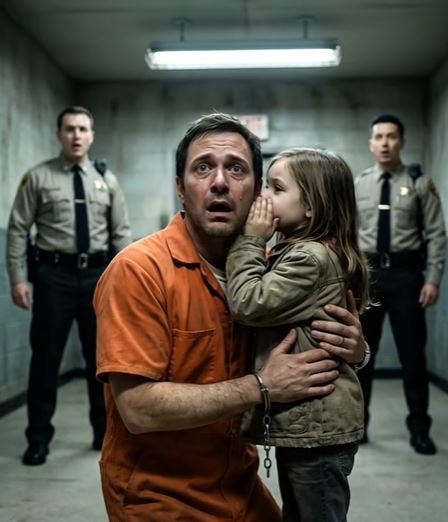
The execution chamber at the state penitentiary was colder than it had any right to be. The concrete walls seemed to absorb every sound, every breath, every heartbeat.

Fluorescent lights buzzed overhead like dying insects, casting a harsh, clinical glow on the gurney where Marcus Hale lay strapped down. At thirty-seven, he looked older—gaunt, hollow-eyed, the weight of twelve years on death row carved into every line of his face.
The lethal injection drugs were already prepared. The witnesses sat behind the glass partition: a few journalists, the victim’s family, and a handful of officials. The warden stood ready to give the final order.
Marcus had made peace with his fate, or at least he told himself he had. He had been convicted of murdering a police officer during a botched robbery when he was twenty-five. The evidence had been overwhelming. He had stopped fighting the system years ago. All that remained was the final walk, the final words, and the final needle.
Then the door to the witness area opened one last time.
His eight-year-old daughter, Lily, walked in holding her grandmother’s hand. She wore a simple yellow dress, her dark hair in two neat braids, her small face pale but determined. The warden had made a rare exception, allowing the child to say goodbye. Marcus had begged them not to bring her, but Lily had insisted. She wanted to see her father one last time.
The guards hesitated, but the warden nodded. Lily was escorted to the glass. Marcus turned his head as much as the straps allowed, his eyes filling with tears at the sight of her.
“Lily… baby, you shouldn’t be here,” he whispered, his voice hoarse from disuse.
She pressed her small hands against the glass, leaning as close as she could. Her voice was soft, almost a whisper, but in the heavy silence of the chamber it carried clearly through the intercom.
“Daddy… the man who really shot the policeman was wearing a red hat. I saw him. He was hiding behind the blue car. I told the police lady, but she said I was too little to understand. I drew a picture. It’s in my backpack. Please don’t die, Daddy. The real bad guy is still out there.”
The room froze.
The guards exchanged uneasy glances. The warden’s hand hovered over the intercom button. The victim’s family shifted uncomfortably. One of the journalists leaned forward, suddenly alert.
Marcus stared at his daughter, his heart hammering against the straps. “Lily… what are you saying?”
“I saw him, Daddy,” she repeated, her voice trembling but clear. “He had a red hat and a black jacket. He ran away after the gun went off. I was hiding behind the trash can like you told me to.
I tried to tell the police, but they said I was making it up because I was scared. But I wasn’t making it up. I drew the picture with the red hat and everything. Please don’t let them kill you.”
The silence that followed was absolute.
The warden finally spoke into the intercom, his voice tight. “Execution is temporarily suspended. Clear the chamber. We need to review new information.”
Within minutes, the lethal injection was halted. Lily was gently taken aside with her grandmother while officials scrambled. The drawing—carefully preserved in her backpack for three years—was retrieved and examined. It was crude but unmistakable: a stick figure in a red hat running from a blue car, with a police officer lying on the ground. The date on the back of the paper matched the night of the crime.
The chain reaction began almost immediately.
The original lead detective was pulled back into the case. The red hat description matched a known associate of the victim’s partner, a man who had been questioned but never seriously pursued because the focus had been on Marcus from the beginning.
Security footage from a nearby store—previously dismissed as too grainy—was re-examined with new technology and revealed a man in a red baseball cap fleeing the scene moments after the shooting.
By the next morning, the governor had issued a temporary stay of execution. Within forty-eight hours, new charges were filed against the real shooter. The case against Marcus was reopened. Evidence that had been suppressed or ignored—witness statements, ballistics reports, the timeline—suddenly came under fresh scrutiny.
Lily’s quiet words, spoken through the glass just seconds before the drugs were to flow, had cracked open a conviction that had been considered airtight.
Marcus was moved from death row to a regular cell while the investigation continued. Lily visited him every week, bringing new drawings and stories from school. For the first time in years, father and daughter spoke without the shadow of an execution date hanging over them.