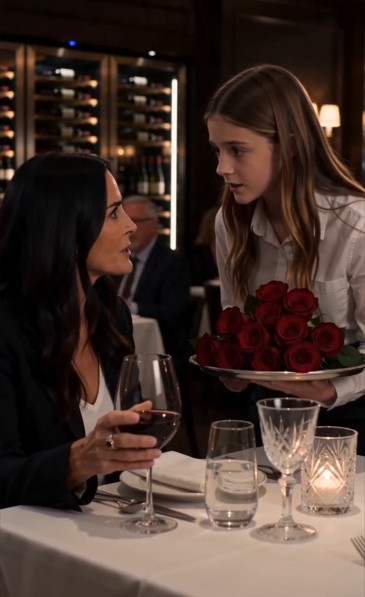
Around them, the restaurant kept moving for a few seconds longer—quiet conversations, the soft clink of glasses, the distant sound of a piano playing something slow and familiar. But at one table, time had stopped.
People nearby began to notice.
The silence there didn’t belong in a place like this.
The woman leaned forward slightly, her voice barely steady.
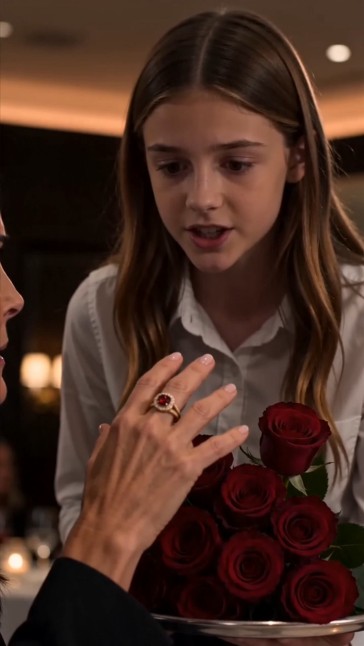
“Who told you that?” she asked.
The girl didn’t hesitate.
“My mother,” she said softly. “Before she died.”
Something shifted immediately in the woman’s expression.
Her hand slowly tightened around her ring, as if the metal had suddenly become heavier than before.
Because what the girl had just said was not supposed to be possible.
Not after all these years.
Not after all the lies.
Seventeen years earlier, everything had started on a night she tried hard not to remember.
A storm had covered the city in rain and noise. That night, she had met her younger sister in secret outside an old church—far from the eyes of their powerful family.
Her sister, Isabel, had been frightened. Pregnant. Desperate to leave behind a life she no longer wanted to live under control.
There had been arguments.
Raised voices.
Fear disguised as love.
The older sister had begged her to return home. To let the family “handle it.” To avoid something irreversible.
But Isabel refused.
Then everything went wrong.
Cars arrived. Men stepped out. Panic followed.
In the chaos, Isabel was pushed. She fell against stone steps, injured, and disappeared into the confusion of that night.
By morning, the story had already changed.
She was gone.
According to the family, she had left the country.
Alive.
Safe.
Far away.
And because she was young, pressured, and taught to obey without question, the older sister accepted the version she was given.
Even when it never felt right.
Now, standing in front of her was a girl who should not exist.
“My mother didn’t die that night,” the girl continued quietly. “A woman from the convent found her and hid her. She was injured… but she survived.”
The woman’s breath caught.
“And the baby?” she asked, almost afraid to hear the answer.
The girl looked up.
“That was me.”
The words didn’t feel real.
They couldn’t.
The weight of the past collapsed into a single moment.
Everything the family had buried with money, silence, and distance suddenly felt fragile.
The woman stood up so quickly her chair scraped loudly across the floor.
“Where is she?” she asked.
The girl’s expression changed.
A sadness settled in.
“She isn’t here,” she said.
A pause.
Heavy.
Final.
“My mother died three days ago.”
The impact of those words didn’t land like shock.
It landed like loss that had already finished happening without permission.
Three days.
So close.
So final.
The woman’s eyes filled instantly.
All those years of distance, silence, and uncertainty now collapsed into something irreversible.
She reached out instinctively, but the girl stepped back slightly.
“I wasn’t supposed to find you,” the girl said softly. “But she told me I would.”
The woman’s voice broke. “What else did she tell you?”
The girl hesitated, then reached into her pocket.
She pulled out a folded piece of paper—old, worn, carefully kept as if it had been the only constant in her life.
She placed it on the table.
“For you,” she said. “She said only give it to the woman with the ring.”
The woman unfolded it slowly.
Her hands were shaking.
The handwriting was unmistakable.
It belonged to Isabel.
And there, in a single sentence, everything changed:
If our father is still alive, do not let him know she found you first.
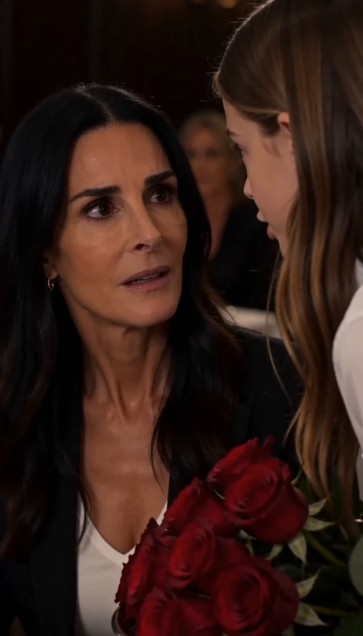
The room didn’t move.
The air didn’t shift.
But in that moment, something deeper had been uncovered.
Not just a family secret.
But a truth that had been buried for far too long—
and was now finally awake.