The forest was quiet in that strange, heavy way that comes just before something breaks the silence. Leaves barely moved, the air thick with the scent of damp earth and moss. A narrow stream cut through the trees, its gentle trickle the only sound in an otherwise still world.
Near the water’s edge, a small group of raccoons moved carefully through the underbrush. They weren’t alone by chance—they were a tight-knit group, bound not just by survival, but by familiarity. They foraged together, traveled together, and watched out for one another in ways that went beyond simple instinct.
One of them, smaller than the rest, wandered slightly ahead. Curious and energetic, it pawed at the ground, sniffing around a fallen log partially covered in vines. The others lingered behind, digging through leaves and stones in search of food.
Then everything changed.
The ground near the log shifted—just slightly, almost unnoticeable.
Before the young raccoon could react, something struck.
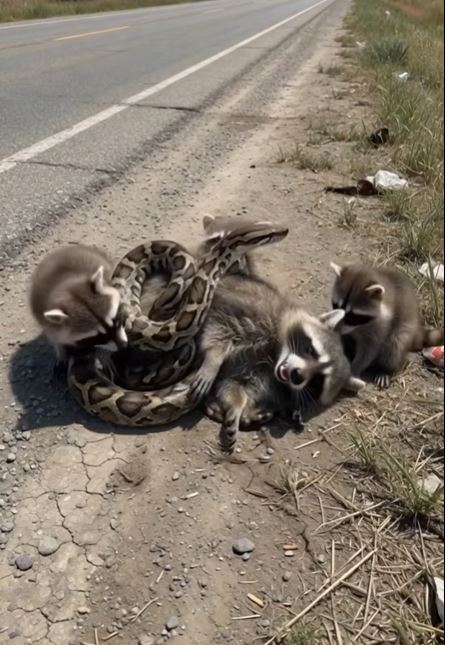
A massive snake, perfectly camouflaged among the branches and leaves, lunged forward with terrifying speed. Its body coiled instantly around the small raccoon, tightening with crushing force.
A sharp, panicked screech pierced the silence.
The rest of the group froze.
For a split second, instinct told them to run. The size of the predator alone was enough to send any animal fleeing in fear. The snake’s thick body twisted and tightened, its grip growing stronger with every passing second.
The young raccoon struggled, clawing desperately, but it was no match for the power of the coils. Its movements became more frantic, more desperate.
Then something unexpected happened.
Instead of retreating, one of the larger raccoons stepped forward.
It hesitated—but only for a moment.
Then it charged.
With a sudden burst of energy, it lunged toward the snake, snapping its jaws and clawing at the thick, scaled body. The snake reacted instantly, tightening its grip on its prey while turning its head toward this new threat.
But the raccoon didn’t back down.
Another raccoon joined.
Then another.
Within seconds, the entire group had surrounded the snake.
They moved quickly, unpredictably—darting in and out, biting and scratching wherever they could reach. Their goal wasn’t to overpower the snake directly. It was to disrupt it, confuse it, and force it to divide its attention.
The snake lashed out, its head striking toward one attacker, then another. Its body shifted, coils tightening and loosening as it tried to maintain control of its captured prey while defending itself from all sides.
But the raccoons were relentless.
One grabbed at the snake’s tail, pulling sharply. Another lunged toward its midsection, forcing it to recoil. A third moved closer to the trapped raccoon, trying to create an opening.
The forest, once silent, erupted into chaos—rustling leaves, snapping branches, sharp cries, and the heavy movement of a powerful predator fighting to maintain dominance.
The snake was strong. It had the advantage of size and raw power. But it was alone.
And the raccoons were not.
They worked together without hesitation, each movement feeding into the next. When one pulled back, another moved in. When the snake focused on one target, another attacked from behind.
Slowly, the balance began to shift.
The snake’s movements became less controlled, more reactive. Its grip on the young raccoon, once tight and unyielding, began to falter—just slightly at first, then more noticeably.
That was the moment they had been waiting for.
One of the raccoons lunged directly at the snake’s head, forcing it to recoil sharply. At the same time, another bit down hard near the base of its coil.
The pressure broke.
The young raccoon slipped free.
It tumbled onto the ground, weak but alive, scrambling clumsily away from the snake’s reach.
The group didn’t stop.
Even after their friend was free, they continued their attack for a few seconds more, pushing the snake further back, forcing it to retreat rather than risk another attempt.
The snake hissed loudly, its body coiling defensively now instead of offensively. It assessed the situation—multiple attackers, no longer holding its prey, energy already spent.
The decision came quickly.
It withdrew.
Sliding back into the underbrush with controlled, deliberate movements, it disappeared into the same camouflage that had made it so dangerous just moments before.
Silence returned.
But it felt different now—charged, alive, as if the forest itself had witnessed something rare.
The raccoons gathered around their injured companion.
The small one lay still for a moment, breathing heavily, its body trembling from the ordeal. One of the others nudged it gently. Another stayed close, alert, watching the surroundings in case the danger returned.
After a few seconds, the young raccoon moved.