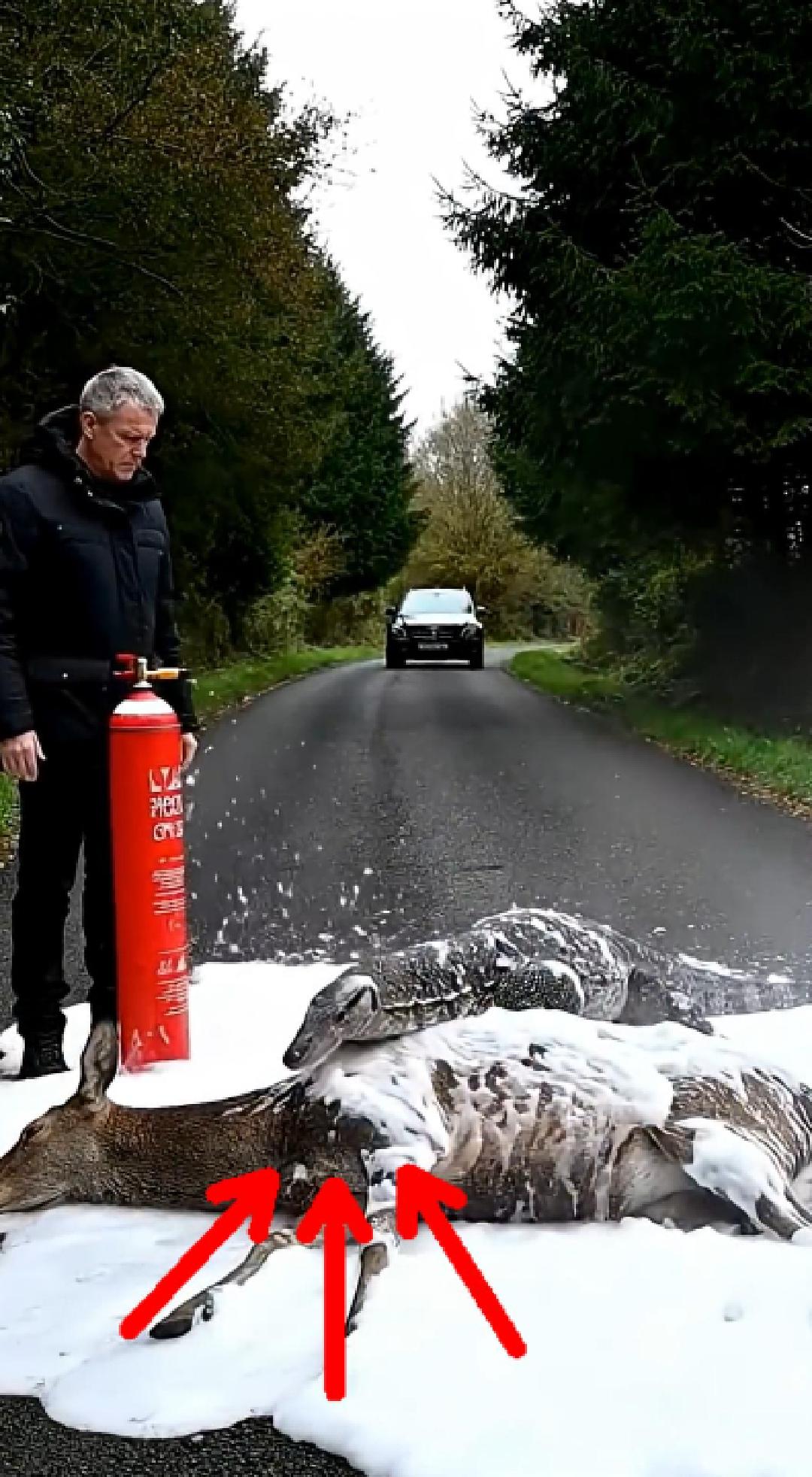
The forest near the river was thick and humid, with tangled vines hanging between trees and patches of sunlight breaking through the canopy in scattered shapes. The air carried the sound of insects, distant birds, and the slow movement of water flowing over stones. It was the kind of environment where life constantly moved just out of clear sight—hidden, alert, and unpredictable.
A young deer was moving cautiously along a narrow path near the riverbank.
It wasn’t fully grown yet, its steps still a little uncertain, its awareness sharp but inexperienced. It paused often, lifting its head to listen, then lowering it again to navigate the uneven ground. The forest felt familiar, but something about this stretch of land seemed different—quieter, more tense than usual.
It stopped near a patch of disturbed soil.
Something had moved there recently.
The deer hesitated.
Then it took another step forward.
From the water’s edge nearby, something shifted.
At first it was subtle—just a ripple that didn’t match the current. Then a low movement in the mud, followed by the slow emergence of a large lizard-like predator from the shallow riverbank. Its body blended with the environment at first, but as it moved fully onto land, its presence became unmistakable.
It was large.
Heavy.
And fast.
The deer froze for half a second—the critical moment where instinct either decides escape or hesitation. Then it turned sharply and bolted.
But the predator had already locked on.
It surged forward with sudden speed, pushing through the shallow water and onto the muddy bank. The chase began instantly. The deer ran, weaving between roots and low branches, trying to create distance, but the terrain was uneven and the predator was powerful in short bursts.
The forest filled with movement.
Leaves scattered. Branches bent. Water splashed behind them.
The deer tried to reach higher ground, but the predator was closing the gap. Each moment of acceleration reduced the space between them. The young deer’s breathing became faster, more desperate, its path less stable as panic began to affect direction.
The predator lunged.
Just short.
The deer slipped forward again, narrowly avoiding capture, but it was losing momentum. The river bend ahead offered no clear escape route.
Then something unexpected happened.
From higher ground above the riverbank, a sudden presence broke into the scene.
A human figure.
A man moving along the edge of the forest trail noticed the chaos immediately—the movement, the direction, the pursuit. He didn’t hesitate long enough to analyze everything fully. The situation was already unfolding too fast for that.
The deer was still running.
The predator was still chasing.
And the distance between them was shrinking again.
The man reacted.
He picked up a large branch from the ground and moved quickly toward the edge of the path, positioning himself in a way that would intercept the predator’s line of movement without getting too close to either animal. Timing mattered more than force.
He stepped into view.
The predator reacted instantly, its focus shifting for a fraction of a second toward the new obstacle. That fraction was enough.
The man struck the ground sharply with the branch and made a loud, forceful sound, breaking the momentum of the chase. The sudden disruption created confusion in the predator’s movement pattern.
It hesitated.
The deer, sensing the break in pressure, pushed forward immediately, using the opening to break away from the direct line of pursuit.
The man repeated the motion, maintaining presence, increasing noise and visual disruption to discourage continued attack. It wasn’t about confrontation—it was about interruption.
The predator slowed.
Its focus divided.
The chase lost its precision.
After a few tense seconds, the predator shifted its direction, stepping back toward the riverbank, no longer fully committed to pursuit. The sudden disruption had changed the balance of the moment.
The deer kept running.
It didn’t stop immediately. It continued through the forest, pushing until it reached denser cover, where the terrain offered more protection and fewer clear lines of sight.
Only then did it slow down.
The forest gradually returned to its natural rhythm.
Leaves settled.
Water flowed as before.
The predator remained near the river, no longer advancing.
The man stood still for a moment, making sure the danger had truly passed before lowering the branch. He watched the direction the deer had gone, ensuring there was no further pursuit.
Then he stepped back onto the trail.
The moment faded into the wider forest, as if it had been absorbed back into the landscape.
But for the deer, the outcome had changed in an instant—because something outside the natural chain of events had intervened at the exact moment it mattered most.
And sometimes, that brief interruption is all it takes to turn survival into escape.