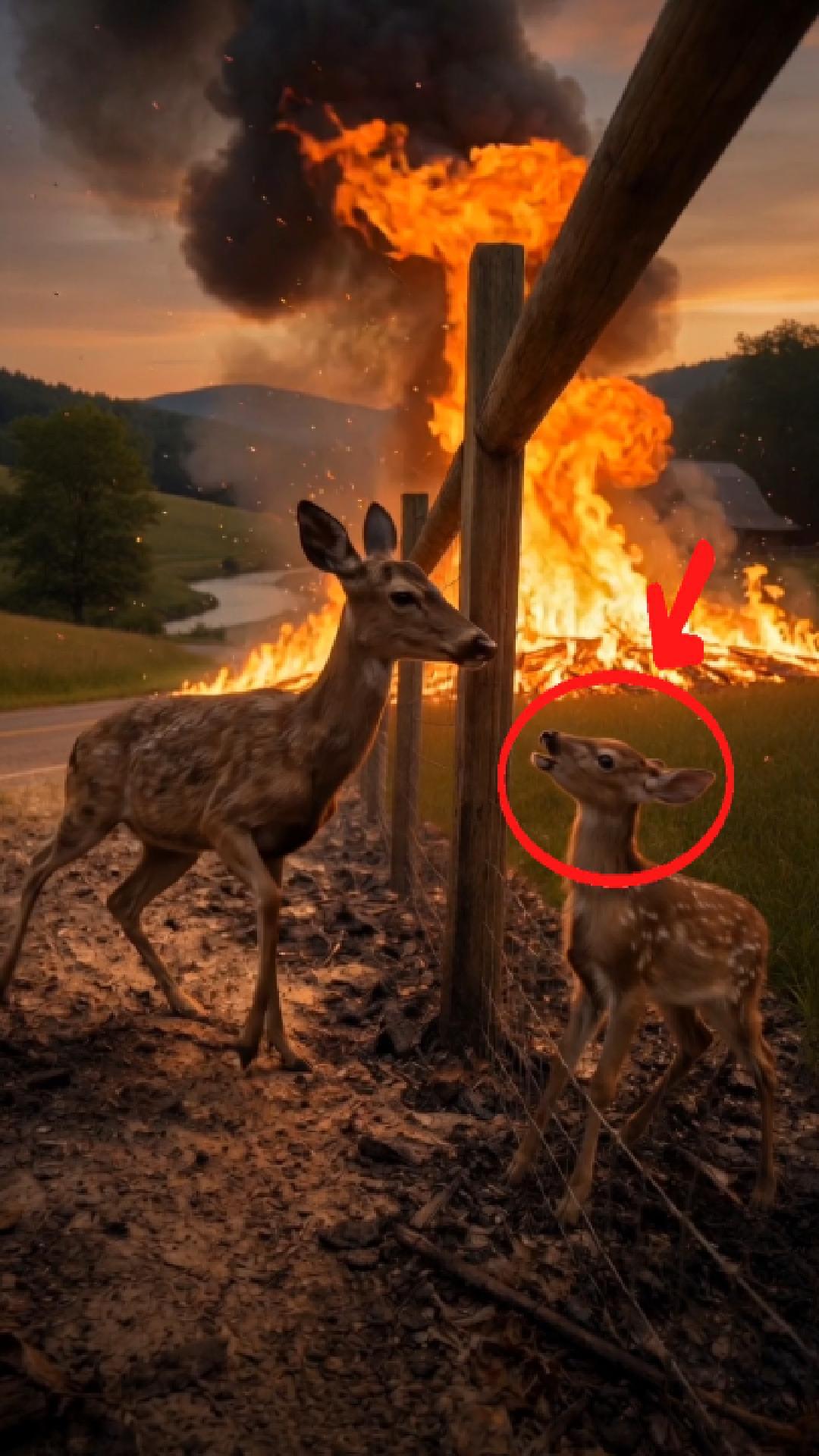
The forest had been dry for weeks, the kind of dryness that turns leaves brittle and grass into tinder. That afternoon, a wind picked up without warning, carrying with it the sharp, unmistakable scent of smoke.
At first, it drifted lightly through the trees, almost easy to ignore. But within minutes, it thickened, darkened, and turned urgent.
A wildfire had begun.
Flames moved low and fast across the forest floor, feeding on dry brush and fallen branches. The crackling grew louder, spreading in waves as the fire advanced, climbing over roots, wrapping around tree trunks, and sending sparks ahead of itself with every gust of wind. What started as a distant threat quickly became a moving wall of heat and light.
Near the edge of a narrow clearing, a deer and her fawn were trapped.
They had been moving along a worn path when the fawn’s small leg became tangled in a section of abandoned wire fencing, partially hidden beneath tall grass and debris. The metal strands had twisted tightly around its leg, and every attempt to pull free only made it worse. The more the fawn struggled, the tighter the wires seemed to grip.
The mother deer stayed close, pacing anxiously around her trapped young.
She nudged the fawn gently, trying to guide it to calm down, but fear had already taken hold. The approaching fire added urgency to every second. Smoke began to drift into the clearing, and the faint crackle of flames grew louder in the distance.
The fawn cried out.
High-pitched.
Panicked.
The mother deer looked in every direction, searching for an escape, but there was none—not while her fawn was trapped. She refused to leave. Instead, she stayed close, circling, nudging, and standing guard even as the threat drew closer.
The wind shifted again.
This time, it brought the fire with it.
The edge of the clearing began to glow orange, and flames appeared between the trees, moving steadily toward them. Heat followed quickly, pressing into the space and making the air difficult to breathe.
The situation had turned critical.
Not far from the forest’s edge, a wildfire response team had already been deployed. Among them was a firefighter named Daniel, who was monitoring the spread along a containment line. As he moved along the perimeter, scanning for hotspots and possible flare-ups, he heard something unusual through the roar of the fire.
A sound that didn’t belong to burning wood.
A cry.
Faint.
But urgent.
He stopped immediately, turning toward the direction it came from.
Through the smoke, barely visible, he saw movement—a deer pacing frantically near the edge of a clearing. That alone was unusual. Wild deer typically flee at the first sign of danger, especially fire. But this one stayed, moving in tight circles, repeatedly returning to the same spot.
Something was wrong.
Daniel radioed his team quickly, alerting them to a possible animal entrapment. Without wasting time, he moved toward the clearing, staying low to avoid thicker smoke and navigating carefully around patches of fire that had already begun to spread.
When he reached the edge of the clearing, the full scene came into view.
The fawn was trapped.
The wire was wrapped tightly around its leg, anchoring it to the ground. The mother stood just a few meters away, clearly torn between fear and the instinct to stay with her young.
And behind them…
The fire was coming.
Fast.
Daniel knew he had very little time.
He approached slowly, aware that sudden movement could cause the fawn to panic and worsen its entanglement. The mother deer stepped back slightly but did not run, her eyes locked on him as if trying to understand his intent.
He dropped to one knee and assessed the wires quickly. They were old but strong, partially rusted and twisted into a tight knot around the fawn’s leg. Pulling them directly would only tighten the grip.
He needed to cut them.
Calling out over his radio, he requested bolt cutters immediately. But even as he spoke, the heat behind him intensified. Flames were now visible at the far edge of the clearing, moving closer with every passing second.
There was no time to wait.
Daniel pulled a multi-tool from his gear and began working at the wires manually. It was slower, harder, and far from ideal—but it was the only option he had in that moment.
The fawn struggled at first, but Daniel spoke softly, trying to keep it as still as possible. The mother deer stood nearby, watching every movement, her body tense but not interfering.
The wire resisted.
Then shifted.
One strand loosened slightly.
Daniel kept working, cutting through another section as the heat pressed closer. Smoke thickened around them, and embers began to fall from nearby branches.