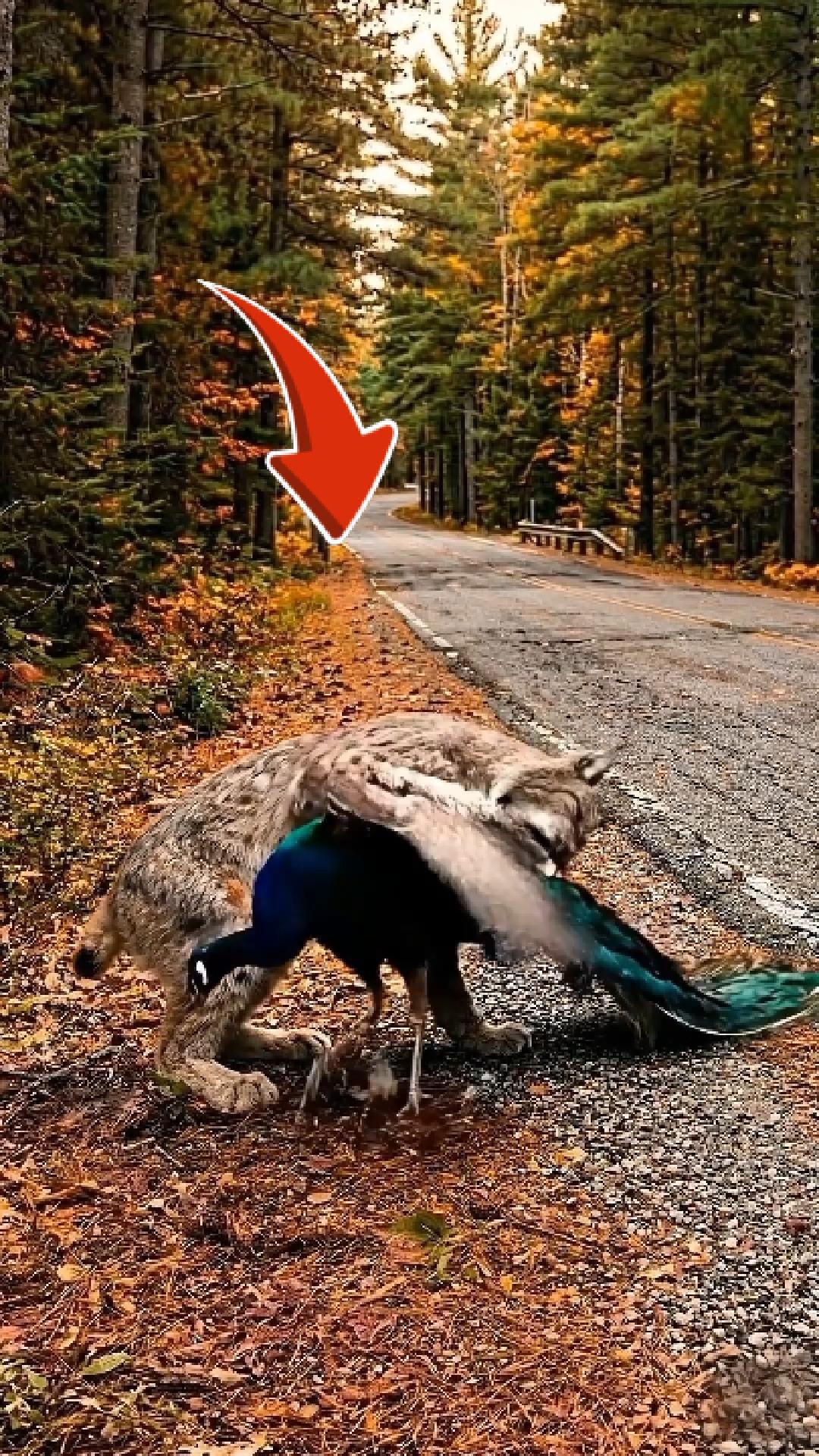
The forest was unusually still that morning, as if nature itself was holding its breath. Sunlight filtered through tall trees in thin, broken streams, touching the ground in shifting patterns of gold and shadow.
Somewhere in that quiet, a peacock had wandered further than it should have. Its feathers, though partially folded while it moved, still carried a faint shimmer of color that stood out sharply against the muted greens and browns of the forest floor.
It had been searching for food, moving slowly and carefully, unaware that the edge of safety had already been left behind. The deeper parts of the forest were not always dangerous, but they were unpredictable. And in that unpredictability, something far more patient had already taken notice.
The lynx had been watching.
It did not move like other predators. There was no rush, no unnecessary noise, no wasted motion. It simply existed in stillness, blending into the broken light beneath the trees. Its eyes tracked every movement of the peacock with quiet focus, calculating distance, timing, and angle. Hunger sharpened its awareness, but experience kept it controlled. It knew that success was not about speed alone—it was about certainty.
The peacock stopped briefly, pecking at the ground, completely unaware of the presence nearby. It tilted its head, listening to distant sounds, but nothing alarmed it. The forest often carried whispers of movement, and it had learned to ignore most of them. That comfort, however, was fragile.
The lynx shifted slightly.
It was enough.
In an instant, everything changed.
The peacock reacted first, sensing movement rather than understanding it. It turned sharply, feathers lifting instinctively as its body registered danger. But the distance between awareness and action was too small. The lynx had already committed. Its body launched forward with controlled precision, closing the gap in a burst of silent force.
The peacock tried to escape, wings opening in a sudden rush of color and panic. It lifted awkwardly, not fully airborne, more startled than prepared. The forest floor became a blur beneath it as it attempted to flee, but the space was too tight, the moment too sudden. The lynx adjusted mid-charge, staying aligned, never losing focus.
For a brief moment, everything was motion.
Feathers scattered light through the air. Leaves shifted under rapid movement. The balance between predator and prey narrowed into something dangerously thin. The peacock veered, attempting to gain distance, but the terrain offered little advantage. Every direction felt equally uncertain.
The lynx closed in.
Yet even in that moment, the outcome was not fully decided.
A sudden burst from the peacock—unexpected, desperate, instinct-driven—created just enough separation. It surged upward again, not fully flying, but lifting enough to break the direct path. The lynx missed its immediate grasp, landing instead on shifting ground where its momentum carried it slightly off line.
The forest seemed to pause.
The peacock landed awkwardly a short distance away, stumbling but still moving. Its breath came fast, feathers partially spread, body trembling with adrenaline. It did not understand strategy, only survival. It knew only that it had to move.
The lynx turned quickly.
Now the chase had shifted.
What had begun as a silent ambush was now an open pursuit, though still controlled, still calculated. The lynx did not rush blindly. It adjusted its path, reading the peacock’s movement, anticipating where panic would lead it. The peacock, meanwhile, was no longer still. Fear had fully taken over, driving it forward in unpredictable bursts.
Branches blurred past. Sunlight flickered between motion. The forest floor became uneven, forcing both to adapt with every step. The peacock’s advantage lay in sudden movement and agility in tight spaces, but the lynx had endurance, precision, and the ability to track without hesitation.
The distance between them narrowed again.
The peacock attempted another escape burst, angling toward a cluster of low shrubs where visibility might break the pursuit. It moved erratically, not in a straight line, but in instinctive zigzags that made tracking more difficult. The lynx followed, adjusting smoothly, never breaking rhythm.
But something unexpected happened.
The terrain changed.
A fallen branch lay hidden beneath leaves, and as the lynx pushed forward, its movement slowed for a fraction of a second. Not enough to stop it, but enough to shift timing. That single interruption created a gap—small, but meaningful.
The peacock used it.
It pushed itself upward again, this time gaining slightly more lift, reaching a low branch where it scrambled upward with desperate effort. Its claws gripped uneven bark, feathers disheveled, body shaking but rising. It was not escape yet, but elevation changed everything.