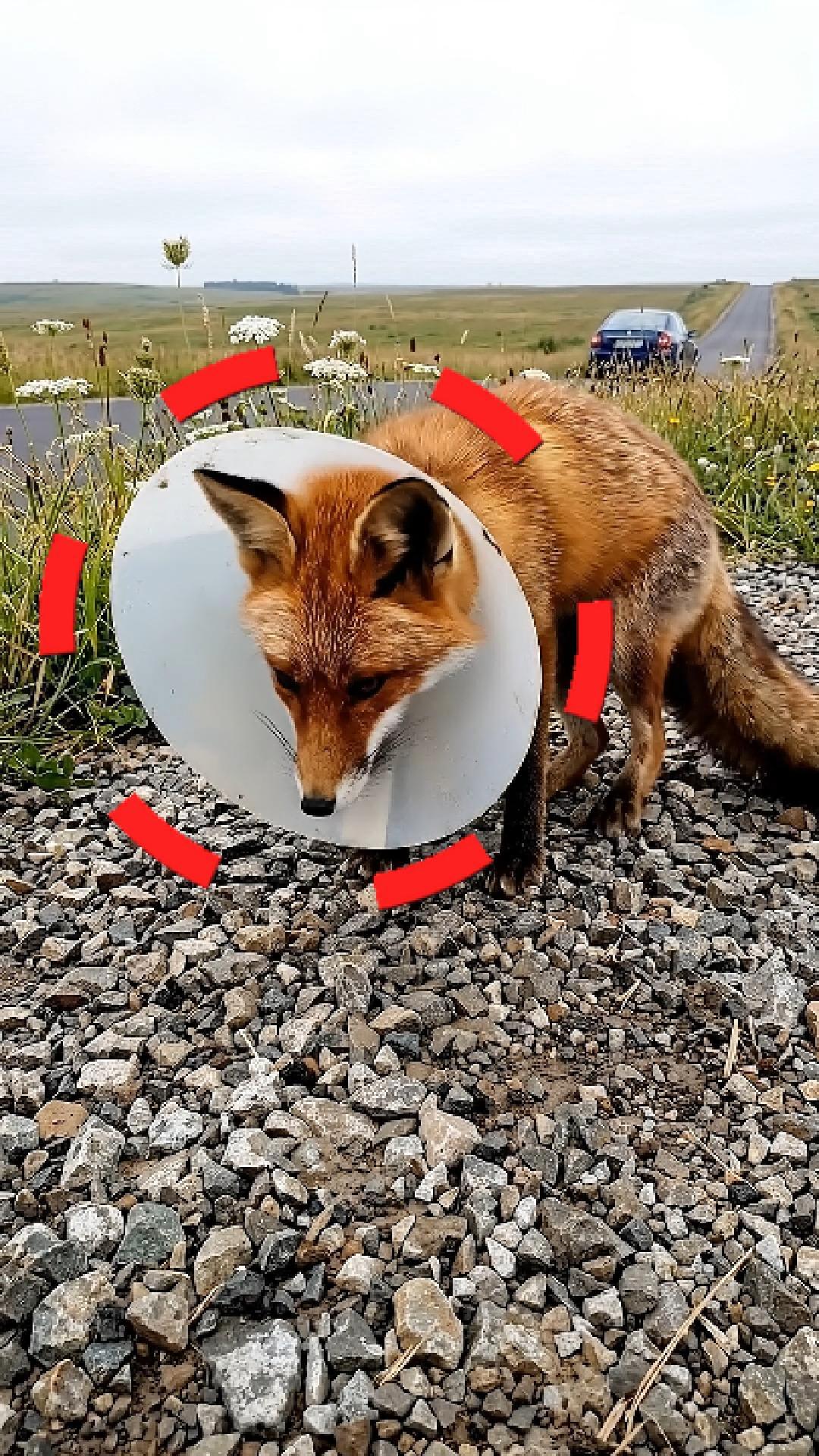
The edge of the woodland had slowly become a place where human traces and wild life crossed paths in uneasy ways.
Among the tall grass and scattered bushes, something unnatural glinted faintly in the morning light—a discarded piece of plastic, half-buried, shaped by wind and time into something that no longer belonged to anything living.
A young fox had come across it while moving through the area in search of food.
At first, it had likely seemed harmless. Foxes are curious by nature, often investigating unfamiliar objects with cautious interest. The plastic container had probably still carried faint scents of something edible long after it was thrown away. But curiosity has a way of turning quickly into danger in the wild.
In an attempt to reach inside, the fox had pushed its head into the opening.
It had fit at first—just enough for exploration, just enough to search. But then, when it tried to pull back, something went wrong. The angle had shifted. The edges had caught. What was once an opening became a trap.
Now the fox stood still in the undergrowth, its head completely stuck inside the plastic container.
The world around it had changed instantly.
Sound became distorted, vision disappeared entirely. The fox could no longer see the forest, only darkness inside the hard shell around its head. Panic began to rise quickly, spreading through its body in sharp bursts of movement. It jerked backward, then forward, trying to shake free, but every motion only made the container shift with it, refusing to release its hold.
Breathing grew faster. The fox’s body lowered instinctively, trying to use the ground for leverage. It pawed at the air, then at the sides of the container, but there was nothing to grip properly. The plastic was smooth, rigid, and unyielding.
The forest around it remained unchanged—birds continued calling in the distance, leaves moved gently in the wind—but for the fox, everything had collapsed into a single overwhelming problem: escape.
It turned sharply, trying to run, but the obstruction disoriented it completely. It stumbled into roots, then froze again, unsure of direction, unable to trust its senses. Without sight, every movement became guesswork. Fear replaced instinct.
Time stretched.
Minutes passed, though the fox could not understand how many. Its energy began to drain as repeated attempts to free itself failed. Each effort became slightly weaker, slightly more desperate. The plastic did not loosen. It only reminded the fox that it was trapped in something it could not understand or fight directly.
Then, a sound.
Footsteps.
At first distant, faint, barely noticeable beneath the forest noise. The fox froze immediately, body tense, head still locked inside the container. It could not see who or what was approaching, only sense vibration through the ground. Instinct told it to flee, but it could not.
The footsteps grew closer.
A human presence entered the clearing.
The person stopped immediately upon noticing movement. At first, it was unclear—a strange shifting shape near the bushes. But as they stepped closer, the situation became obvious. The fox was trapped, head fully inside a piece of discarded plastic.
There was no sudden movement.
The person understood immediately that rushing in could make the situation worse. The fox was already panicked, already disoriented. Any quick approach would increase fear and resistance. So instead, they paused, maintaining distance, observing carefully.
The fox reacted to their presence instantly, twisting sharply in their direction even though it could not see them. It backed away slightly, bumping into grass and branches, trying to orient itself toward a threat it could only sense, not identify.
The person spoke softly—not to communicate meaning, but to provide calm presence.
Slow movements only.
Step by step, the distance was reduced carefully. The fox remained rigid, breathing heavily, every muscle alert. It tried again to pull free at the sound of approaching footsteps, but the container held firm. Panic surged again, but there was no progress.
The person stopped a few meters away and crouched slowly, lowering their profile to appear less threatening. They assessed the situation: the plastic was stuck at an angle around the fox’s head, likely wedged rather than tightly sealed. That meant rescue was possible—but only with precision.
The fox shifted again, exhausted now, movements less forceful than before. Fear remained, but energy was fading.
The person carefully reached toward the container—not the fox itself, but the plastic. The fox reacted immediately, jerking backward. The container scraped against branches and ground, making everything worse for a moment.