The courthouse plaza was already busy when the man in the charcoal suit approached the front entrance.
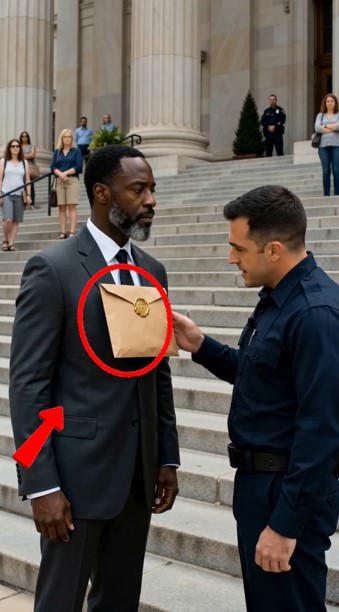
Lawyers moved quickly up the marble steps. Clerks carried coffee and case files. Security officers directed visitors toward the screening area while judges and staff entered through separate doors.
In the middle of the morning rush, one man walked quietly toward the entrance carrying a large sealed envelope.
His suit was clean and neatly pressed, though it had clearly been worn for many years. His leather briefcase showed signs of age, and his shoes were polished but modest.
He did not attract attention at first.
That changed when a security officer stepped in front of him.
“Sir, may I ask what brings you here today?” the officer said.
The man stopped.
“I have documents that need to be delivered to the presiding judge’s chambers before nine o’clock.”
The officer glanced at the envelope and raised an eyebrow.
The seal on the front was official, and the paperwork appeared to be urgent.
Still, the officer remained skeptical.
Several people nearby slowed down to watch the exchange.
The man stood calmly, holding the envelope with both hands.
“I need to deliver these documents as soon as possible,” he said politely.
Instead of allowing him to proceed, the officer took the envelope to inspect it more closely.
The man spoke quietly.
“If you open that, it becomes part of the official record.”
The officer hesitated only briefly.
Then he broke the seal.
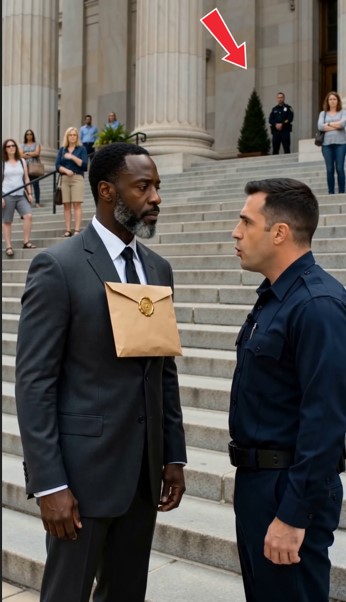
The sound of the paper tearing echoed in the entrance plaza.
A few bystanders exchanged uneasy glances.
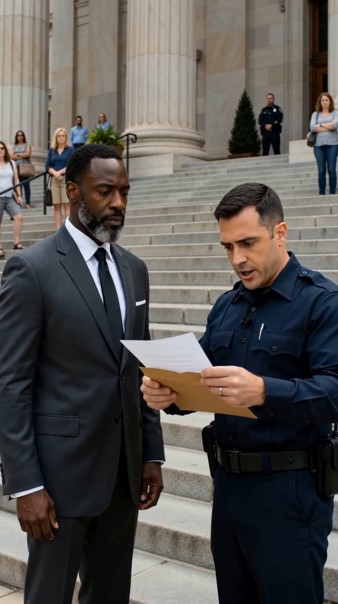
The officer unfolded the documents and began reading.
At first, his expression showed confidence.
Then it changed.
The color drained from his face.
He read the first page again, this time more slowly.
The people watching noticed the sudden shift.
The second officer stepped closer.
“What is it?” he asked.
The first officer handed him the papers without saying a word.
The document was an emergency administrative order issued by the court.
The order concerned immediate personnel changes at the courthouse.
Near the top of the page was the name of the officer who had opened the envelope.
The second officer looked up in surprise.
The plaza fell completely silent.
The man in the charcoal suit remained composed.
He accepted the papers when they were returned and carefully placed them back into the envelope.
“I said these documents were important,” he said calmly.
The first officer straightened his posture.
“Sir, I apologize.”
The man gave a polite nod.
“Thank you.”
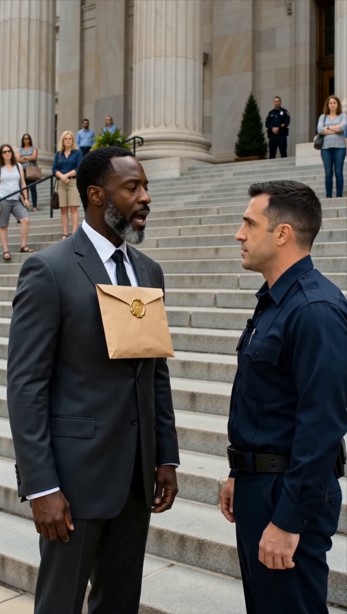
He proceeded through security and entered the courthouse.
As the doors closed behind him, conversations resumed in hushed tones.
Everyone who had witnessed the moment understood that they had seen something unusual.
What had seemed like a routine security check had become a powerful lesson about assumptions and professionalism.
Later that morning, courthouse staff learned more about the man.
He was a senior court administrator responsible for delivering confidential judicial orders.
He had been entrusted with documents that needed immediate attention.
His appearance had been modest, but his responsibilities were significant.
Those who knew him described him as dependable, respectful, and deeply committed to his work.
He rarely sought attention and preferred to let his actions speak for themselves.
That morning, they certainly had.
In the days that followed, the story spread throughout the courthouse.
Staff members discussed the importance of treating every visitor with courtesy.
Security supervisors reviewed procedures and reminded officers to balance caution with professionalism.
The incident was not remembered for conflict.
It was remembered for the quiet dignity with which the man handled the situation.
He never raised his voice.
He never demanded special treatment.
He simply remained calm and trusted that the facts would speak for themselves.
And they did.
The lesson was one that extended far beyond the courthouse walls.
We cannot know someone’s role, experience, or responsibilities based on appearance alone.
Respect should not depend on titles, clothing, or assumptions.
It should be offered freely to everyone.
On that busy courthouse morning, a sealed envelope delivered more than an official order.
It delivered a lasting reminder that dignity, patience, and professionalism can reveal the truth more powerfully than any argument ever could.