I had debt collectors calling every day, overdue bills stuffed beneath the passenger seat of my truck, and exactly forty-three dollars left in my checking account. Most nights, I slept behind a grocery store parking lot with a blanket stretched across the back seat and my jacket rolled under my head as a pillow.
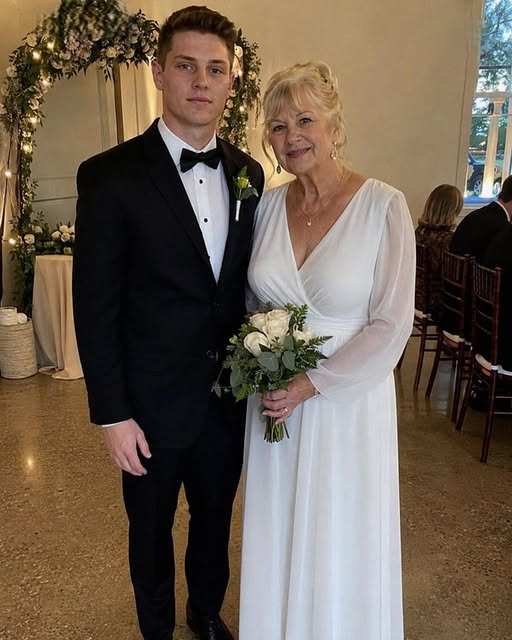
Meanwhile, Evelyn Whitmore was seventy-one.
She lived alone in a beautiful two-story home at the end of a quiet street lined with oak trees and trimmed hedges. Her late husband had left her financially comfortable. She wore pearl earrings, baked blueberry muffins every Sunday morning, and spent most evenings reading beside the fireplace with soft jazz playing in the background.
And no — I did not marry her for love.
At least, not in the beginning.
I met her by accident at a small diner where I had stopped to warm up during a winter storm. I looked terrible that day. Exhausted. Hungry. Defeated. My boots were wet, my hands shook from cold, and I had spent the previous night arguing with a bank representative over a loan I could no longer pay.
Evelyn sat alone near the window sipping tea.
At one point, I dropped my wallet while reaching for change, and several coins rolled across the floor. Embarrassing doesn’t even begin to describe how I felt. But before I could gather them, Evelyn quietly bent down and helped pick them up.
“You look tired,” she said gently.
Nobody had asked me that in a long time.
Most people looked straight through me back then. I was just another struggling young man trying not to fall apart in public.
But Evelyn saw me.
Over the next few weeks, we kept running into each other. Sometimes at the diner. Sometimes at the library where she volunteered twice a week. She would invite me for coffee, ask questions about my life, and actually listen to the answers.
Eventually, she learned the truth.
I had no stable home. No family nearby. My construction job had ended months earlier, and debt had swallowed whatever savings I once had.
“You can stay in the guest room for a while,” she offered one evening.
I should have said no.
But desperation has a way of making decisions feel smaller than they really are.
Living in Evelyn’s house felt unreal at first. Hot showers. Clean sheets. Real meals. Silence at night instead of traffic noise and fear. She never treated me like a burden. Never made me feel ashamed.
Still, I always knew why I stayed.
Security.
Comfort.
Survival.
And when she eventually suggested marriage one quiet evening over dinner, I said yes far too quickly.
Part of me convinced myself it made sense. She was lonely. I needed stability. We could help each other.
But deep down, I knew the truth.
I was using her.
The wedding itself was tiny. No grand celebration. Just a courthouse ceremony, two witnesses, and a simple silver ring Evelyn insisted on buying for me even though I told her not to.
The neighbors whispered, of course.
Some assumed I was manipulating her. Others thought she had lost her mind. A few openly stared whenever we went grocery shopping together.
Evelyn ignored all of it.
Oddly enough, she never demanded affection from me. Never pressured me to become someone I wasn’t. She simply appreciated having another person in the house. Someone to drink coffee with in the mornings. Someone to sit beside while watching old movies at night.
And slowly, something uncomfortable began happening.
I started caring about her.
Not because of the house.
Not because of money.
But because Evelyn was kind in a world that rarely is.
She remembered every small detail about people. She baked extra cookies for delivery drivers. She sent birthday cards to neighbors most barely noticed. She spoke softly to everyone, even telemarketers.
One night, during a thunderstorm, the power went out across the neighborhood. We sat near the fireplace wrapped in blankets while rain hammered against the windows.
“You know,” she said quietly, “people think loneliness is about being alone.”
I looked over at her.
“But the worst loneliness,” she continued, “is feeling invisible to everyone around you.”
For some reason, those words stayed with me.
Because that was exactly what my life had felt like before her.
Invisible.
Years passed more quickly than I expected.
Then Evelyn got sick.
At first it was small things. Fatigue. Forgetfulness. Doctor appointments she brushed off casually. But eventually the diagnosis came, and suddenly our peaceful routines became hospital visits, medications, and quiet fear neither of us fully spoke about.
I stayed.
Not because I had nowhere else to go anymore.
But because by then, leaving never crossed my mind.
When Evelyn passed away, the house felt impossibly empty.
The funeral was small but beautiful. Neighbors filled the chapel. People I had never met approached me afterward with stories about how Evelyn had helped them over the years.