The morning sun had just begun to illuminate the treetops when a family of Rainbow Lorikeets started another day in their natural habitat.
The colorful parrots moved energetically among the branches, their bright feathers flashing shades of green, blue, orange, and yellow as they searched for food.
It was a peaceful scene, and for one mother lorikeet, the day seemed destined to be routine as she cared for her growing chicks.
Hidden inside a nest nearby, several young chicks waited patiently for their mother’s return.
They were still too young to venture far on their own and relied heavily on their parents for food, protection, and guidance. Each time the adult bird left the nest, the chicks eagerly anticipated her return.
That morning, however, an unexpected event would interrupt their normal routine.
The mother lorikeet flew across the area searching for food, moving swiftly between trees and open spaces.
Like many birds, she was experienced at navigating obstacles in her environment. Yet on this particular day, a fence located near the edge of a property became the source of a serious problem.
As the bird attempted to pass through the area, something went wrong.
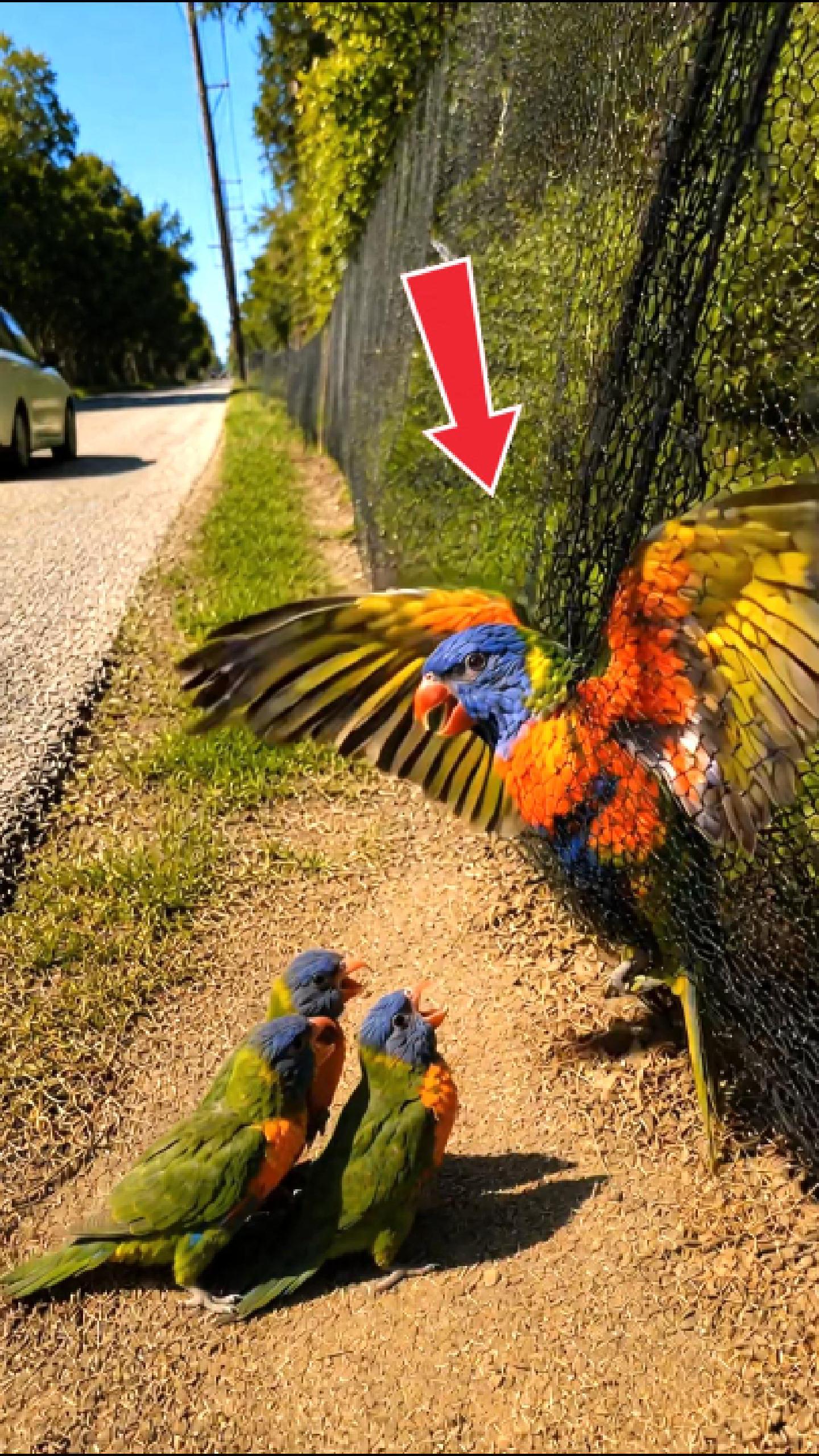
Within moments, the lorikeet became tangled in part of the fence. Startled by the sudden restriction, she immediately tried to free herself. Her wings fluttered rapidly as she searched for a way to escape, but each attempt seemed unsuccessful.
The situation quickly became stressful.
The colorful bird remained trapped, unable to continue her journey back to the nest. Despite her determination, she could not free herself alone. The fence held her in place, leaving her vulnerable and increasingly exhausted.
Meanwhile, back at the nest, the chicks waited.
Time passed, yet their mother did not return.
The young birds occasionally peeked from the safety of their nesting spot, unaware of exactly what had happened but sensing that something was different. Their usual feeding schedule had been interrupted, and the absence of their mother became increasingly noticeable.
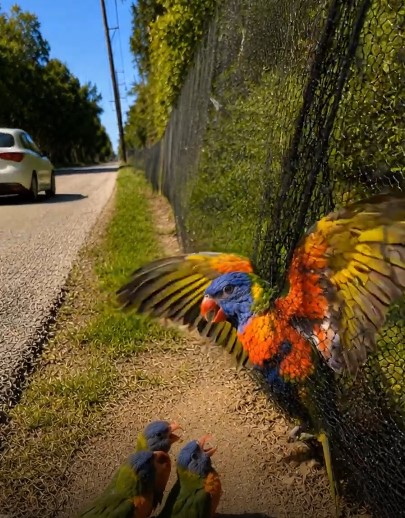
The trapped lorikeet continued struggling.
Although frightened, she never stopped trying to regain her freedom. Her instincts pushed her to return to her chicks, but the obstacle remained firmly in her way.
Fortunately, someone nearby eventually noticed the situation.
A passerby spotted the brightly colored bird and immediately realized that it was in trouble. From a distance, the unusual movement near the fence caught their attention. Upon closer inspection, the problem became obvious.
The bird needed help.
Recognizing that frightened animals can become stressed by sudden movements, the individual approached slowly and carefully. The goal was to assist without causing additional fear.
The lorikeet watched nervously.
Like most wild birds, it remained cautious around humans. However, exhaustion had begun replacing panic, and the bird appeared increasingly in need of assistance.
The rescuer carefully examined the fence.
Every movement had to be deliberate. The bird was small and delicate, meaning patience would be essential throughout the process. Rushing could accidentally make the situation worse.
For several tense minutes, the individual worked methodically.
The lorikeet remained alert but gradually became calmer as the rescue effort continued. Little by little, progress was made.
Nearby, the nest remained quiet.
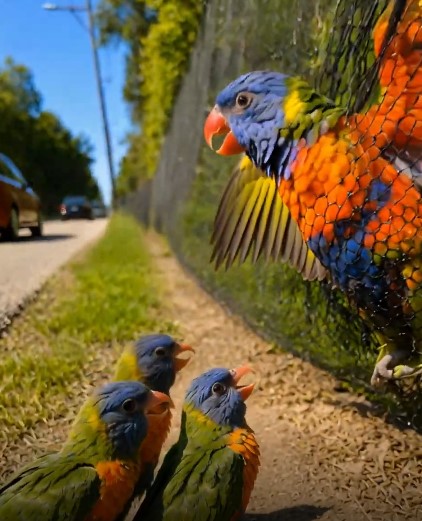
The chicks continued waiting, unaware that help had finally arrived for their parent.
The rescuer remained focused.
Each small adjustment brought the bird closer to freedom. Although the process seemed slow, every step represented meaningful progress.
Then came the breakthrough.
A section of the obstruction was successfully cleared.
The lorikeet suddenly had more room to move.
Encouraged by the improvement, the rescuer continued carefully until the remaining entanglement was removed.
Finally, the bird was free.
For a brief moment, the Rainbow Lorikeet remained still, almost as though it could hardly believe the ordeal was over. Then it spread its wings.
Everything appeared normal.
The bird tested its movement, flapped its wings, and prepared to leave. Relief swept over the rescuer, who stepped back and allowed the lorikeet the space it needed.
Moments later, the colorful parrot lifted into the air.
Its flight was strong and steady.
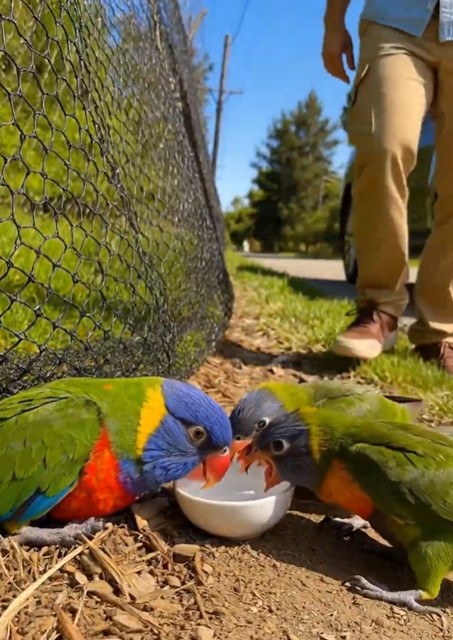
The sight was beautiful.
The same wings that had been restricted only minutes earlier now carried the bird freely across the sky.
The lorikeet quickly disappeared toward the trees where its nest was located.
Back at the nesting site, the waiting chicks soon received the reunion they had been hoping for.
Their mother had returned.
The interruption was over, and the family was together once again.
For the rescuer, the reward was simple: knowing that a vulnerable bird had been given a second chance to continue caring for its young. No recognition was needed beyond that.
Rainbow Lorikeet tangled in a fence while its chicks watch closely pic.twitter.com/5wxlNJBwNH
— Animal Rescue Stories (@AnimalStory5) June 3, 2026
Stories like this remind us how easily wildlife can encounter unexpected challenges in environments shared with humans. Even common structures can occasionally create difficulties for animals simply trying to go about their daily lives.