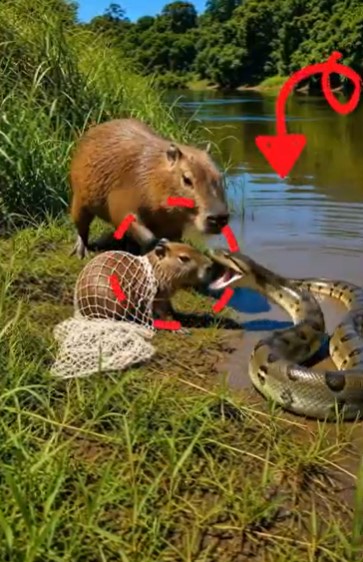
A peaceful day along a remote riverbank suddenly became an unforgettable wildlife moment when a group of boatmen noticed a young capybara near the water.
The animal appeared to be having difficulty moving away from the edge, while a large anaconda was nearby in the same stretch of riverbank.
The boatmen immediately slowed down and watched carefully.
From their position on the water, they could see that the young capybara was close to an area where the vegetation was thick and movement was difficult.
The presence of the large snake made the situation even more unusual, and the men understood that any response needed to be handled with great caution.
Instead of rushing toward the animals, the boatmen first considered their own safety and the safest way to create more space around the capybara.
Wildlife encounters along rivers can change quickly, particularly when large animals are involved. Remaining calm and avoiding sudden movements was therefore the first priority.
The young capybara stayed close to the riverbank, using the vegetation and shallow water around it as it searched for a suitable path.
Capybaras are excellent swimmers and spend much of their lives around rivers, wetlands, and other waterways.
For a young animal, however, navigating an unfamiliar situation can be challenging.
The boatmen remained nearby and continued observing.
The large anaconda was also part of the natural environment.
Although its presence created concern for the young capybara, the boatmen understood that the snake was a wild animal following its own instincts.
Their goal was not to harm it, but simply to create enough distance for the young capybara to move toward a safer area.
One of the boatmen carefully repositioned the boat while the others remained attentive to the riverbank.
By keeping their distance and using the boat as a barrier between themselves and the animals, they were able to approach the area without stepping directly into the vegetation.
This was an important decision.
Large snakes should never be approached casually, especially by people without appropriate training.
Anaconda species are powerful wild animals, and attempting to physically handle one could create serious risks.
The boatmen therefore focused on encouraging the snake to move away rather than attempting to touch or capture it.
The sound and movement of the boat gradually caused the anaconda to shift farther from the immediate area.
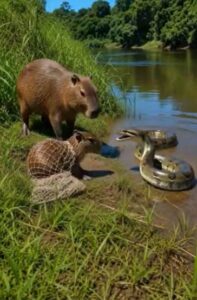
The men remained cautious, using the distance between the boat and the riverbank to avoid unnecessary contact.
As the snake moved away, the young capybara gained more room.
For a few moments, the animal remained still, apparently assessing its surroundings.
The boatmen waited.
There was no reason to rush the capybara. Once the immediate disturbance had moved farther away, the young animal needed time to decide where to go.
Eventually, the capybara began moving toward the water.
Its natural swimming ability quickly became an advantage. The young animal entered the shallows and began moving away from the original location.
The boatmen continued watching but did not follow closely.
Once the capybara had created enough distance, the situation became much calmer. The animal was able to continue along the river, while the anaconda remained farther back in the vegetation.
The entire encounter demonstrated how patience can be more effective than force when dealing with wildlife.
The boatmen did not try to capture the capybara or physically confront the snake. Instead, they created space and allowed the young animal to use its own natural abilities.
That approach is especially important when people encounter wildlife in its natural environment.
Capybaras are highly social animals and are often found in groups near water.
Their connection to rivers and wetlands makes waterways an important part of their daily lives. A young capybara may rely on nearby vegetation and water for both movement and shelter.
The riverbank therefore provided the animal with a natural route away from the situation.
The boatmen’s presence gave it an opportunity to use that route without the immediate disturbance.
The encounter also highlights the importance of respecting predators and other wildlife. Anacondas are part of the ecosystems where they live, and their presence is not necessarily something humans should interfere with.
Boatmen Help a Baby Capybara During a Close Encounter With a Giant Anaconda pic.twitter.com/3JIAkVJfOz
— Animal Rescue Stories (@AnimalStory5) August 9, 2026
What should you do if you find an animal/person in this situation?
Keep a safe distance, avoid approaching large wild animals, and contact local wildlife professionals if an animal appears to need assistance. Near rivers, remain especially cautious around snakes and other wildlife.
Should you try to help the animal/person yourself?
Only if professionals confirm that it is safe and appropriate. Never attempt to handle or confront a large snake yourself. Creating distance and contacting trained wildlife specialists is generally the safest option.