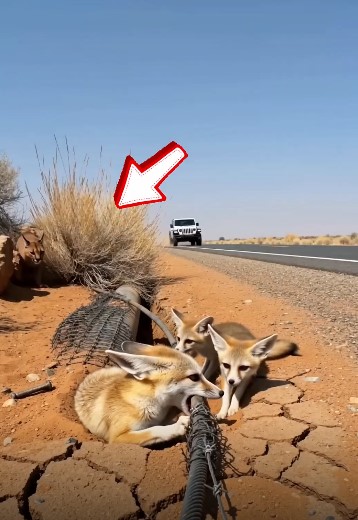
A quiet stretch of road can become the setting for an unexpected wildlife encounter in just a few moments.
That was the scene when a caracal came close to a young fox while the fox’s mother remained nearby on the roadside.
With several wild animals sharing a limited space, the situation quickly became one that demanded careful observation and patience.
The young fox was moving through the area when the caracal appeared.
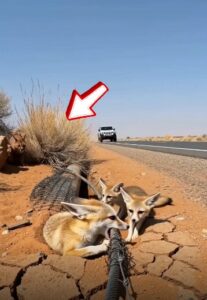
Its mother was nearby, but the surrounding road made movement more difficult than it would have been in an open natural habitat.
The unusual combination immediately drew attention, and anyone watching had to consider the animals’ behavior before deciding whether any assistance was appropriate.
Caracals are agile wild cats known for their alertness and ability to move quietly through different environments.
Foxes are also adaptable animals that can travel across fields, scrubland, and areas close to roads.
When these species encounter one another unexpectedly, their reactions can be difficult to predict.
The young fox remained close to the roadside while the caracal watched the area.
Its mother appeared aware of what was happening, but her position made it difficult to move freely.
The road itself became an important part of the situation, since vehicles and unfamiliar sounds can add another layer of uncertainty for wildlife.
For anyone witnessing such a moment, rushing toward the animals would not necessarily be the best choice.
Wild predators can react suddenly when people approach, and frightened foxes may also move unpredictably.
The safest first step is usually to keep a considerable distance and observe carefully.
The caracal continued moving through the area while the young fox remained attentive to its surroundings.
The mother fox stayed nearby, watching the changing situation. For a few moments, the animals seemed to be assessing one another, with every movement influencing what might happen next.
Attention also turned toward the roadside itself. Wildlife near roads can face additional challenges because vehicles may not notice animals until they are very close.
Anyone who encounters wildlife in such a location should prioritize road safety and avoid stopping in a place that could endanger themselves or other drivers.
As the encounter continued, the young fox looked for a more suitable route away from the immediate area.
Its natural instincts became important as it searched for space, while the mother remained nearby.
The caracal continued through the surroundings according to its own instincts, creating a moment where patience was more valuable than sudden action.
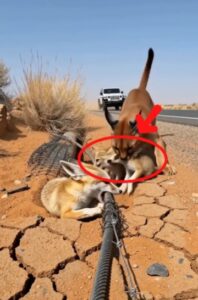
Eventually, the distance between the animals began to change.
The young fox found an opportunity to move toward a safer part of the surrounding landscape, while the caracal shifted its attention elsewhere.
The mother fox remained close enough to follow the situation, and the atmosphere gradually became calmer.
The encounter highlights why wildlife should be allowed to behave naturally whenever possible.
Predators and prey animals share ecosystems where unexpected meetings are part of life.
Although these scenes can be difficult to watch, human interference can sometimes create even more stress or cause animals to move toward unsafe areas.
The roadside setting also provides an important lesson about responsible driving.
Drivers should slow down when wildlife is visible near the road and avoid sudden swerving.
If an animal appears unable to move away from traffic, contacting local wildlife or road authorities may be safer than attempting to approach it personally.
Foxes are especially adaptable and can sometimes live surprisingly close to people.
A mother fox may travel with young through areas that seem unsuitable to humans, particularly when searching for food or moving between familiar locations.
Giving them space is important, even when an encounter appears unusual.
Caracals, meanwhile, are wild predators that should never be approached.
Their presence in an area does not automatically mean that human intervention is necessary.
Maintaining distance allows them to continue moving through their habitat without unnecessary disturbance.
The mother fox’s position made the moment especially memorable. Her young was nearby, and she remained attentive to the changing circumstances.
Although the road limited movement, the animals still relied on their natural instincts and awareness of the environment to navigate the encounter.
Gradually, the scene became less crowded as the animals moved in different directions.
Caracal Approaches a Young Fox While Its Mother Waits Nearby pic.twitter.com/Dp3lKewd2C
— Animal Rescue Stories (@AnimalStory5) August 14, 2026
What should you do if you find an animal/person in this situation?
Slow down and keep a safe distance from wildlife near a road. Do not approach a caracal or fox directly, and contact local wildlife professionals if an animal cannot safely leave the area.
Should you try to help the animal/person yourself?
Avoid handling wild animals or approaching predators. If the animals remain near traffic or appear unable to move safely, allow trained wildlife professionals to assess the situation.