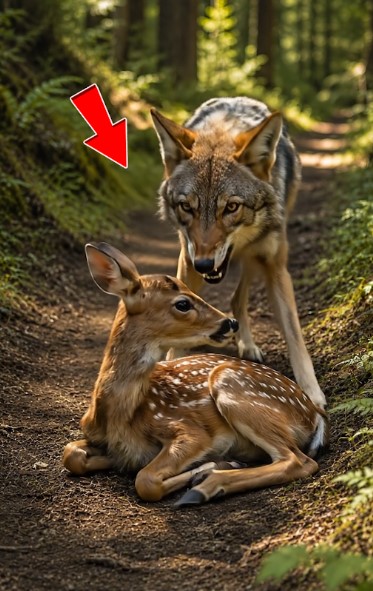
The young fawn suddenly froze on the forest trail as a wolf emerged between the trees just ahead.
For a brief moment, the small deer stood completely still, watching the larger animal while searching for a safe direction to move.
The wolf slowly shifted its position, and the quiet trail became the center of an unexpected wildlife encounter.
The fawn turned toward the surrounding vegetation, looking for an opening between the trees.
The wolf remained nearby, following the young deer’s movements with careful attention.
With dense woodland on both sides, the fawn had to choose its route carefully rather than simply continuing along the open trail.
Forest trails can become natural travel routes for many different species.
Deer use them to move between feeding and resting areas, while wolves travel through the same landscapes as they search for food and move across their territories.
Encounters between predators and young animals are part of the natural balance of these ecosystems.
The fawn began moving slowly along the edge of the trail. It occasionally looked back toward the wolf while continuing forward.
The wolf followed at a measured pace, keeping its distance while remaining focused on the young deer.
A nearby observer noticed the unusual scene but stayed well away from the animals.
Approaching either a wolf or a young deer could change their behavior and create unnecessary risks. The safest choice was to remain quiet and allow the wildlife to determine what happened next.
The fawn moved toward thicker vegetation beside the trail.
Its small body disappeared partially among the leaves and branches, giving it more cover than the open path. The wolf paused at the edge of the vegetation and watched carefully.
The young deer continued through the trees, stepping cautiously over roots and uneven ground.
It seemed to be using the forest itself to create more distance. The wolf remained nearby but had to slow down as the terrain became less open.
The fawn’s natural alertness became especially important in this moment.
Young deer learn to navigate their surroundings through instinct and experience, using movement, cover, and awareness to respond to changing situations.
Staying calm enough to choose a route can be just as important as speed.
The wolf continued observing from the trail. It shifted slightly before following the direction the fawn had taken.
The surrounding vegetation made it harder to see exactly where the young deer was moving.

The observer remained at a safe distance and did not attempt to distract the wolf.
Interfering in a natural predator encounter can place people at risk and may also cause the animals to behave unpredictably.
Wildlife should generally be given space unless trained professionals identify a genuine reason for intervention.
The fawn eventually reached a denser section of forest. It paused briefly before continuing deeper between the trees.
The wolf remained farther behind, no longer moving directly along the same route.
The distance between them gradually increased. The young deer continued through the vegetation while the wolf slowed near the edge of the trail.
The encounter was becoming less immediate as the forest provided more separation.
The scene also demonstrates why people hiking in wildlife areas should remain observant. A forest can appear empty while animals are moving nearby.
Staying on designated paths, keeping dogs under control, and following local wildlife guidance helps reduce unexpected encounters.
The fawn continued deeper into the woodland. Its movements became steadier as it found more suitable ground.
The wolf remained closer to the trail, occasionally looking toward the trees.
Young deer may sometimes appear alone, but that does not automatically mean they have been abandoned.
Mothers can remain nearby while allowing their young to stay concealed. People should avoid approaching a fawn unless there are clear signs that it is injured or genuinely unable to move.
The observer continued watching from a distance while the fawn disappeared farther into the vegetation.
No attempt was made to follow it. This gave the young animal an opportunity to continue without additional pressure.
The wolf eventually moved along the trail in another direction. Its attention shifted away from the section of forest where the fawn had gone.
The two animals were now separated by increasing distance.
Young Fawn Encounters a Wolf on a Forest Trail pic.twitter.com/bhg5mscYMY
— Animal Rescue Stories (@AnimalStory5) August 25, 2026
What should you do if you find an animal/person in this situation?
Keep a safe distance from both animals and never approach the wolf or follow the fawn. If the fawn appears injured or unable to move normally, contact local wildlife professionals for advice.
Should you try to help the animal/person yourself?
No. Do not interfere with a wolf and young deer encounter. Stay at a safe distance, keep pets away, and allow trained wildlife professionals to determine whether any assistance is actually needed.