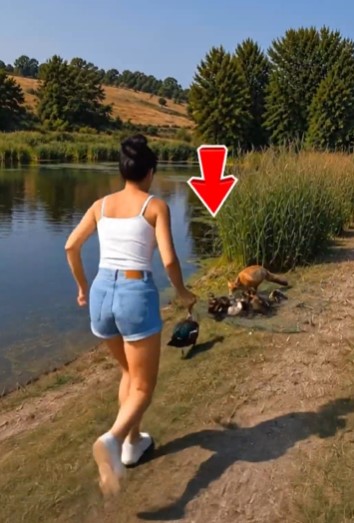
Women Step In as a Fox Approaches a Mother Duck and Her Chicks
The women were walking near the water when they noticed something moving along the edge of the reeds. At first, it looked like an ordinary moment in nature, but then they spotted a fox slowly approaching a mother duck and her tiny chicks. The duck immediately became alert, gathering the young birds close while the women watched from a distance, trying to decide what to do. Within moments, they realized that their next move could make a difference.
The mother duck kept the chicks close as the fox continued moving through the nearby grass. The little ducklings stayed together, following their mother whenever she changed direction, while the fox appeared focused on the activity near the water. The women understood that both animals were part of a natural wildlife encounter, so they avoided rushing toward them or creating unnecessary noise.
Instead, they carefully watched the situation and looked for a way to discourage the fox from getting too close without physically handling either animal. One woman moved toward a safer position while another kept an eye on the ducklings. Their goal was not to capture the fox or interfere aggressively, but to create enough space for the mother duck and her young to move toward the water.
The scene quickly became tense as the fox approached the shoreline. The mother duck appeared increasingly alert, keeping herself between the fox and the ducklings whenever possible. The women remained nearby, ready to contact wildlife professionals if the situation became more serious.
A Protective Mother Keeps Her Chicks Close
The mother duck suddenly began guiding the ducklings toward a more sheltered part of the shoreline. The chicks followed closely behind her, moving in a small group as they tried to stay together. The fox paused nearby, watching the movement before slowly changing its position.
The women recognized that sudden movements could make the animals more frightened. Instead of chasing the fox or attempting to pick up the ducklings, they focused on keeping people away from the area and giving the birds room to move. This approach reflects an important part of wildlife rescue safety tips: sometimes the safest way to help wildlife is to reduce disturbance rather than physically intervene.
One of the women contacted local wildlife authorities for guidance while the others continued observing from a safe distance. They described what they could see and explained that a mother duck and several chicks were near a fox. This allowed professionals to determine whether intervention was actually necessary.
The fox remained close enough to keep everyone watching carefully. The women understood that it was a wild animal following its natural instincts, so they did not try to corner or confront it. At the same time, they wanted to make sure the ducks had a clear path toward safer cover.
The mother duck continued moving along the water’s edge. Every few seconds, she looked back to make sure the ducklings were following, and the chicks stayed remarkably close. The women could see that the group was gradually getting farther from the fox.

The Duck Family Finds a Safer Route
The mother duck eventually reached a quieter section of the water where reeds provided better cover. The ducklings followed her into the vegetation, making themselves increasingly difficult to see. The women remained where they were rather than following the birds, knowing that getting too close could cause unnecessary stress.
The fox watched from a distance before eventually moving away from the immediate shoreline. Without the women needing to chase it, the distance between the predator and the duck family gradually increased. The tense scene began to settle as both animals moved in different directions.
The experience also highlights what to do if you find a mother duck and chicks in trouble. People should keep a safe distance, avoid picking up the ducklings, and keep dogs and children away from the family. If the birds are injured, trapped by human-made obstacles, or unable to move safely, contacting a qualified wildlife rehabilitator or local wildlife authority is usually the safest option.
People often want to know how to help a duck in trouble, especially when young ducklings are involved. However, separating chicks from their mother can create a much bigger problem, even when someone believes they are helping. Unless there is an immediate danger, allowing the mother and young to remain together while seeking professional advice is generally preferable.
Women Step In as a Fox Approaches a Mother Duck and Her Chicks pic.twitter.com/21YuyFpFVS
— Animal Rescue Stories (@AnimalStory5) August 30, 2026
What should you do if you find a trapped duck?
If you find a trapped duck, keep a safe distance and avoid unnecessary physical contact. Keep children and pets away, especially if ducklings are nearby, and avoid separating young birds from their mother. If the duck or ducklings are injured, caught in fencing, or unable to move safely, contact trained wildlife professionals or local authorities for guidance.
Can you rescue a wild duck yourself?
You generally should not physically handle or restrain a wild duck without proper training and equipment. Wild birds can become stressed very quickly, and attempting to capture them can cause injury or separate a mother from her young. The safest approach is to maintain distance, keep the area quiet, prevent pets from approaching, and contact qualified wildlife rescuers or local authorities when professional help is needed.