Aisha had only been inside the boutique for a few minutes when the handbag caught her attention.
The store was quiet in the way expensive stores often were. Soft lighting reflected off polished shelves. Clothing hung with wide spaces between each piece. Handbags and accessories were displayed beneath glass and on raised platforms, each one positioned carefully enough to make it feel less like merchandise and more like an exhibit.
Aisha moved slowly through the room.
She was in her late twenties, dressed simply but well, with the kind of understated confidence that did not require anyone else to notice it.
She stopped beside a structured leather handbag displayed on its own pedestal.
The design was part of the boutique’s newest collection.
Aisha leaned slightly closer.
She had seen the piece online but wanted to examine the stitching and hardware in person before deciding whether to add it to the rest of her order.
An associate noticed her.
Her name tag read Melanie.
She approached with a polished smile that seemed professional at first.
“Ma’am, that one is display only.”
Aisha looked at her.
“Can I see it?”
Melanie’s eyes moved briefly over Aisha’s outfit.
“It’s very expensive.”
Aisha paused.
“I asked if I could see it.”
The smile on Melanie’s face tightened.
“We have other options.”
“I want that one.”
Melanie glanced toward another display.
“There are some beautiful pieces over there that are a little more accessible.”
Aisha looked in the direction she was pointing.
Then back at her.
“I’m not looking for something more accessible.”
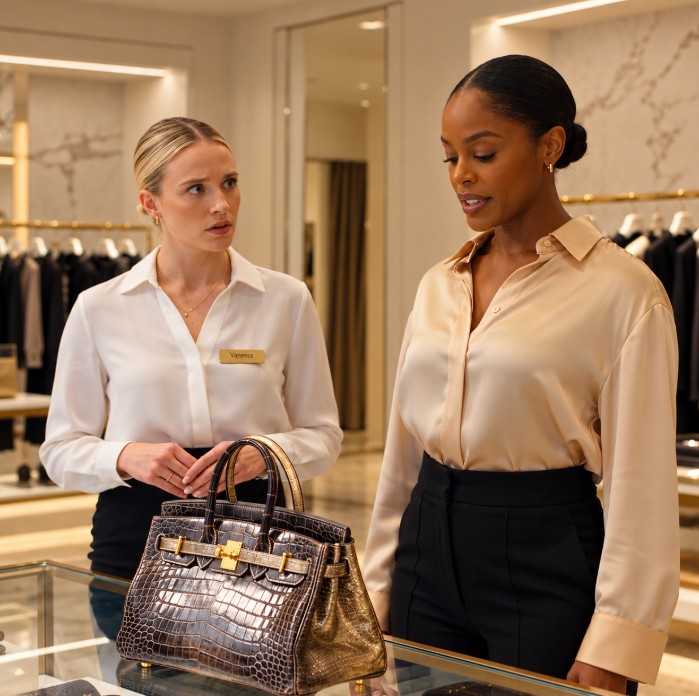
Melanie folded her hands.
“Are you planning to purchase today?”
“If I like it.”
Melanie gave a small sigh.
“I just don’t want to waste your time.”
Aisha held her gaze.
“Mine or yours?”
For the first time, Melanie seemed unsure how to respond.
“I’m trying to help.”
“Then show me the bag.”
Melanie looked toward the handbag but still did not reach for it.
“We usually reserve that collection.”
Aisha raised an eyebrow.
“For who?”
The question stayed between them.
Melanie clearly realized she had backed herself into an answer she did not want to say out loud.
Around them, the boutique remained calm.
A customer near the fitting rooms was looking through a clothing rack.
Another associate was arranging scarves near the front.
Soft music continued playing overhead.
Nothing about the room had changed.
But the conversation had.
Aisha knew exactly what was happening.
It was not the first time someone had tried to decide what she could afford before asking what she wanted.
She had experienced versions of it in hotels, restaurants, showrooms, and stores.
Sometimes it was subtle.
A recommendation toward a cheaper option.
A question about budget before anything else.
An associate who became suddenly unavailable.
Other times, like now, it was obvious.
Aisha could have explained herself.
She could have mentioned the appointment she had made earlier in the week.
She could have told Melanie that she already had an order waiting in the back.
She could have pulled up the confirmation on her phone.
But she did not.
She wanted to see how long Melanie would continue treating her differently without any real information.
“So,” Aisha said calmly, “are you going to show it to me?”
Melanie glanced toward the counter.
“I’d need approval.”
“Then get approval.”
Another pause.
Melanie looked slightly irritated now.
“Ma’am, these pieces are limited.”
“I know.”
“They’re usually shown to established clients.”
Aisha smiled faintly.
“And how do you know I’m not one?”
Melanie said nothing.
That was when another voice came from behind them.
“Ms. Carter?”
Aisha turned.
The store manager was walking toward her with a warm expression.
“Good afternoon. I’m sorry you had to wait.”
Aisha returned the greeting.
“No problem.”
The manager looked toward Melanie, then back at Aisha.
“Your order is ready in the private room.”
Melanie’s face changed.
“Order?”
The manager glanced at her.
“Yes.”
Then she looked at Aisha.
“The full new collection arrived this morning.”
Melanie stared.
“The full collection?”
The manager nodded.
Aisha looked back toward the handbag on display.
“I was deciding whether to add this one.”
Melanie’s mouth opened slightly.
“You bought all of them?”
Aisha looked at her.
“I ordered the collection.”
The confidence Melanie had been carrying disappeared almost instantly.
The manager looked from one woman to the other.
It was clear she could sense that something had happened before she arrived.
“I can assist you with this piece,” she said.
Aisha nodded.
“Please do.”
The manager carefully lifted the handbag from the display and placed it on a nearby counter.
Only then did Melanie speak.
“I apologize.”
Aisha turned toward her.
Melanie looked embarrassed.
“I misunderstood.”
Aisha gave her a measured look.
“No. You assumed.”
Melanie lowered her eyes.
Aisha continued.
“Next time, sell before you assume.”
Then she turned back toward the manager.
The manager opened the bag and began showing her the interior.
The craftsmanship was exactly what Aisha wanted.
The stitching was precise.
The hardware felt solid.
The proportions were better in person than they had looked online.
“I’ll take it,” she said.
The manager smiled.
“Of course.”
Melanie remained nearby for another moment before quietly stepping away.
Aisha followed the manager toward a private seating area near the back of the boutique.
Several garment bags and presentation boxes had already been arranged there.
Her earlier order included coats, shoes, accessories, and several bags from the new season.
It had taken her less than an hour to choose most of it during a private preview the previous week.
Today, she had returned only because the final pieces had arrived.
The manager offered her a seat.
“I want to apologize for what happened out there.”
Aisha sat down.
“You don’t know what happened.”
The manager gave her a thoughtful look.
“I know Melanie well enough to guess.”
Aisha smiled slightly.
“She didn’t want to show me the bag.”
The manager’s expression became serious.
“Did she say why?”
“Not directly.”
Aisha leaned back.
“She told me it was expensive. Then she suggested other options. Then she said the collection was usually reserved.”
The manager closed her eyes briefly.
“I’m sorry.”
Aisha nodded.
“I appreciate that.”
The manager sat across from her.
“I’ll speak with her.”
“You should.”
“I will.”
Aisha looked toward the merchandise arranged around them.
“But don’t make the lesson about how much I bought.”
The manager paused.
Aisha continued.
“If she only changes because she found out I placed a large order, then she learned the wrong thing.”
The manager nodded slowly.
“You’re right.”
“She should have shown me the same respect if I came in to buy nothing.”
The manager looked thoughtful.
“That’s how it should be.”
“It’s also better business.”
The manager smiled faintly.
“I imagine you know something about that.”
Aisha did.
She had spent years building a company that began from a spare room in her apartment.
At first, there had been no investors.
No staff.
No impressive office.
Just her laptop, long nights, and a product she believed could work.
For almost two years, most people around her thought it was a side project.
Then sales grew.
She hired her first employee.
Then another.
Eventually the company expanded into several cities and entered markets she had once only hoped to reach.
Success had changed many things in her life.
Her schedule.
Her responsibilities.
Her financial position.
But it had not changed her preference for simple clothing or her dislike of proving herself to strangers.
If anything, success had made her notice assumptions more clearly.
She had seen how quickly people’s behavior changed when they discovered what she owned or what she had built.
That change never impressed her.
The first interaction mattered more.
The manager began reviewing the pieces from Aisha’s order.
They discussed sizing, delivery, and which items would be held for alteration.
After about twenty minutes, the manager asked, “Would you like the new handbag sent with the rest?”
“Yes.”
“Same address?”
“Same address.”
The manager made a note.
Then she hesitated.
“Can I ask you something?”
“Sure.”
“Why didn’t you just tell Melanie you already had an order?”
Aisha smiled.
“Because I shouldn’t have to.”
The manager nodded.
“That’s fair.”
Aisha looked toward the main floor.
“If someone needs proof that I can spend money before treating me properly, then the issue isn’t my explanation.”
The manager had no argument.
A little later, as Aisha prepared to leave, Melanie approached again.
This time her posture was different.
Less polished.
More uncertain.
“Ms. Carter?”
Aisha stopped.
“Yes?”
“I wanted to apologize again.”
Aisha waited.
Melanie took a breath.
“What I did was wrong.”
“Yes.”
“I saw how you were dressed and assumed you weren’t a serious buyer.”
The honesty surprised Aisha slightly.
Melanie continued.
“I know that sounds terrible.”
“It sounds honest.”
Melanie nodded.
“I think I’ve gotten used to judging who is likely to buy something.”
Aisha looked at her.
“That can be useful in sales until it becomes an excuse not to serve people.”
Melanie lowered her eyes.
“I understand that now.”
Aisha remained quiet for a second.
Then she asked, “Do you?”
Melanie looked up.
Aisha continued.
“Would you understand it if I hadn’t bought anything?”
Melanie did not answer immediately.
That hesitation told Aisha more than a quick yes would have.
Finally, Melanie said, “I think that’s what I need to work on.”
Aisha nodded.
“That’s a better answer.”
Melanie looked relieved that Aisha had not simply dismissed her.
“I really am sorry.”
“I believe you.”
Aisha adjusted the strap of her handbag.
“Just make sure the next person doesn’t need a purchase history to get good service.”
Melanie nodded.
“I will.”
Aisha left the boutique a few minutes later.
Outside, the shopping district was much busier than the quiet store she had just left.
People moved between restaurants and storefronts.
Cars passed slowly along the street.
Shoppers carried bags from stores both expensive and ordinary.
Aisha walked toward her car without thinking much more about the incident.
She had no interest in feeling victorious.
Finding out she had purchased an expensive collection did not make Melanie’s original behavior more wrong.
That was the important part.
The amount of money involved was irrelevant to the principle.
Back inside the boutique, the manager asked Melanie to join her in the office.
The conversation was uncomfortable.
But it was not dramatic.
The manager did not shout.
She did not threaten her job.
Instead, she asked a question.
“Why didn’t you show her the bag?”
Melanie looked down.
“I thought she wasn’t going to buy it.”
“Why?”
Melanie was quiet.
The manager waited.
Eventually, Melanie answered.
“Because of how she looked.”
The manager nodded.
“And if she had not placed that order?”
Melanie looked up.
“What?”
“If she had walked out without buying anything, would you still think you had treated her badly?”
Melanie paused.
That was the real question.
“I should.”
“Yes.”
The manager leaned back.
“Luxury service is not about deciding which people deserve attention because they look wealthy.”
Melanie listened.
“It’s about making every person feel comfortable enough to decide whether they want what we sell.”
The manager pointed toward the main floor.
“The moment you start filtering people based on appearances, you stop selling and start judging.”
Melanie nodded slowly.
“I understand.”
The manager looked at her carefully.
“Then show me.”
Over the following weeks, Melanie began catching herself.
A young woman wearing a sweatshirt came in and asked about an expensive pair of shoes.
Melanie almost mentioned the price immediately.
Instead, she said, “Would you like to try them?”
The woman smiled.
“Yes.”
She did not purchase them.
That was fine.
Another customer spent nearly an hour examining bags before leaving empty-handed.
Melanie still thanked her for coming.
A man entered near closing time in work clothes and asked about a gift for his wife.
Melanie did not decide what he could afford.
She asked what his wife liked.
Slowly, the habit changed.
One afternoon, a woman stood near the same handbag display where Aisha had been.
She looked uncertain.
Melanie approached.
“Good afternoon. Would you like to see that one?”
The woman seemed surprised.
“Can I?”
“Of course.”
Melanie unlocked the display without asking what the woman planned to spend.
She placed the bag carefully on the counter.
The woman examined it for several minutes.
“It’s beautiful,” she said.
“It is.”
Then she checked the price.
Her eyes widened.
“Oh. That’s far outside my budget.”
Melanie smiled.
“No problem.”
The woman started to hand it back.
“Sorry for wasting your time.”
Melanie shook her head.
“You didn’t.”
The answer came naturally.
Only after saying it did she remember Aisha.
Mine or yours?
Melanie smiled to herself.
The woman eventually purchased a smaller accessory.
Not because Melanie pushed her toward it.
Because she felt comfortable enough to keep looking.
That evening, Melanie told the manager what had happened.
The manager smiled.
“Sounds like you learned something.”
Melanie nodded.
“I think I finally understand what Ms. Carter meant.”
“What part?”
“Sell before you assume.”
The manager laughed.
“That’s a pretty good rule.”
Months later, Aisha returned to the boutique.
She walked through the doors wearing simple trousers, a plain top, and almost no visible jewelry.
Melanie saw her.
For a brief second, the memory of their first meeting flashed across her face.
Then she smiled.
“Good afternoon, Ms. Carter.”
“Hi, Melanie.”
“Would you like to see the new collection?”
Aisha looked toward the displays.
“Maybe.”
Melanie smiled.
“No pressure.”
Aisha noticed the difference immediately.
She walked toward one of the new bags.
“This one is interesting.”
Melanie reached for the display key.
“Would you like to see it?”
Aisha looked at her and smiled.
“Yes.”
Melanie unlocked the case.
No questions about price.
No questions about purchase intention.
No judgment.
Just service.
And that was all Aisha had wanted the first time.
Because the measure of good service was never how people treated the customer after learning what she could afford.
The real measure came before the purchase.
Before the order history.
Before anyone knew whether the person standing in front of them would spend thousands, spend twenty dollars, or leave without buying anything at all.
Respect should come first.
Everything else was just a transaction.