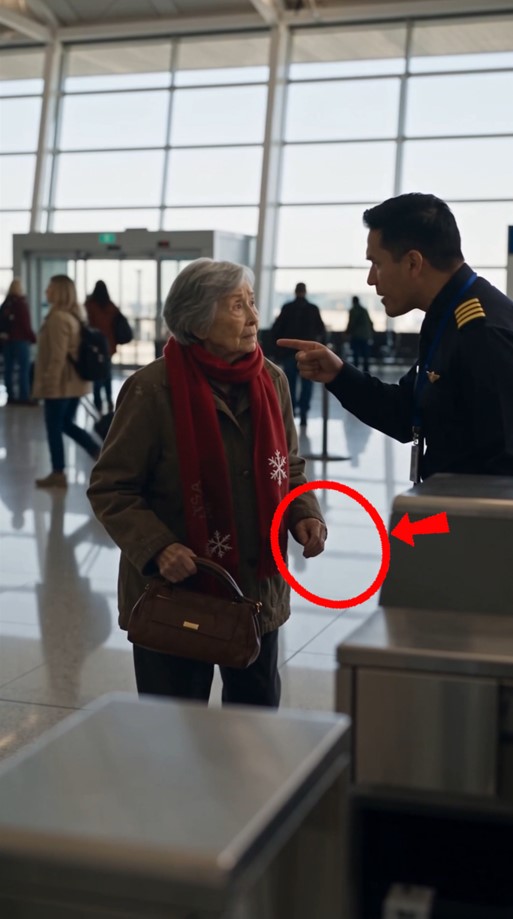
An Unexpected Encounter at the Airport
The departure hall of Northbridge International Airport buzzed with travelers rushing toward their gates, dragging suitcases across the polished floor.
Near the check-in counters, an elderly woman named Margaret stood quietly beside a small, worn suitcase.
Her gray hair was tucked beneath a knitted hat, and a faded blue scarf rested gently around her neck.
Unlike the other passengers, she carried no expensive luggage and wore an old brown coat with carefully mended sleeves.
Margaret approached the airline service desk and politely asked an employee to help her locate her boarding information.
The employee, a young man named Jason, glanced at her clothes before returning his attention to the computer screen.
When Margaret explained that she had misplaced the paper containing her flight details, Jason sighed impatiently.
He asked whether she had checked the information on her phone.
Margaret admitted that her old phone no longer worked and apologized for holding up the line.
Instead of offering assistance, Jason spoke loudly enough for nearby passengers to hear.
“If you don’t have your documents ready, you shouldn’t be standing here,” he said.
Margaret lowered her eyes and tightened her fingers around the handle of her suitcase.
She explained that she had traveled a long way and only needed someone to confirm her reservation.
Jason shook his head and told her to move away from the counter.
When she tried to explain again, he called a supervisor and claimed she was disrupting the check-in area.
The supervisor was assisting another passenger, leaving Jason to handle the situation himself.
Frustrated, he pointed toward the terminal exit and told Margaret she needed to leave.
As she turned away, the blue scarf around her neck slipped slightly from beneath her coat.
Across the hall, a uniformed pilot had just entered the terminal.
He stopped mid-stride when he noticed the unusual pattern woven into the scarf.
The Worker Refuses to Listen
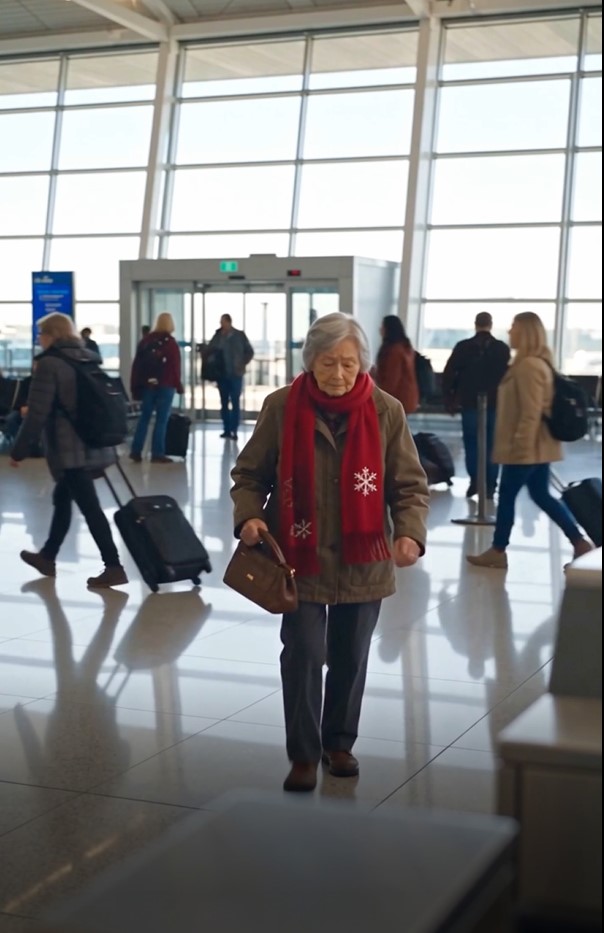
Margaret slowly lifted her suitcase and began walking toward the terminal entrance.
Her shoulders had lowered, and her face showed the exhaustion of someone who had already endured a difficult journey.
Jason watched her leave, seemingly satisfied that the problem had disappeared.
A woman waiting nearby stepped forward and asked why the elderly passenger had been treated so harshly.
Jason replied that airport rules required passengers to have their travel information ready.
The woman pointed out that Margaret had asked for assistance rather than demanding special treatment.
Jason dismissed the comment and returned to his computer.
Meanwhile, Margaret stopped beside a row of airport seats and placed her suitcase near her feet.
She carefully adjusted her scarf, smoothing its faded blue fabric with her fingertips.
The scarf had been repaired several times, but its distinctive silver stitching remained visible along the edges.
Margaret looked toward the departure boards, uncertain where she could turn for help.
She did not want to cause trouble or make a scene.
She simply wanted to reach her destination before an important appointment the following morning.
Near the security entrance, Captain Daniel Reed continued watching her from a distance.
He had noticed the scarf because its pattern was unlike anything he had seen in years.
He approached slowly, trying to get a clearer look without startling her.
When Margaret turned toward him, he stopped and studied the silver stitching.
Then he glanced at her face.
For several seconds, the busy terminal seemed to fade into the background.
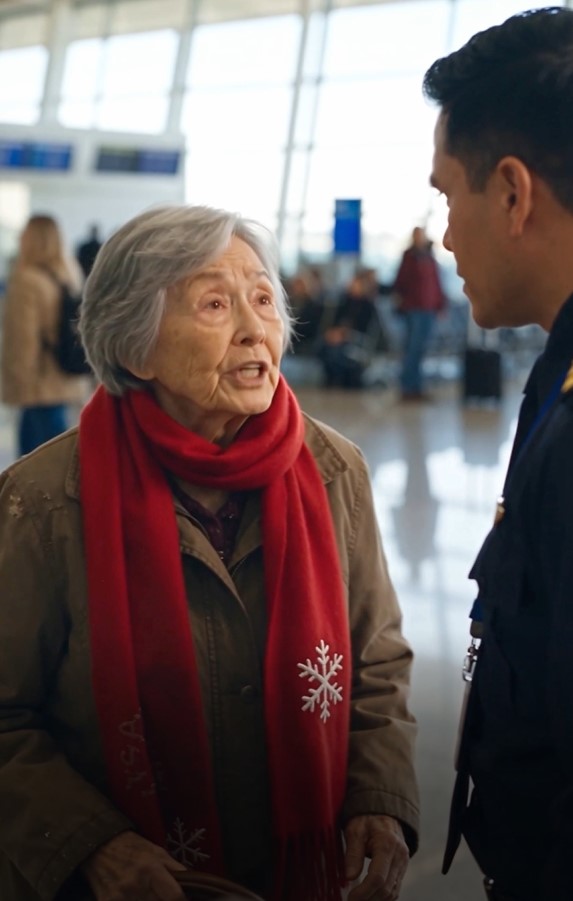
“Ma’am,” he asked gently, “may I ask where you got that scarf?”
Margaret looked surprised by the question.
She touched the fabric and explained that someone very special had given it to her many years earlier.
Daniel’s expression changed.
He recognized the pattern from a photograph that had remained among his most treasured family possessions.
But he still needed to confirm something before drawing conclusions.
The Pilot Recognizes the Scarf
Daniel introduced himself and asked Margaret whether she had known a flight engineer named Thomas Reed.
At the sound of the name, Margaret’s eyes filled with emotion.
She nodded slowly.
Thomas had been Daniel’s grandfather, a man who had worked in aviation for decades before retiring.
Margaret explained that she had known Thomas when they were young adults.
During a difficult winter, she had knitted the blue scarf for him before he left on a long overseas assignment.
The silver pattern represented the stars they had watched together outside a small airfield.
Thomas had treasured the scarf and carried it through many years of travel.
Daniel remembered seeing it in an old family photograph, draped around his grandfather’s shoulders beside an aircraft.
After Thomas passed away, the scarf had disappeared from the family home.
Daniel had often wondered what happened to it.
Margaret explained that Thomas had returned it to her near the end of his life.
He had told her that she should keep it because it reminded him of the kindness they had shared.
Daniel listened quietly, deeply moved by the connection.
He asked why she was traveling that day.
Margaret explained that she was flying to attend a small remembrance gathering for former aviation workers.
Thomas had once spoken about the people who helped build and maintain the aircraft that connected distant communities.
Margaret wanted to attend the gathering and leave a handwritten note in his memory.
She had booked the flight weeks earlier but misplaced her printed itinerary during the journey.
Daniel looked toward the check-in counter where Jason was still working.
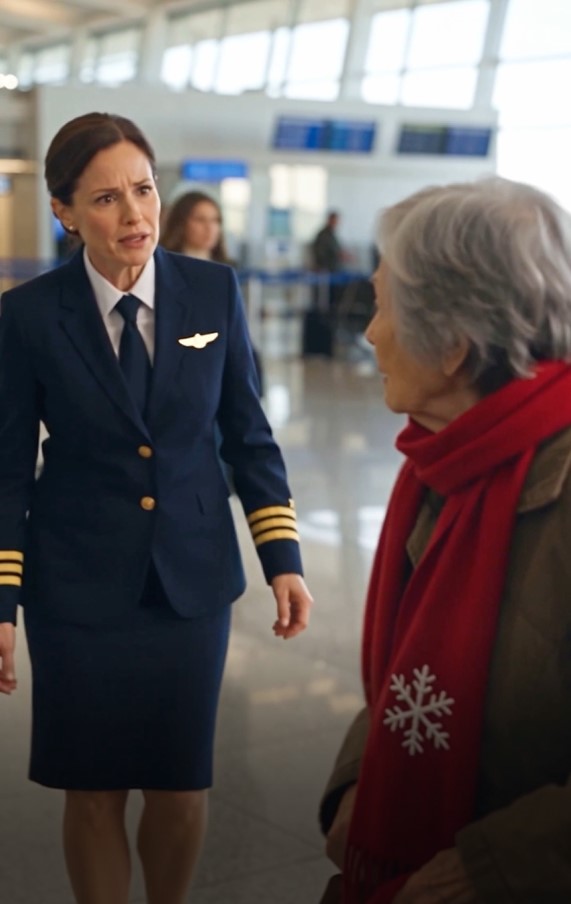
He realized that the elderly woman he had just met was being sent away without anyone making a reasonable effort to help.
“Please wait here for a moment,” he told Margaret. “I would like to help you find your reservation.”
For the first time since arriving at the airport, Margaret smiled.
The Truth Reaches the Check-In Desk
Daniel accompanied Margaret back toward the airline counters.
He did not demand that employees ignore airport procedures or bypass security requirements.
Instead, he asked a senior customer-service representative to help verify her identity and locate her booking.
The representative checked the reservation system and found Margaret’s name on a confirmed passenger list.
Her identification matched the booking, and her seat was still available.
She had not missed her flight.
The representative printed a replacement boarding pass and explained where Margaret needed to proceed.
Margaret thanked her repeatedly, relieved that the problem had been resolved.
Daniel then asked whether the service supervisor was available.
Jason noticed the pilot standing beside Margaret and immediately straightened behind the counter.
He had not expected the elderly passenger to return with a uniformed captain.
The supervisor arrived a few minutes later and listened as Daniel explained what he had witnessed.
He described how Margaret had asked for basic assistance before being told to leave.
The supervisor reviewed the situation with the employees who had been nearby.
Several passengers also confirmed that Margaret had remained polite throughout the exchange.
Jason attempted to defend his decision by saying he had been trying to keep the line moving.
The supervisor explained that efficiency did not excuse dismissive treatment or an unnecessary demand that a passenger leave.
Airport staff could request appropriate documentation, but they were also expected to direct passengers toward legitimate assistance.
Jason was asked to step away from the counter while the supervisor addressed the complaint.
Margaret stood quietly nearby, holding her new boarding pass.
She did not ask for anyone to be punished.
She only wanted to complete her journey without further embarrassment.
Daniel respected her wishes but made sure the incident was formally recorded.
He knew that an apology alone would mean little if the same treatment continued for other passengers.
An Apology in the Busy Terminal
The supervisor returned to Margaret and apologized for the way she had been treated.
He explained that the airport would review the incident and reinforce its customer-service procedures.
Jason eventually approached her after being instructed to address the complaint.
He appeared uncomfortable and avoided looking directly at her at first.
He admitted that he had made assumptions about her because of her appearance and the condition of her belongings.
Margaret listened without interrupting.
Jason apologized for speaking harshly and ordering her to leave before properly understanding her problem.
She accepted his apology but reminded him that not every traveler knew how to navigate modern airport systems.
Some passengers needed extra time, clearer instructions, or assistance finding their documents.
A person’s worn coat did not tell anyone whether they deserved patience.
Jason nodded, acknowledging that he should have handled the situation differently.
Daniel remained beside Margaret, but he did not turn the exchange into a public spectacle.
He wanted the airport staff to learn from what had happened rather than simply embarrass one employee in return.
The supervisor arranged for another representative to accompany Margaret toward the correct security entrance.
Before they left, Margaret turned toward Daniel and thanked him for recognizing the scarf.
Daniel smiled and told her that his grandfather would have been grateful to know she had kept it safe.
Margaret carefully touched the silver stitching.
She said that some gifts became precious not because of their value, but because of the memories they carried.
Daniel agreed.
He then checked the time and reminded her that boarding would begin soon.
Together, they walked toward the departure gates while the airport continued moving around them.
Margaret no longer looked lost or unwelcome.
She carried her suitcase with renewed confidence, her blue scarf resting neatly around her shoulders.
A Journey Connected by Memory
At the departure gate, Margaret found a seat beside the window overlooking the runway.
She watched ground crews guide aircraft into position while passengers gathered around the boarding area.
Daniel had to return to his preflight duties, but he promised to check on her before departure.
When he returned, Margaret showed him the handwritten note she planned to leave at the remembrance gathering.
It thanked the people whose quiet work had made air travel safer and more accessible.
Daniel read it carefully and recognized several names from stories his grandfather had shared.
He told Margaret that the aviation community often remembered pilots, while forgetting the many people who worked behind the scenes.
Her note would help bring some of those forgotten contributions back into view.
Margaret folded the paper and slipped it into her handbag.
Then she removed the scarf briefly, checking the repaired edge where the silver thread had begun to loosen.
Daniel offered to help her find a local textile conservator after her trip, but she laughed gently and said she preferred its imperfections.
Every repair reminded her of the years it had survived.
When boarding was announced, a gate agent greeted Margaret respectfully and confirmed her seat.
She thanked the agent and walked down the jet bridge at her own pace.
Daniel met her again near the aircraft entrance and welcomed her aboard.
He arranged for a flight attendant to help her settle comfortably before the other passengers boarded.
As Margaret took her seat, she folded the blue scarf carefully across her lap.
The aircraft soon began preparing for departure.
Through the window, she watched the airport buildings grow smaller as the plane moved toward the runway.
Airport Worker Asks an Elderly Woman to Leave as a Pilot Notices Her Scarf https://t.co/es0nTWNzHT
— Animal Rescue Stories (@AnimalStory5) October 12, 2026
How the Pilot Recognized Margaret’s Scarf
Margaret arrived at the airport hoping to reach a remembrance gathering honoring former aviation workers.
When she asked an airport employee named Jason for help locating her boarding information, he judged her by her worn clothes and ordered her to leave.
As Margaret walked away, Captain Daniel Reed noticed the distinctive silver stitching on her faded blue scarf.
He recognized its pattern from an old photograph of his grandfather, Thomas Reed, a flight engineer who had treasured the scarf for years.
Margaret explained that she had knitted it for Thomas when they were young and that he had returned it to her later in life.
Moved by the connection, Daniel helped her contact the airline’s customer-service team.
Staff verified her reservation, printed a replacement boarding pass, and confirmed that she could still take her flight.
Daniel also reported how Margaret had been treated, prompting the supervisor to review the incident.
Jason eventually apologized for making assumptions and dismissing her request for help.
Margaret accepted the apology and continued toward her gate, where Daniel checked on her before departure.
The scarf remained a reminder of a friendship that had lasted across decades and connected two generations of an aviation family.