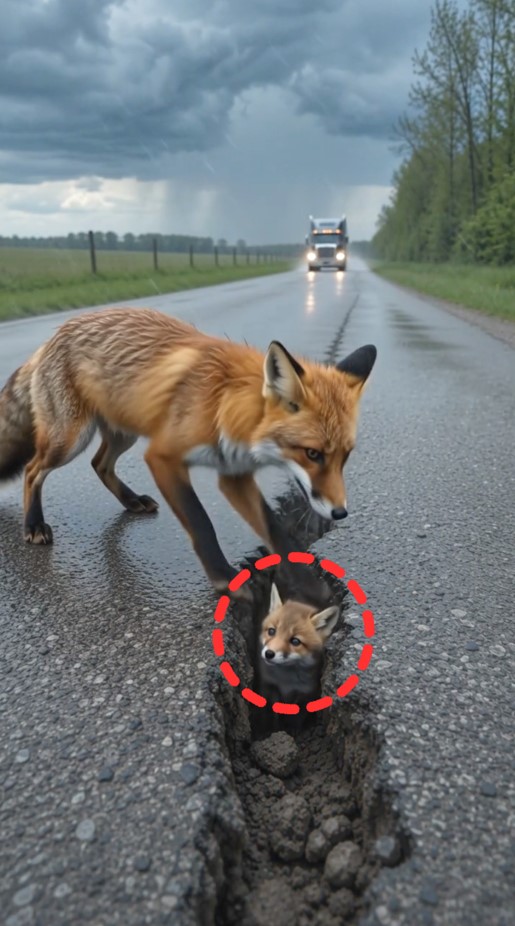
The narrow country road wound between green fields and patches of dense woodland, quiet except for the occasional passing vehicle.
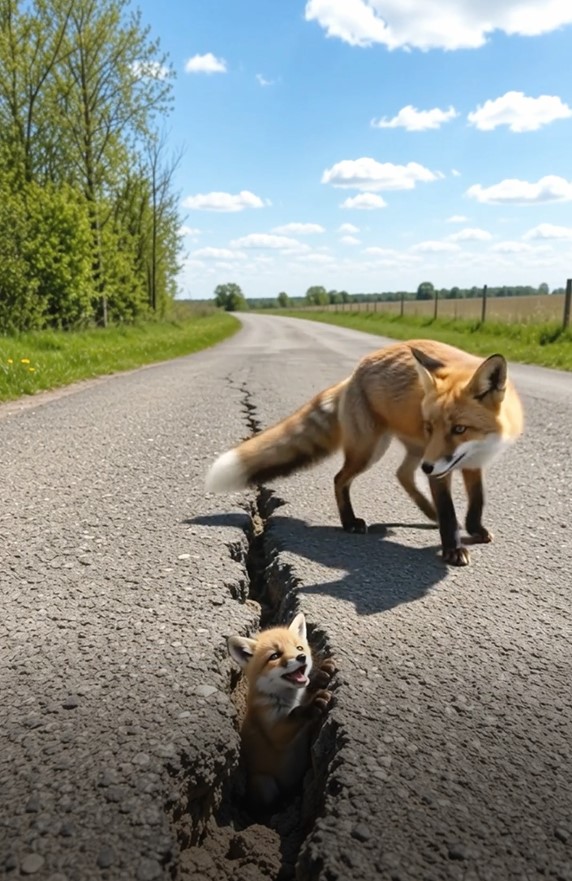
Near a sharp bend, a tiny fox cub struggled inside a deep crack in the broken pavement.
Its reddish fur was dusted with gray grit, and its small paws pressed desperately against the rough edges. Every attempt to climb out sent loose stones tumbling into the narrow gap.
The cub let out a faint, high-pitched cry.
A few feet away, its mother paced nervously along the roadside, repeatedly approaching the crack before retreating into the grass.
She could hear her young one but could not reach it.
A delivery driver named Mark was traveling along the road when he noticed the adult fox moving strangely near the bend.
He slowed down, expecting the animal to disappear into the bushes.
Instead, the fox stopped beside the pavement and looked toward the ground.
Mark pulled safely onto the shoulder and stepped out of his vehicle.
Then he heard the sound.
A tiny cry rose from somewhere beneath his feet.
He followed it to the damaged road and looked down into the narrow opening.
Two frightened eyes stared back at him.
A fox cub was trapped inside the crack, with barely enough room to turn around.
The Mother Fox Refuses to Leave
Mark kept his distance from the adult fox and carefully examined the damaged pavement.
The crack extended beneath a broken section of asphalt, forming a narrow pocket where the cub had become wedged.
Its front paws rested against one side, while its hind legs struggled for traction against loose gravel.
Whenever the cub tried to climb, its body slipped backward.
Mark knew that pulling it out without understanding how it was stuck could cause further injury.
He stepped away from the road and contacted a local wildlife rescue service.
While he waited, the mother fox remained nearby.
She moved between the roadside grass and the crack, her ears constantly turning toward the faint cries.
At one point, she approached the opening and lowered her nose toward it.
The cub responded with another desperate whimper.
The mother backed away, pacing in a tight circle before returning to the same spot.
Mark watched from a safe distance, careful not to block her escape route.
He also placed a warning triangle behind his parked vehicle so approaching drivers would notice the obstruction.
A tractor appeared in the distance, moving slowly toward the bend.
Mark signaled for the driver to reduce speed and explained that a small animal was trapped beneath the road surface.
The tractor passed carefully.
For several minutes, the roadside grew quiet again.
Then the cub began struggling more urgently, sending another shower of tiny stones into the darkness below.
Mark checked his phone.
The rescue team was on its way.
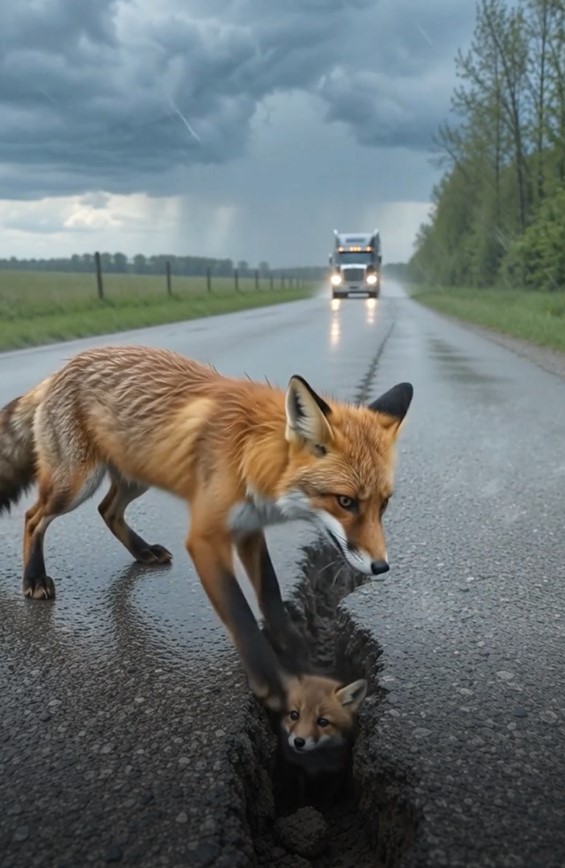
A Dangerous Gap Beneath the Asphalt
The wildlife rescuers arrived with protective gloves, a flashlight, a small animal carrier, and tools for examining the damaged pavement.
Their team leader, a wildlife specialist named Sarah, crouched beside the crack.
She directed a beam of light into the opening without touching the cub.
The light revealed that the gap widened slightly beneath the surface.
The cub had apparently slipped through the broken asphalt and become lodged in the narrower section below.
Its body was twisted at an awkward angle, but Sarah could not immediately determine whether its legs were injured.
“We need to make more room before attempting to move it,” she explained.
The team examined the surrounding pavement for loose sections that might collapse during the rescue.
One worker placed temporary barriers around the area, while another contacted the local road maintenance crew.
Sarah continued observing the cub’s breathing and movements.
The animal appeared frightened and exhausted, but it was still responsive.
The mother fox watched from the grass, her body low and her eyes fixed on the rescuers.
Sarah asked everyone to remain quiet and avoid approaching her.
A frightened wild animal could flee into traffic or become defensive if it felt cornered.
The road maintenance worker arrived with equipment suitable for carefully removing a small section of loose asphalt.
Rather than widening the crack indiscriminately, the team marked the area that could be safely lifted away.
Sarah explained that the goal was to free the cub without pulling on its body or allowing additional rubble to fall into the opening.
The workers prepared their tools.
Below them, the cub gave another weak cry.
Everyone paused to listen.
There was very little time to waste, but rushing the next step could make the situation worse.
The Rescue Begins
The road worker carefully removed a loose piece of asphalt from the edge of the crack.
The team stopped after each movement to check whether the surrounding surface remained stable.
As the opening widened, Sarah could see more of the cub’s body.
Its hindquarters were trapped beneath a small shelf of broken pavement, while its front paws pressed against the opposite wall.
The rescuers used a narrow tool to remove loose gravel from around the trapped area.
They worked slowly, keeping their hands away from the cub’s face and limbs.
When enough space had been created, Sarah prepared a soft towel to support the animal’s body.
She waited until the loose material had been cleared before attempting to move it.
“Easy, little one,” she murmured.
The cub struggled once, then stopped.
Sarah supported its body while another rescuer carefully cleared the remaining obstruction.
For one tense moment, the cub seemed unable to move.
Then the trapped hind leg slipped free.
The animal slid forward into the waiting towel.
The team lifted it out gently and placed it inside the carrier.
The mother fox immediately stood taller in the grass.
She took several quick steps toward the road, then stopped when she noticed the rescuers moving away from the crack.
Sarah checked the cub’s breathing and watched for signs of bleeding or obvious injury.
The little fox was alive.
Its fur was covered in dust, and its body trembled from the ordeal.
But it could move all four limbs.
The rescuers secured the carrier and prepared to take the cub for a veterinary examination.
Mark stood beside his vehicle, watching in relief.
He had heard the cries before he had even understood where they were coming from.
Now the sound coming from the carrier was softer.
The cub was no longer trapped beneath the road.
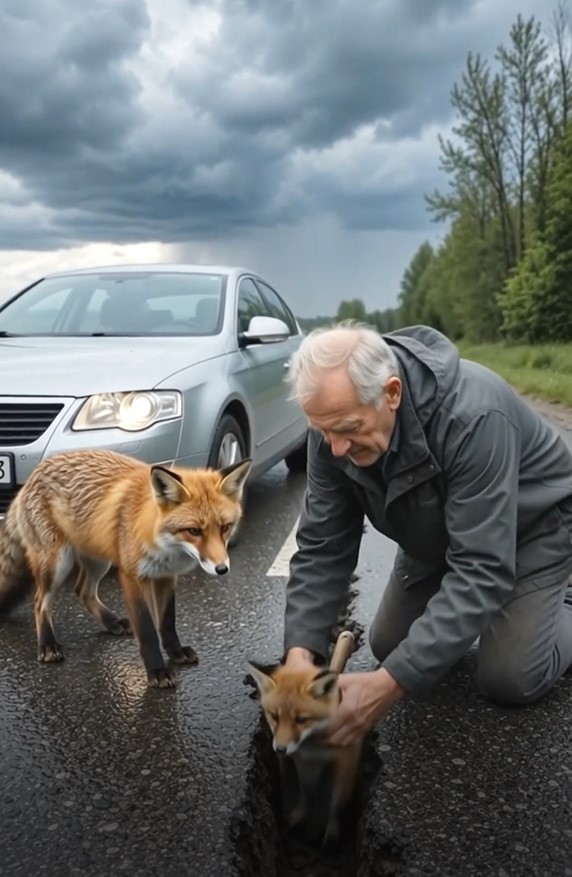
A Careful Examination at the Wildlife Clinic
At the wildlife clinic, a veterinarian examined the fox cub for injuries caused by the confined space and the struggle to escape.
The team checked its legs, paws, breathing, and overall condition.
There were several minor scrapes and signs of exhaustion, but the initial examination revealed no obvious fractures.
The veterinarian recommended observation before the cub could be returned to the area where it had been found.
The rescue workers also checked whether it was old enough to remain near its mother without immediate danger.
Sarah explained that fox cubs depended on their parents for protection and guidance during their early months.
Separating a healthy cub from its mother for longer than necessary could create additional problems.
After the cub had warmed up and settled, the team began arranging a controlled return.
Meanwhile, a wildlife camera was placed near the roadside to help monitor the area.
The damaged section of pavement was marked for repair, reducing the risk of another animal falling through the opening.
Mark received an update later that afternoon.
“The little one is doing well,” Sarah told him. “We’re planning to return it once the veterinarian is satisfied that it’s safe.”
Mark smiled with relief.
“Will its mother still be nearby?”
“She was in the area when we arrived. We’ll give the cub the best chance of reuniting with her.”
The rescue team chose a sheltered location near the original site, away from moving traffic and human activity.
They waited until conditions were calm before opening the carrier.
The cub hesitated at first.
Its nose moved rapidly as it tested the unfamiliar scents around it.
Then it stepped into the grass.
Fox Cub Gets Trapped in a Narrow Crack in the Road https://t.co/WhM5mx3U33
— Animal Rescue Stories (@AnimalStory5) October 12, 2026
The Fox Cub Returns to the Woodland
The rescue team placed the carrier near dense roadside vegetation, allowing the cub to leave on its own.
Sarah and her colleagues retreated to a safe distance.
Mark watched quietly from behind the temporary barrier.
For several moments, nothing happened.
Then a reddish shape moved between the grass stems.
The mother fox appeared at the edge of the woodland.
She paused, lifting her nose into the air.
The cub responded with a small call.
The mother approached cautiously, stopping every few steps to observe the surroundings.
The cub moved toward her, stumbling slightly over the uneven ground but continuing forward.
When they were close enough, the mother lowered her nose and sniffed her young one carefully.
The cub pressed against her chest.
She remained beside it for several seconds before turning toward the trees.
The cub followed, disappearing with her into the thick undergrowth.
The rescuers did not follow them.
They watched until both foxes had moved beyond sight, then began packing their equipment.
Mark stood beside the road, feeling a quiet sense of relief.
He had stopped because an animal’s behavior seemed unusual.
That small decision had led him to a trapped cub and a mother unable to reach her young.
The road maintenance crew later repaired the damaged pavement, filling the crack and checking the surrounding surface for other weak spots.
The warning barriers remained until the repair was complete.
In the days that followed, the wildlife team monitored the area from a distance.
They found signs of fox activity near the woodland and saw no reason to interfere further.
The cub had returned to its natural environment, where its mother could continue raising it.
Mark occasionally passed the bend on his delivery route.
Whenever he did, he remembered the tiny cries rising from beneath the asphalt and the sight of the mother fox waiting helplessly nearby.
He hoped he would never encounter another animal trapped in such a dangerous place.
But he also knew he would stop and seek help if he ever heard those cries again.
This fictional story highlights the importance of contacting trained wildlife rescuers when an animal becomes trapped, rather than attempting a dangerous extraction without proper equipment.
Beneath a broken stretch of road, a tiny fox cub faced a frightening ordeal, but careful hands gave it the chance to find its mother again.